During the ceremony, the martyr’s eldest son, Sayyed Mostafa Khamenei, delivered a speech in which he conveyed his brother Sayyed Mojtaba Khamenei’s gratitude to the Iranian people and all those who took part in the funeral ceremonies held across all regions of Iran.
A symbol of loyalty and defiance
In this context, former diplomat Sayyed Hadi Sayyed Afqahi stressed that “the mourning gatherings held for the repose of the soul of the martyred Imam are not traditional ceremonies, but rather a renewal of allegiance, loyalty, and appreciation.”
Sayyed Afqahi emphasized that holding these commemorative gatherings across all Iranian provinces, cities, and villages “carries a clear message of defiance to the enemy and confirms the widespread popular support and unity around the leadership.”
Millions bid farewell to the martyred leader
Following the assassination of Sayyed Ali Khamenei in a joint US-Israeli aggression on Iran on February 28, the Islamic world witnessed an unprecedented outpouring of grief as millions participated in funeral and mourning ceremonies spanning multiple cities and two nations over the course of a week.
Public farewell events commenced in Tehran on July 4, drawing millions to the capital's streets. Iranian media reported that mourners arrived from across all provinces of the country, alongside representatives and visitors from nearly 100 nations, to pay their final respects. The Financial Times described the gatherings as "the largest in the modern history of the world," with estimates suggesting between 12 and 15 million people participated across the various ceremonies.
On Tuesday, July 7, millions of mourners packed the streets of the holy city of Qom, home to Iran's foremost religious seminaries and shrines, with a population of approximately 1.5 million, to perform funeral prayers for the martyred leader and members of his family who were also killed in the February 28 bombing. The ceremonies at Jamkaran Mosque drew vast crowds that analysts described as a massive reaffirmation of allegiance to the principles of the Islamic Revolution.
July 7 and 8 saw Iraq hold its own monumental funeral rites in the holy cities of Najaf and Karbala. A sea of mourners, estimated at over 2.3 million, flooded the sacred city in what officials described as one of the largest processions in modern regional history. Following the Najaf ceremonies, the body of the martyred leader arrived in Iraq's Karbala province, where millions of mourners were awaiting the start of the funeral ceremony.
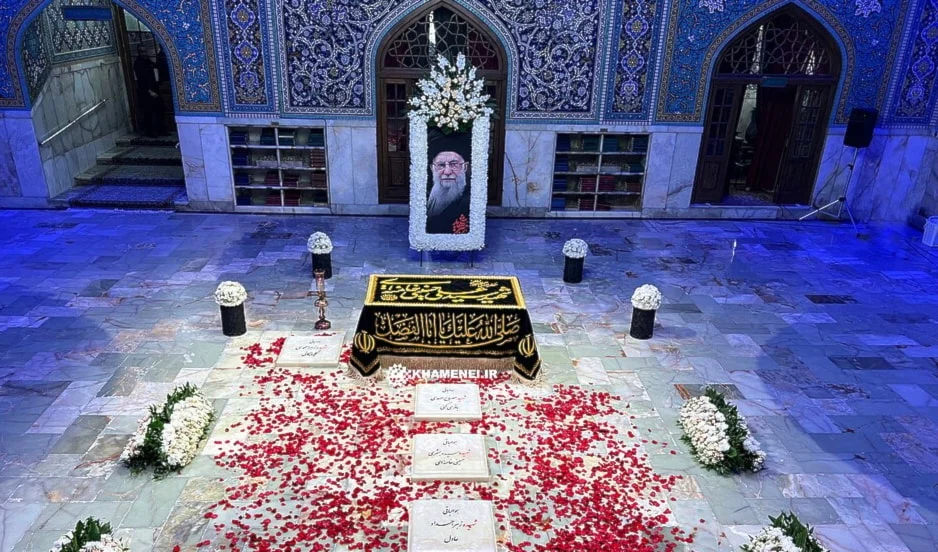
The burial ceremony concluded in Sayyed Khamenei's hometown of Mashhad on July 9, where millions gathered to bid their final farewell. Iran's state broadcaster confirmed that the martyred leader was laid to rest at the Dar al-Dhikr portico within the Imam Reza Shrine, one of the most revered religious sites in Shia Islam.
Throughout the week of mourning, the ceremonies continued to draw crowds of a scale rarely witnessed in contemporary times, standing as a testament to the profound impact of the martyred leader across the region and beyond.
Source:Websites