At the most sensitive strategic juncture, Yemeni intelligence has struck the Saudi-American propaganda apparatus at its most vulnerable point, demonstrating an exceptional capability to penetrate and surveil, crippling the movement of its media machine and undermining the effectiveness of its technological superiority.
In a short period of time, Yemen has once again succeeded in choking off the movements of the Saudi-American enemy, following a round in which U.S. destroyers, along with other Western vessels engaged in commercial relations with the Zionist enemy, became easy targets for missiles and drones operated by the Yemeni Armed Forces.
Once again underscoring that the true test of military prowess does not necessarily lie in technological superiority, but rather in the ability of those who wield such capabilities to employ them in ways that translate into genuine operational effectiveness on the battlefield, the Yemeni forces have brought Saudi maritime traffic to a standstill, turning its mobilization efforts—through a single, indivisible operational equation—into nothing more than a heap of sources of frustration.
Cross-Domain Control and Surveillance Across Land and Sea
The matter of Yemeni intelligence superiority is not simply about targeting a vessel that dared to defy the Armed Forces’ decision to ban access to or departure from Saudi ports, nor is it merely about striking hostile movements involving vehicles, equipment, and assets on the ground.
Rather, it reflects a pre-established control system built upon a precise intelligence database and the ability to read the enemy’s intentions, then control its movements both on land and at sea.
Within just a few days, the world watched as the maritime blockade of Saudi energy shipments sent shockwaves through global markets and triggered widespread confusion over the precautionary measures needed to preserve the momentum of global economic activity.
Then came the preemptive protective operations against Saudi movements in parts of Yemen, reinforcing the conviction that the era ahead is indeed on the threshold of profound and inevitable shifts in the balance of power.
By exercising its internationally recognized right to self-defense—not by overstepping it, as America, the world’s foremost practitioner of bullying, routinely does—Yemen succeeded in extinguishing the spark of discord that Saudi Arabia, using every capability at its disposal, sought to ignite by bringing the battle onto Yemeni soil.
This informational dominance transformed the maritime blockade from a mere political decision into a reality enforced by fire, while turning preemptive strikes into an immediate deterrent that buried the Saudi plan to unleash chaos within the very closed-door rooms where it was being prepared.
Foiling Plans in Their Infancy
There remains much in the details of Yemen’s military operations that continues to command the attention of observers and experts, while frustrating the efforts of the forces of arrogance to silence what remains of the free voices.
The facts on the ground demonstrate that what is being achieved today is not the product of coincidence, but rather the outcome of a solid, cumulative process.
From the initial announcement imposing the maritime blockade on Saudi Arabia, followed by a series of precise, high-impact operations targeting vital oil facilities deep inside Saudi territory, through the targeting of naval vessels that violated the Yemeni decision, and culminating in consequential preemptive operations, Yemeni intelligence has maintained an extraordinary presence, serving as the solid backbone behind every successful operational move.
There is little doubt that confidence in possessing accurate, real-time intelligence has constituted the fundamental support and strategic foundation for bold action under the equation of “direct preemptive deterrence.”
It has enabled Saudi military movements to be cut off at their organizational inception, eliminating opportunities for them to take shape as a tangible battlefield threat.
These swift and surprise strikes could never have evolved into operational nightmares capable of crippling command centers at staging sites were it not for the construction of a highly penetrative and exceptionally capable intelligence network.
Moreover, intelligence operations have gone beyond the boundaries of conventional physical surveillance to penetrate deep into the realm of anticipating the enemy’s intentions, infiltrating its ongoing logistical channels, and dismantling its operational plans at the planning table—before they can be translated into orders for an advance or deployment.
Operational Paralysis Along the Enemy’s Fronts
At the height of maintaining the equation of “blockade for blockade, escalation for escalation,” Yemeni intelligence directed its deterrent focus toward the Saudi enemy’s military build-ups in Mokha, Marib, and Hadramawt, thwarting Saudi Arabia’s efforts, which were aimed not merely at applying pressure to break the Yemeni people’s firm positions on humanitarian and sovereign issues, but, more importantly, at containing Yemen’s rising regional role and attempting to constrain its long reach by entangling it in complex, attritional internal fronts.
Within this context, the fronts of Mokha, Marib, Hadramawt, and the border areas have been transformed from theaters of confrontation into living evidence of a broad-ranging and highly consequential Yemeni intelligence penetration deep into Saudi military movements.
Surveillance and reconnaissance agencies succeeded in penetrating the secrecy surrounding hostile fronts, precisely identifying troop and equipment concentrations, weapons shipment routes, and meeting locations.
Possessing this intelligence provided a comprehensive dissection of the enemy’s battlefield, from deployment and distribution maps down to the finest details of transportation and ammunition-supply schedules.
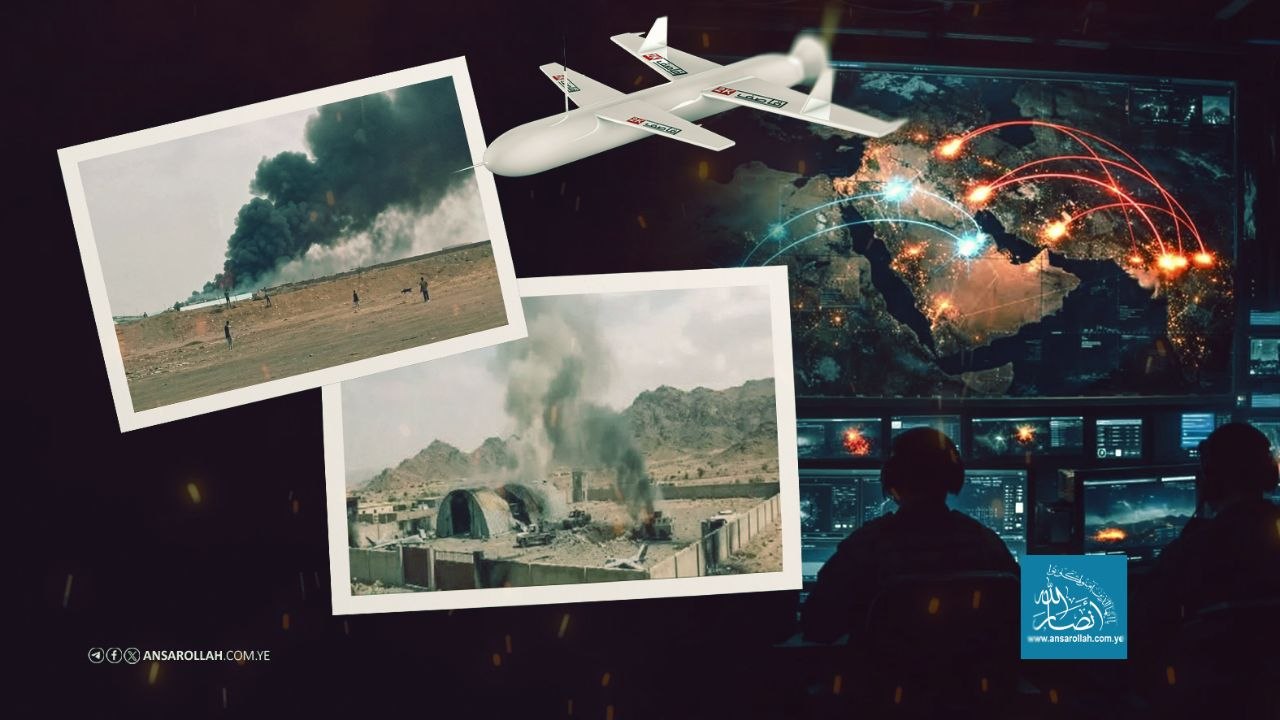
The latest preemptive operations, which pounded weapons depots and staging centers, then provided a practical manifestation of this sweeping intelligence superiority.
This immediate targeting of concealed coordinates, coupled with live, real-time tracking of equipment movements and meetings as they unfolded, left no room for doubt that Yemeni surveillance and intelligence agencies had penetrated deep into the enemy’s clandestine infrastructure. They had thus moved beyond merely monitoring the threat to directing it—and extinguishing it in its infancy.
Managing Moving Targets
The targeting of Saudi military build-ups also offered another indication of the professionalism and operational expertise of Yemen’s military establishment.
It demonstrated that the target bank is not confined to static parameters or fixed targets alone, but can expand with a high degree of operational flexibility to track—through fire and pursuit—any sudden movements or newly emerging targets, underscoring the sustained state of vigilance required to confront every changing circumstance.
This growing battlefield success is nothing less than the product of an intelligence architecture that has moved beyond the conventional frameworks of information gathering and routine surveillance.
Instead, it operates with penetrating insight, mapping out scenarios for operational superiority and pinpointing the “zero hour” with extraordinary precision.
In this way, security and intelligence agencies have evolved from merely observing and monitoring the battlefield into genuine producers of live, real-time targeting coordinates and decisive drivers of surprise strikes that disrupt the enemy’s calculations and strip it of its ability to achieve surprise.
Dismantling International Espionage Networks
Throughout the years of aggression, Yemeni intelligence operations have served as a powerful safeguard for the stability of the home front and its protection against infiltration.
This has represented a cumulative buildup of operational experience and the gradual development of the security services’ capabilities to fortify the internal front and dismantle hostile espionage infrastructure.
Over the course of the confrontation, military security has achieved a series of major, high-impact successes, including the destruction and dismantling of highly sophisticated and extensively trained espionage networks planted by international and regional intelligence agencies—American, “Israeli,” British, and Saudi—in desperate attempts to penetrate the military manufacturing infrastructure, collect data on launch platforms, and track weapons supply routes.
This firm control over international espionage networks, coupled with the seizure of their advanced technical equipment, dealt a devastating and far-reaching blow to the aggressors’ intelligence infrastructure.
It also delivered Yemen an unprecedented strategic gain in safeguarding the secrecy of its military manufacturing capabilities and vital surveillance radars, surrounding them with a formidable security barrier that has created a hardened strategic environment insulated from infiltration.
Surgical Screening and Foiling Maritime Deception
During the “Promised Victory and Holy Jihad” battle, Yemen’s formidable intelligence capabilities dealt a devastating blow to the American, British, and “Israeli” “Axis of Evil,” playing a pivotal role in imposing and tightening the blockade on the port of Umm al-Rashrash in occupied Palestine.
Such an outcome was hardly expected from entities such as the so-called Axis of Evil powers, which found themselves in a position of weakness and incapacity, unable to identify any opening through which they could circumvent the measures imposed by our armed forces.
These profound shifts have imposed themselves forcefully on the discourse of the Western press. Reports by The New York Times and The Wall Street Journal, citing officials at the U.S. Department of Defense (the Pentagon), confirmed that Washington was stunned by the precision of Yemeni surveillance intelligence.
The officials acknowledged that disabling tracking systems, changing vessel ownership, and concealing ships behind shell companies had failed to prevent Yemeni forces from hunting down targeted vessels through highly precise, surgical screening.
Experts at the Institute for the Study of War and analysts at the Foundation for Defense of Democracies regarded this as evidence of the highly creative and effective use of open-source intelligence, coupled in real time with field surveillance in the strait, to enforce a maritime ban that even international powers possessing the world’s largest defense budgets proved unable to match.
Western and Zionist Acknowledgments
On the “Israeli” side, reports by the Hebrew-language newspaper Yedioth Ahronoth, along with statements by the director of the Umm al-Rashrash port, amounted to explicit public acknowledgments of the success of Yemen’s intelligence and military blockade.
They confirmed that the port had been brought to a state of complete paralysis and severe financial collapse, with activity falling by more than 85%.
They also pointed to the extraordinary precision with which vessels were screened, noting that ship captains received detailed warnings demonstrating Yemen’s precise knowledge of the vessel’s owner and final destination.
This forced the world’s largest shipping companies, including Maersk and MSC, to immediately suspend their routes through the Bab al-Mandab Strait, while international shipping unrelated to the Zionist enemy continued to pass through safely and uninterrupted.
The Washington Institute for Near East Policy likewise summed up this qualitative development by noting that the capabilities of the Yemeni Armed Forces had undergone a decisive leap, moving them from the conventional model of indiscriminate firepower to the execution of “surgical strikes” based on possessing operational awareness and knowledge of the battlespace.
This has made concealing weapons concentrations and attempting to deceive Yemeni forces across land and maritime theaters an extraordinarily complex—and ultimately ineffective—task in the face of a “renewable target bank” managed with the highest levels of vigilance and operational responsiveness.
The Institute for the Study of War (ISW) stated: “They are not attacking just any ship; they know exactly which ship it is, who owns it, and where it is headed, even if it is sailing without tracking systems or under the Panamanian flag. This level of maritime screening points to a cohesive intelligence architecture, not a random one.”
Meanwhile, John Hardy, deputy director of the defense program at the Foundation for Defense of Democracies (FDD), noted that what the Yemenis are doing at sea is not simply random fire, but rather “a highly creative and effective use of open-source intelligence.”
He explained that they had demonstrated an ability to track shipping data, maritime ownership records, and commercial databases, and then immediately cross-reference them with field surveillance in the strait—something that countries with enormous defense budgets had failed to accomplish.