On March 26, 2015, the spark of a US-Saudi aggression against Yemen was ignited from the White House. This aggression was an open-ended project of extermination, systematic destruction, and starvation that stretched over twelve years, leaving behind one of the most horrific humanitarian catastrophes of the modern era.
The crime went far beyond airstrikes, escalating into a brutal biological and economic war enforced by a suffocating blockade that sealed off border crossings and airports, turning the lives of millions of Yemenis into a daily ordeal that claimed lives and undermined the basic means of survival.
Despite the staggering human and economic toll documented by human rights organizations and official reports, the international system remained either powerless or complicit, standing by and watching the crime of the age unfold without lifting a finger.
Yet Yemen, which refused to be broken under the weight of the blockade, moved from the position of victim to that of an active force, transforming its suffering into a resolute will to confront its adversaries.
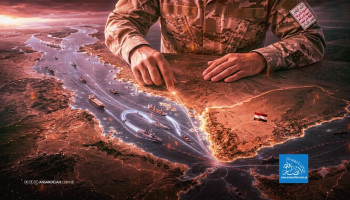
It imposed a new equation—“blockade for blockade”—which reached its climax when the Yemeni Armed Forces announced a naval ban on Saudi shipping in the Red Sea, the Bab al-Mandab Strait, and the Gulf of Aden.
Relentless American-Saudi Drive to Destroy Yemen
The US-Saudi aggression has relentlessly pursued an open-ended crime against Yemen, one whose scale defies both enumeration and measure, ever since its ill-fated announcement from the White House in Washington on March 26, 2015.
In this context, a comprehensive 12-year documentation of the aggression and blockade, published in a report by the Eye for Humanity Center for Rights and Development, has revealed a staggering human toll inflicted on civilians and civilian property.
The machinery of killing and destruction has claimed the lives of 61,010 civilians, either killed or wounded, including 24,728 martyrs, among them 4,365 children and 2,653 women. The number of wounded stood at 36,282 civilians, including 5,578 children and 3,351 women.
The tools of extermination did not stop at direct bombardment. They extended into a biological and economic war imposed through a suffocating blockade and the closure of border crossings and airports.
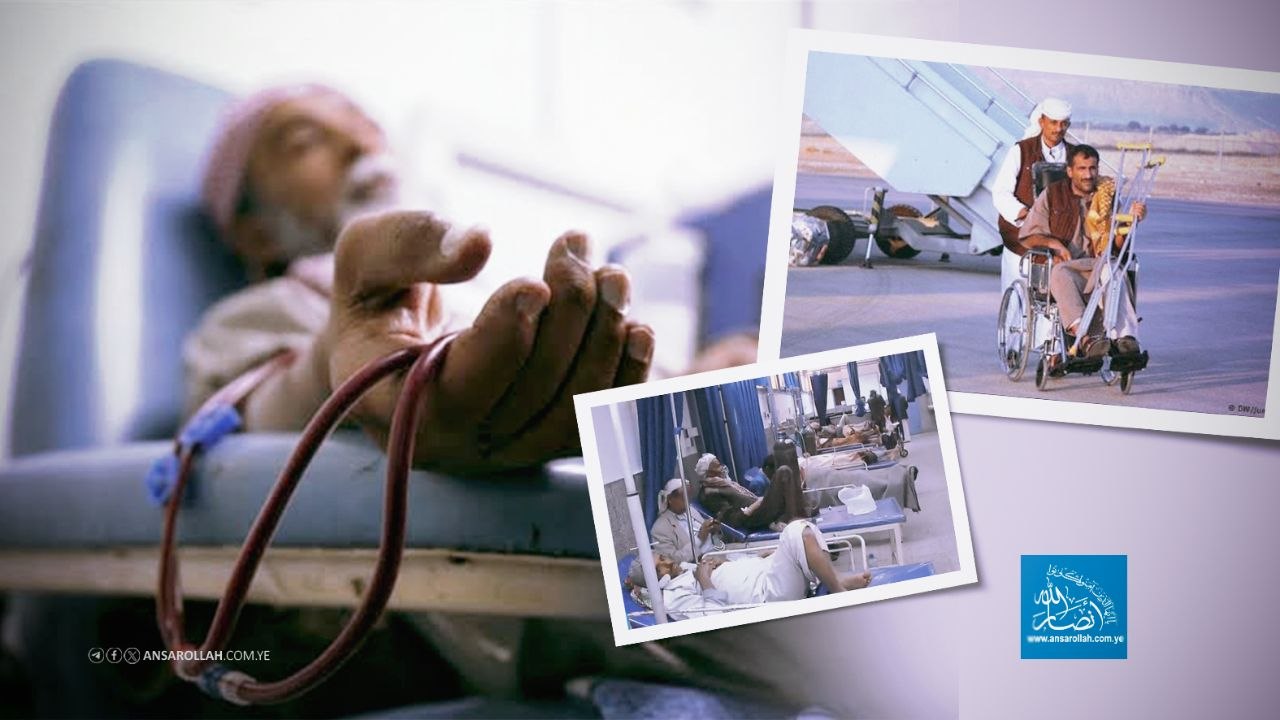
According to the press conference, the travel ban has resulted in the deaths of approximately 120,000 patients who were unable to leave the country to seek treatment abroad, while more than 1.2 million patients face an imminent risk of death due to their desperate need for medical care that is unavailable.
Field data have also documented the deaths of more than 46,000 women as a result of malnutrition and complications stemming from the blockade, while nearly 1.8 million women have been left suffering from acute malnutrition. This paints a stark picture of a coercive strangulation strategy aimed at Yemen’s social fabric and demographic structure.
On the economic front, official figures have revealed the staggering scale of the systematic plundering of Yemen’s national resources. Losses in the agricultural sector have exceeded $147 billion, while losses in the oil and gas sector have surpassed $123 billion.
This is in addition to the theft of legitimate oil and gas revenues, which exceeded $10 billion, as well as losses of $64.7 billion inflicted on the foreign trade sector—all as part of an overt effort to engineer an all-out war of starvation and drive state institutions into bankruptcy.
As for infrastructure and vital services, direct airstrikes deliberately sought to bring public life to a complete standstill. The center documented the destruction of and damage to more than 623,599 homes, along with attacks on 476 hospitals and healthcare facilities, 1,510 schools and educational facilities, and 204 university institutions.
The destruction also targeted 16 airports, 16 seaports, more than 492 power stations and generators, 720 telecommunications networks and facilities, 3,609 water tanks and facilities, 9,033 roads and bridges, and 2,548 government facilities.
Added to this were attacks on 2,031 mosques, 435 tourism facilities, 158 sports and youth facilities, 304 archaeological sites, and 75 media facilities—a sweeping campaign of destruction aimed at dismantling the foundations of everyday life and erasing Yemen’s civilizational memory.
The Toll Widens as the Consequences Come to Light
As the body of testimony and compelling evidence continues to mount, official data released by Yemen’s Ministry of Economy, Industry and Investment, presented in the exhibition “The Yemeni Economy: 12 Years Under Blockade (2015–2026)”, has laid bare the staggering cost of the Saudi enemy’s policy of “slow death” imposed on the Yemeni people.
The report’s figures show that the national economy has suffered devastating initial losses exceeding $1.13 trillion as a result of the aggression and blockade. These losses include $648 billion in cumulative losses to gross domestic product and $482 billion in direct losses inflicted on productive and service sectors.
The toll rises to several times that trillion-dollar figure when indirect losses and the cost of compensation for the comprehensive war are factored in, with the daily cost of compensating for those losses estimated at approximately $150 million.
The destruction has extended across every component of the economy. Foreign trade suffered losses of $111.13 billion, as the volume of trade contracted by 65%, costing hundreds of thousands of people their jobs.
The agriculture and livestock sector sustained losses of $111 billion, affecting approximately 1.2 million farmers, while losses in the industrial sector exceeded $82.5 billion, amid the shutdown of thousands of productive facilities.
In the oil and mineral sector, direct losses reached $57 billion, exceeding $130 billion overall as production fell by 250,000 barrels per day, in addition to $30 billion in losses to the state treasury.
The damage also extended to the electricity and energy sectors, which suffered $27.4 billion in losses; transportation, with $23.2 billion; tourism and antiquities, with $11 billion; telecommunications, with $6.3 billion; healthcare, with $7 billion; and water services, with approximately $800 million.
On the infrastructure and public services front, the report charted the scale of the devastation inflicted on the foundations of the state.
A total of 16 airports, 17 seaports, 5,600 power facilities and generators, 12,400 water facilities and units, 718 telecommunications facilities, 476 health centers and facilities, 1,510 schools, 16,798 commercial establishments, and 470 factories were targeted and either partially or completely destroyed.
In addition, 9,017 roads and bridges were destroyed, while 623,599 homes and residential facilities were damaged or demolished, resulting in widespread disruption to essential services and supply chains.
The human consequences of these crimes were equally devastating. Unemployment soared to 65%, while approximately 31 million people were left facing the direct threat of famine, including more than 2.2 million children under the age of five and more than 1.3 million pregnant and breastfeeding women suffering from acute malnutrition.
This was compounded by the dismissal or loss of employment of approximately 60% of the workforce across various sectors.
Shedding light on these damning statistics, despite the fact that they represent only a fraction of the catastrophic dimensions of the blockade and aggression, constitutes an enduring human rights and legal record—one that preserves the memory of the victims and places the international system before its moral obligations.
From a human rights and justice perspective, crimes against humanity do not become extinguished with the passage of time.
Preserving evidence and establishing the facts therefore remain essential steps toward safeguarding victims’ rights, pursuing those responsible for the crimes, and ensuring that they are not allowed to escape accountability—even as the United Nations, the Human Rights Council, and international judicial bodies continue to shirk their responsibilities and fail to launch impartial investigations that would uphold the rule of law above the power of money and influence.
Between the Silence of the International System and the Will to Confront
Up close, the scene transcends the language of cold statistics to reveal something far more horrific and painful. Added to the toll of victims is the devastating impact of unpaid salaries affecting more than one million male and female employees, whose incomes support between 5 and 10 million people.
Beyond that, hundreds of deeply moving human stories continue to emerge, documenting families that have endured—and continue to endure—every form of suffering, including the cases of hundreds of families and victims who have died of starvation.
In this tragic reality, tens of thousands of children wait for a bottle of milk, while hundreds of thousands of young people and workers stand in queues searching for a means of survival after losing their livelihoods as a result of direct attacks on factories, farms, and productive facilities, or through the collapse of businesses and the destruction of sources of income by the blockade and airstrikes.
This is compounded by a catastrophic health crisis in which chronic diseases—including cancer, diabetes, and hypertension—are claiming the lives of hundreds of thousands of patients.
Countless others are being ravaged by infectious diseases such as malaria and acute diarrheal illnesses, while they wait for medicines held aboard humanitarian and relief vessels that the Saudi enemy deliberately prevents from entering and detains under flimsy pretexts of inspection.
These damning crimes, documented through documentaries and audiovisual media reports, reflect the tragic scenes produced by the aggression’s airstrikes over the course of 12 years, through their deliberate targeting of residential neighborhoods, markets, wedding celebrations, mourning halls, schools, airports, seaports, and border crossings. In doing so, they have exposed the criminal depravity and utter disregard for the lives of the Yemeni people.
In the face of this abhorrent UN failure, the moral collapse behind the slogans of “protecting civilians,” and the continued disregard for Yemen’s position rejecting the blockade and aggression, national and strategic necessity compels Yemen—its leadership, armed forces, and people—to mobilize all the decisive power at its disposal to break the blockade, lift restrictions on the movement of citizens, and ensure the unrestricted flow of food, medicine, and fuel.
This is rooted in the steadfast principle that “grave crimes do not become extinguished with the passage of time.”
Decisive Equations and Imposing Costs on the Ground
In the face of this continued Saudi intransigence, the warnings issued by Revolution Leader Sayyed Abdul-Malik Badr al-Din al-Houthi at the beginning of last July came to put an end to the policy of procrastination, making clear that the continuation of aggression and the blockade would be met only with further escalation and economic pressure.
This follows the explicit equation repeatedly affirmed by the Revolution Leader: “Whoever wants security for his shipping lanes and economy must lift the blockade and aggression against the Yemeni people. The blockade-for-blockade equation has become an inevitable choice from which there will be no retreat.”
Against this backdrop, 12 years of blockade have failed to break the Yemeni will. Instead, they have deepened its resilience and heightened awareness of the inevitability of this decisive battle.
This was vividly demonstrated by the massive million-strong demonstrations that swept the capital, Sana’a, and the squares of the free provinces on Friday, 3 Safar 1448 AH (July 17, 2026), under the banner “Friday of Warning and Mobilization.”
The crowds gave the Revolution Leader an unrestricted mandate to take all military and economic measures necessary to break the blockade, reopen airports and seaports, and reclaim sovereign resources, declaring the implementation of the principle of “reciprocal treatment” through the equation: “Airport for airport, port for port, blockade for blockade.”
This overwhelming popular backing has gone beyond mere solidarity, evolving into an institutional and field-level program of action that translates human rights statements and documentation into conscious measures.
It affirms that the blood of the martyrs and the price of the devastation inflicted on the country constitute a renewed source of momentum for securing a resounding victory, cleansing every inch of national territory, and breaking the arrogance of the Zionist-American hegemonic project and its tools in the region.
As a translation of this popular mandate into action, the Yemeni Armed Forces inaugurated a new strategic phase that brought the era of procrastination to an end.
On July 20, 2026, their official spokesman, Brigadier General Yahya Saree, announced the imposition of a maritime blockade on the Saudi regime in the Red Sea, the Bab al-Mandab Strait, and the Gulf of Aden.
Coming at the heart of an escalating humanitarian crisis, the decision marked a significant shift in the management of the conflict, moving beyond the confines of tactical defense to impose a direct deterrence equation that holds the Saudi regime fully responsible for the closure of Yemeni ports and airports and the plunder of the country’s resources.
Under this equation, Saudi ports, airports, industrial complexes, and petroleum facilities have become exposed and direct targets for painful strikes, in accordance with the strategic principle: “The aggressor is the greater wrongdoer.”
In conclusion, in a strategic shift that has redrawn the region’s geopolitical map, Yemen—by God’s grace, and leveraging its strategic position and growing military capabilities—has succeeded in imposing a stringent maritime blockade on Saudi enemy ports, triggering an unprecedented economic and logistical hemorrhage across the kingdom’s economic infrastructure.
The impact of the blockade on the ground has been evident in the rerouting of large numbers of cargo ships and oil tankers around the Cape of Good Hope, inflicting severe losses on the Saudi regime as supply voyages have been extended by an additional 25 to 34 days.
According to economic analysts, the blockade has also driven a sharp increase in insurance premiums on Saudi ports, from 0.1% to between 0.7% and 1.0% of a vessel’s value, multiplying costs by seven to ten times.
At the same time, cargo and container handling activity at ports along the western coast—Jeddah, Yanbu, and Jizan—has declined by between 20% and 50%.
The cost of chartering oil tankers through the Bab al-Mandab has likewise risen by 40% to 60%, casting a heavy shadow over the projects of Saudi Vision 2030, foremost among them NEOM and the kingdom’s western tourism developments, as supply chains face mounting disruption.