In an unprecedented strategic shift, the region is undergoing a fundamental realignment of the regional balance of power, as Yemen’s military operations have evolved from tactical defensive responses into a carefully calibrated offensive strategy aimed at bringing the enemy’s energy and economic lifelines to a complete standstill.
This shift comes as part of an effort to establish new deterrence equations that impose a “siege for a siege” and answer “escalation with escalation,” with increasingly painful consequences, thereby putting an end to Saudi arrogance.
Amid the battle to break a siege that has lasted for more than twelve years, the Yemeni Armed Forces continue to intensify their operations with methodical precision, shifting their focus to the most vital and influential artery of the Saudi economy.
For weeks, Saudi oil vessels and vital facilities deep inside Saudi territory have come under sustained strikes, marking a strategic shift that places the enemy’s largest economic projects directly in the line of fire.
Jizan Refinery: A Primary Target for Yemeni Missiles
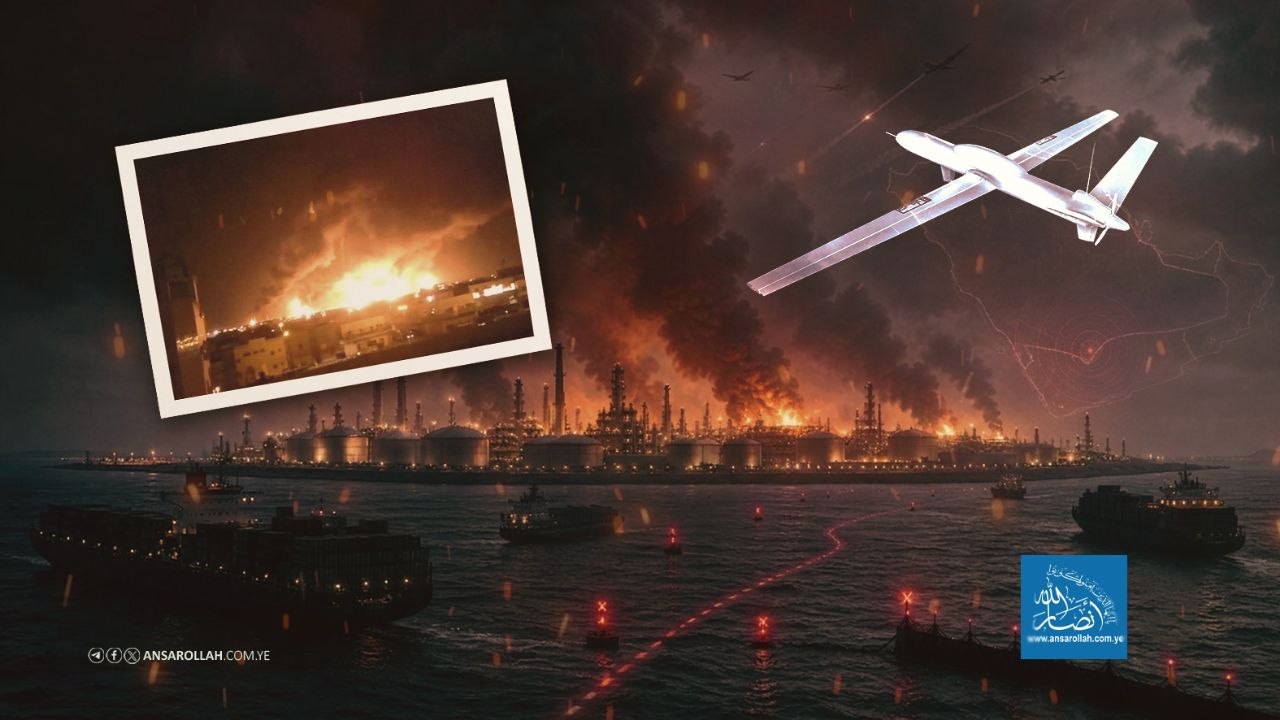
The Jizan Refinery, which the Yemeni Armed Forces have designated as a target for their aircraft and missiles whenever Saudi Arabia violates Yemeni airspace, holds strategic importance due to its design to produce a wide range of high-value petroleum products, foremost among them gasoline, ultra-low-sulfur diesel, and clean gasoline and paraxylene.
The facility is connected to a marine terminal and specialized berths for supplying the refinery with crude oil and exporting refined products, making continued attacks on it a devastating blow to Aramco’s plans to raise its total refining capacity to between 8 million and 10 million barrels per day by 2030.
The Jizan Refinery complex, wholly owned by Saudi Aramco, covers an area of 12 square kilometers within the Jizan Basic and Downstream Industries City on the Red Sea coast.
With a massive refining capacity of 400,000 barrels per day, it is the fifth fully owned petroleum complex operated by the company within the Kingdom.
The enemy’s losses are compounded by the facility’s industrial and logistical integration with a vast network of unprecedented large-scale installations.
The refinery supplies feedstock to the integrated gasification combined-cycle plant and powers a downstream electricity facility described as the largest of its kind in the world using integrated gasification combined-cycle technology, generating approximately 3.8 gigawatts of electricity.
The damage is not confined to the refinery and its marine terminal; it extends to the disruption of core and supporting projects being carried out by Aramco to develop the economic city’s infrastructure.
These projects encompass an integrated hub for downstream industries, a power generation plant, a commercial port, a water desalination plant, as well as road, water, and sewage networks.
Thus, the Yemeni strikes do more than disrupt the supply of refined petroleum products and electricity; they undermine the solid foundation Saudi Arabia has built to attract investment in heavy industry and petrochemicals, turning its development ambitions in the south into an open-ended security and economic predicament.
Supply Disruptions and Paralysis of Global Supply Chains
Deep in the Red Sea, Yemeni operations continue with steadily increasing effectiveness. The Amzan tanker, preceded by the Wafaa, came under precise Yemeni fire at the port of Yanbu, more than 1,000 kilometers from the nearest point in Yemen.
Riyadh had no choice but to acknowledge that both vessels had been hit—an incident too significant to contain or conceal.
The repercussions of the Yemeni escalation have extended to the oil market, triggering growing confusion and uncertainty. Bloomberg reported that a number of oil refineries in East Asia are seriously considering canceling their planned loadings of Saudi crude, citing rising additional costs and a direct increase in marine insurance premiums, as well as mounting logistical risks surrounding the maritime routes leading to Saudi ports.
In the same vein, the Joint Maritime Information Center painted a grim picture of the enemy’s maritime situation after classifying the threat level in the Bab al-Mandab and southern Red Sea region as “high.”
The center confirmed that the possibility of successive attacks targeting Saudi facilities and vessels remains a strong and persistent risk.
South Korea’s Seoul Economic Daily revealed a state of paralysis and a record decline in commercial shipping activity, as global shipping companies avoid Saudi ports and their maritime routes following a comprehensive reassessment of risks and a marked rise in marine insurance premiums.
The newspaper reported a record increase in the number of official notices issued by international import and export companies regarding their inability to deliver goods and shipments destined for Saudi ports.
Citing officials at global shipping companies, the report described clear hesitation and reluctance among maritime carriers, noting the difficulty of dispatching vessels to, or bringing them into, Saudi Arabia at present.
The impact of the Yemeni blockade is also reflected in testimony from leading industrialists and exporters across Asian markets. The head of an export company in the South Korean city of Incheon said that finding even a single cargo vessel bound for Saudi ports has become “nearly impossible.”
The Collapse of the U.S. Security Umbrella and the Failure of Alliances
The U.S. magazine The National Interest has exposed the predicament facing the security strategy of the enemy and its regional allies, asserting that the new maritime coalition Saudi Arabia sought to establish was stillborn, lacking the capacity to prevent the Yemeni Armed Forces from disrupting navigation through the Bab al-Mandab Strait and the Red Sea.
The magazine’s analysis explained that while Saudi efforts remain incapable, in practical terms, of protecting vessels, they nevertheless constitute a highly significant indication of the breakdown of the Gulf states’ longstanding reliance on Washington and the collapse of the illusion of American protection in the face of the effectiveness of Yemen’s escalating strikes and military options.
The U.S. magazine traced the background to Saudi Arabia’s confusion, noting that reports about the newly formed maritime coalition emerged in late July, before Riyadh officially confirmed its efforts to establish it on July 30.
This came in the wake of Yemen’s firm announcement on July 21 that it was imposing a tight blockade on Saudi maritime traffic in the Red Sea.
The report highlighted the structural transformation in Yemen’s military capabilities, which have developed substantially in recent years, enabling the Yemenis to strike oil and vital facilities deep inside Saudi Arabia and the UAE, before expanding the scope of their operations to include the Israeli occupation entity and maritime traffic in the Red Sea.
The magazine also examined the failure of U.S. military campaigns, particularly the aggressive military operations carried out by the Trump administration between March and May 2025, stressing that they completely failed to curtail Yemen’s capabilities while resulting in the killing and wounding of hundreds of civilians.
The analysis linked the establishment of the Saudi maritime coalition to the trilateral military alliance bringing together Saudi Arabia, Türkiye, and Pakistan, viewing both developments as evidence of a profound shift in regional states’ perception of the U.S.-led security architecture that has prevailed for decades.
The magazine explained that this system has historically been based on a trade-off in which U.S. security guarantees were exchanged for preferential agreements in the energy sector. However, the escalating regional conflict has driven the region’s leaders toward the conviction that regional states are best positioned to manage their own security.
The Strategic Shift and the Escalating Cost
The Yemeni escalation has demonstrated the effectiveness of a decisive strategy aimed at striking the enemy’s economic lifeline, turning its oil exports into a deterrent factor for Asian markets rather than a source of funding for its aggression and blockade against Yemen.
The successive military strikes and the scale of the deep losses they have inflicted reflect the collapse of the enemy’s military narrative and the growing confusion on both the battlefield and the political front.
Against the backdrop of this structural shift in military doctrine, Defense Minister Major General Mohammed Nasser Al-Atifi and Chief of the General Staff Major General Yusuf Hassan Al-Madani, in a message of congratulations to the Leader on the occasion of the Prophet’s birthday, affirmed the effective transition from a defensive posture to preemptive offensive action.
“From this day forward, we will not wait for the enemy to extend its hand toward us; we will strike first with painful blows and pursue its mobilization efforts in their strongholds and bases with our ballistic missiles and drones, which, by God’s grace, have become capable of reaching deep into their territory.
Their unjust blockade will be met with a multiplied blockade. The tighter they seek to tighten the noose around us, the broader we will expand our military options and the more we will develop our advanced capabilities, relying on God and placing our trust in Him.”
They further stated that orders had been issued to all our forces to maintain full readiness and remain constantly prepared to respond to any recklessness by the enemy with our hypersonic missiles and attack drones—precisely guided by God’s will and endowed with His might—leaving the enemy no avenue for escape.
“Yemen will no longer be an easy arena for conspirators; rather, it will be a blazing fire that consumes anyone who dares to lay a hand on our land or violate our honor.”
The Three Equations and the New Rules of Engagement
As deterrence continues to escalate amid the Saudi regime’s ongoing confusion and attempts to impose delay and procrastination, Yemeni Armed Forces spokesman Brigadier General Yahya Saree had affirmed that Yemen’s deterrence options have become the sole force shaping the course of events and dictating the rules of engagement.
He stressed that the armed forces are now enforcing three firm and non-negotiable equations: “a blockade for a blockade,” striking enemy mobilizations wherever they may be, and protecting Yemeni sovereignty against any violation.
Field figures demonstrate the scale and effectiveness of Yemen’s maritime operations and their sweeping impact. Since July 20, the Yemeni Armed Forces have succeeded in targeting nine Saudi oil tankers operating across the Red Sea, the Gulf of Aden, and the Arabian Sea.
The repercussions of these strikes have extended beyond direct attacks, encompassing the prevention of dozens of Saudi oil tankers from transiting and forcing them to turn back. This has brought Saudi oil transportation routes to a standstill and disrupted the flow of its oil supplies to global markets.
Conclusion
The facts on the ground confirm that the rules of the military and regional game have been completely redrawn in Yemen’s favor, and that the era of acting against Yemen with impunity and imposing a blockade without consequences is over for good.
If the Saudi regime continues to pursue a policy of procrastination and gamble on the passage of time, it will only face greater economic exposure and further military attrition.
The Yemeni Armed Forces stand ready to activate even more painful deterrence options capable of wreaking havoc on what remains of Saudi Arabia’s oil and development stability, unless it moves swiftly to fulfill its comprehensive peace commitments and meet the legitimate demands of the Yemeni people.
The only path to peace available is the lifting of the comprehensive blockade, implementation of the provisions of the roadmap, an end to the occupation and its withdrawal, and leaving Yemen’s sovereign resources to the Yemeni people.
What the region is witnessing today is a fundamental reshaping of the equations of power and influence, with one defining message: when the will of free peoples is coupled with deep conviction and credible military deterrence, it can impose a new reality that can neither be ignored nor circumvented.