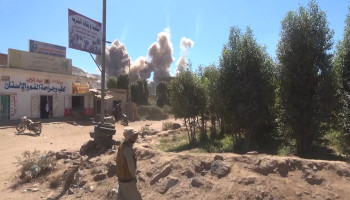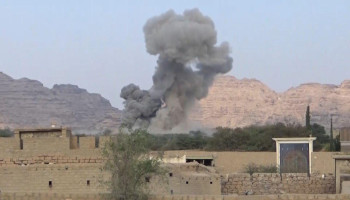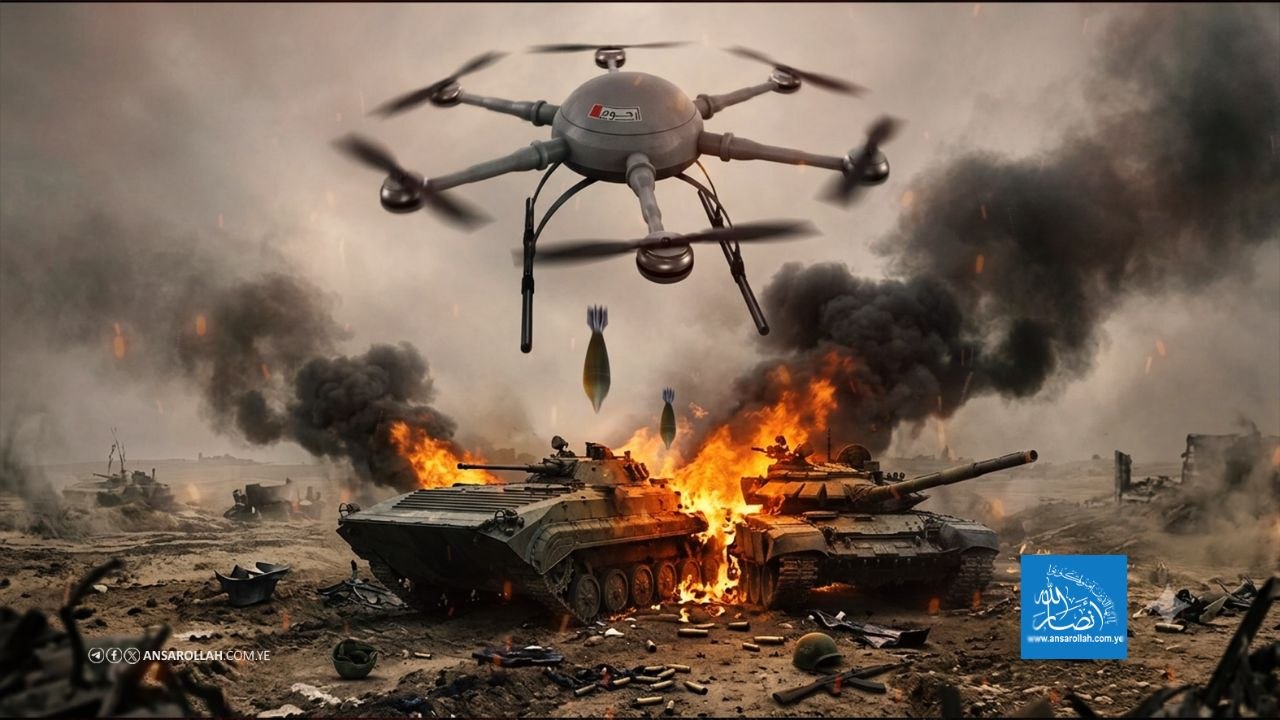
In a notable development reflecting a fundamental shift in the balance of power on the battlefield, Yemeni war media recently released exclusive footage documenting a series of precision operations carried out by the Yemeni Armed Forces using “Rajoom” unmanned aerial vehicles, targeting gatherings and military vehicles belonging to the Saudi enemy’s proxies across several combat fronts. The footage points to a rapidly advancing technological capability that is imposing new equations on the battlefield.
The operational prowess of the Armed Forces is evident in the remarkable precision of the documented strikes. The footage shows an exceptional ability to track both moving and stationary targets, as well as key points of vulnerability within enemy formations.
What stands out in the footage is the rare integration of aerial reconnaissance and direct-strike capabilities. The cameras captured moments in which military vehicles were detected as their personnel attempted to take cover beneath vegetation, disguising themselves as civilians.
Yet the Yemeni drones penetrated the camouflage and exposed their positions with remarkable precision, sending projectiles raining down from above like precisely guided thunderbolts.
What distinguishes these operations is their military economy of force. Rather than engaging in costly ground confrontations, the Armed Forces rely on wearing down the enemy from safe distances, turning every movement of its vehicles into a venture fraught with certain death.
This tactical shift reflects a growing operational maturity grounded in a deep understanding of the structural vulnerabilities within enemy formations.
“Rajoom”: A Technological Platform Challenging Conventional Superiority
The locally manufactured “Rajoom” drones stand as an example of the Yemeni military mind’s ability to overcome technological and financial constraints and develop indigenous combat systems that outperform their counterparts.
Since their official unveiling in 2021, the system has undergone successive developments, transforming it into a multi-mission weapon that combines reconnaissance, targeting, and precision strikes. At the time, no country had yet incorporated this technology into its armed forces.
Notably, Ukraine drew on this experience to develop and manufacture a similar aircraft, following the significant successes achieved by the “Rajoom” drone during the Battle of the Western Coast, particularly in 2020 and 2021.
These drones are distinguished by their ability to take off and maneuver vertically and maintain aerial stability for extended periods, allowing them to monitor targets long enough to deliver the appropriate strike.
More importantly, they employ advanced munitions equipped with guidance fins, which descend along a calculated ballistic trajectory designed to overcome the effects of incidental weather conditions and strike their targets with exceptional precision.
The technological dimension of this system extends far beyond its role as a weapon. The real challenge confronting advanced Western arsenals in Yemen is not simply a fleet of drones, but an integrated system of electronic surveillance, counter-jamming, and intelligent guidance capabilities that together constitute what could be described as the “digital mind” of Yemeni military operations.
The Strategic Dimension: Messages That Transcend the Battlefield
These operations cannot be viewed in isolation from their broader strategic context. They carry coded messages directed at multiple parties.
For the Saudi leadership, the strikes underscore that the massive military build-ups it financed and organized during periods of de-escalation have become fully exposed to Yemeni intelligence, and that the prospect of launching a large-scale ground offensive has effectively turned into collective suicide.
For Washington, which continues to provide logistical and intelligence support to the Saudi side, the Yemeni message is equally clear: advanced American weapons — including Abrams tanks — can no longer provide the protection expected of them.
Continued Western support for the aggression, the message suggests, will do nothing to alter the balance on the battlefield. Particularly striking in the footage is the ability of a single “Rajoom” drone to set numerous Abrams tanks ablaze.
Expert Assessment: An In-Depth Analysis of the Military Implications
Experts believe these operations represent the culmination of a comprehensive intelligence-gathering and surveillance network covering the entire theater of operations, from border crossings to the western coastline and multiple areas of contact.
The diversity of the targets — ranging from personnel concentrations to armored vehicles and fortified positions — reflects an ability to select targets according to carefully considered strategic priorities rather than through indiscriminate targeting.
Moreover, the decision-making cycle in Yemeni military operations has become exceptionally short, with information moving from sensors to command centers and then to launch platforms in record time.
This leaves the enemy with little opportunity to adapt or withdraw. Such a rapid operational tempo places immense psychological pressure on opposing forces, which are forced to operate under a state of constant alert.
Most significant, however, is the notable expansion of the “Rajoom” drone’s operational range, which now exceeds 15 kilometers. This development has drawn the attention of Western research institutions, which have begun studying the phenomenon in earnest.
The Psychological and Moral Dimensions
The significance of these operations extends beyond the material damage inflicted on equipment and personnel, reaching deeper levels aimed at undermining the morale of enemy formations.
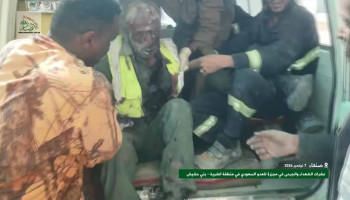
Footage documenting scenes of collective panic and indiscriminate flight under fire serves as counter-propaganda that penetrates the consciousness of enemy fighters, instilling in them the firm conviction that they are facing an inevitable fate from which there is no escape.
The selective release of such footage — suggesting that what is being shown represents only a small fraction of much broader operations — constitutes a sophisticated media strategy designed to heighten the adversary’s sense of vulnerability and keep it in a constant state of uncertainty over the true scale of the capabilities confronting it.
More importantly, these operations carry a message to the forces serving the aggression: the money they are fighting for will not protect them from death, and the path of collaboration they chose for themselves has come at an enormous cost.
Ultimately, the escalating Yemeni military operations can be seen as a practical embodiment of a strategy of preemptive deterrence developed by the Yemeni Armed Forces in response to the suffocating blockade and continuing aggression.
From the outset of the military escalation, the Yemeni leadership recognized the need to develop unconventional capabilities capable of inflicting pain on the enemy at lower cost, while achieving greater impact and effectiveness.
This strategy — combining ballistic missiles, long-range drones, and small attack UAVs — constitutes a multilayered deterrence architecture capable of escalating incrementally in response to the circumstances at hand. The greater the external pressure on Yemen, the broader the range of targets and the higher the level of military response.
Toward a New Equation on the Yemeni Battlefield
The footage released by the Yemeni war media represents far more than documentation of successful military operations; it marks a turning point in the long-running confrontation with the Saudi enemy.
It leaves little doubt that the Armed Forces have moved beyond passive defense into the realm of preemptive offensive action, and have now taken the initiative on the battlefield.
More importantly, these operations reveal that the aggression in Yemen has evolved into a confrontation between two opposing wills and military doctrines.
While the Saudi enemy relies on imported technological superiority and vast financial resources, the Yemeni Armed Forces rely on local ingenuity, fighting spirit, and continuous adaptation to the changing dynamics of the battlefield.
In this confrontation, just as conventional arsenals throughout history have failed to break the will of peoples determined to preserve their sovereignty, advanced Western technology is now failing to decisively settle a battle waged by a people who have chosen to be free or not be at all.
The clearest message conveyed by these operations is that the land of Yemen, fortified by unwavering faith and deep-rooted courage, will not be an easy passage for any invader, regardless of how powerful it may be or how advanced its weapons.