At a time when concepts have become confused, balances have been overturned, surrender has come to be called peace, submission wisdom, and cowardice rationality, Yemen today stands tall like an imposing mountain, offering the world a practical lesson in the true meaning of peace. Yemen is no longer that country upon which peace is imposed under the weight of siege and bombardment. Rather, it has become the one imposing the conditions of peace, determining the equation of deterrence, and teaching the world that peace is neither a paper to be signed nor an agreement that brings humiliation, but a strength that is built, a determination that is forged, and blood offered as the price of dignity.
Yemen has demonstrated that true peace is not obtained through pleading, nor granted through concessions, but imposed through strength, built upon the foundation of deterrence, and based on a clear equation: whoever understands nothing but the language of force deserves to be scorched by its fire. This is the enduring Yemeni wisdom, and this is the lesson presented by the Martyr of the Quran, Sayyid Hussein Badruddin al-Houthi, when he taught us that Islam is the religion of peace, but in its true meaning, not in the distorted meaning that has turned it into surrender.
Deterrence.. The Language of Peace Understood Only by the Strong
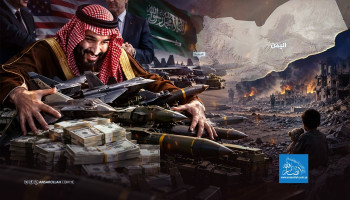
Yemeni deterrence did not come from nowhere, nor was it a military luxury. Rather, it was an existential necessity imposed by years of strategic patience met with obstinacy, procrastination, and disregard for the lives of Yemenis. The Saudi enemy believed that the blockade would break Yemen, that bombardment would bring Sanaa to its knees, and that hunger would make Yemenis stretch out their hands, pleading for peace. But Yemen, raised upon the guidance of the Quran and the path of the Martyr of the Quran, understood that peace is not sought from enemies; rather, it is imposed upon them.
The naval blockade on Saudi maritime traffic in the Red Sea and Bab al-Mandab was the first step on this path. Saudi oil exports declined to their lowest levels in a decade, insurance premiums on ships rose to unprecedented levels, and the journey of Saudi tankers became a logistical nightmare, forcing them to sail around the African continent to escape Yemeni missiles and drones. These are messages of peace in the language of strength, messages saying to the enemy: if the blockade continues on Yemen’s ports and airports, Saudi ports will not enjoy security.
Thus, the Red Sea was transformed from a safe passage for Saudi tankers into a Yemeni operational theater, and the equation of “blockade for blockade” became a tangible military and economic reality. This is the strength that achieves peace, not the humiliation brought by surrender.
Strength as a Tool for Peace
What has taken place over the past days was a living embodiment of a fully integrated equation. It began with imposing a blockade on Saudi maritime traffic, then escalated to striking the Kingdom’s economic and military depth, culminating in burning the cards of the mercenaries on the internal fronts, in a scene where the fronts complement one another and the instruments unite to achieve one goal: forcing the aggressor to halt its aggression and submit to legitimate Yemeni rights.
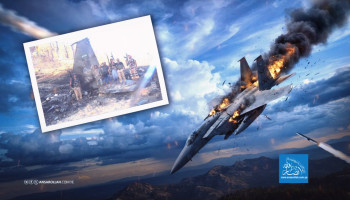
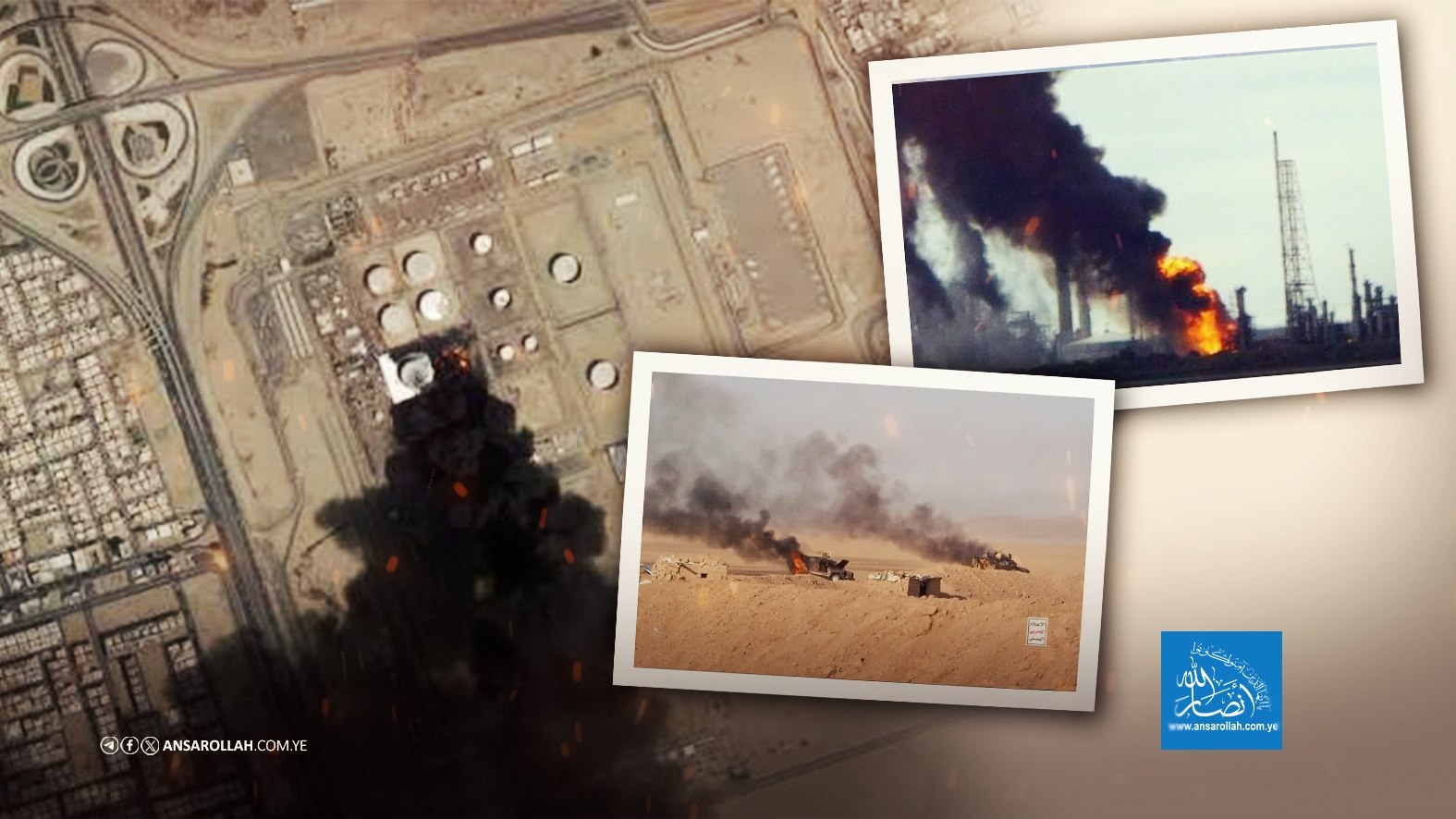
Dozens of ballistic missiles and drones were launched toward strategic targets deep inside Saudi Arabia in qualitative military operations that exceeded all expectations and disrupted all calculations. Aramco in Abha, Najran, the Economic City, and Jizan, as well as Khamis Mushait Air Base, considered one of the most important military bases in the southern region—the Yemeni missiles reached their targets there with extreme precision, penetrating all the American defense systems on which Riyadh spent tens of billions of dollars.
Satellites that monitored the huge clouds of smoke rising from the Jizan refinery and Abha station revealed a reality that could not be concealed: the oil facilities had been struck at their core, and the fires exceeded all expectations, becoming clearly visible from outer space. These strikes were a message of peace in the language of strength, a message saying: the Yemeni hand that reached Aramco and Khamis Mushait is capable of reaching farther, and the Yemeni leadership that demonstrated its strategic patience throughout the long years of war will not hesitate to escalate deterrence to levels the Saudi regime has never witnessed before.
The Collapse of the Myth of Imported Defenses
The paradox in this confrontation lies in the fact that Saudi Arabia, which possesses the latest American air-defense systems, including “Patriot” and “THAAD,” was completely unable to intercept Yemeni missiles and drones manufactured domestically under blockade conditions. This inability has become a defining sign of the collapse of the Western defensive strategy in the region and exposed the fragility of relying on imported technology in confronting deeply rooted fighting will.
The Yemeni strikes have demonstrated that technological advancement is not measured by the amount of money spent on purchasing from abroad, but by peoples’ ability to create and innovate under the harshest conditions. The Yemeni Armed Forces, which began with limited capabilities, have transformed during years of confrontation into an integrated military-industrial force, producing ballistic missiles and drones with precise specifications, managing their intelligence operations with remarkable efficiency, and carrying out their strikes with an accuracy whose margin of error is zero.
These capabilities were the product of a national strategy that invested in Yemeni minds and transformed the blockade from an instrument of suffocation into a catalyst for creativity and innovation. By contrast, the Saudi regime remained hostage to the American illusion, believing that purchasing the latest weapons was sufficient to achieve deterrence, without realizing that real battles are won by will before equipment, and by minds before imported technology.
The Philosophy of Peace in the Thought of the Martyr of the Quran: Peace Through Strength, Not Surrender
The Martyr of the Quran, Sayyid Hussein Badruddin al-Houthi, “may Allah be pleased with him,” presented a vision of the meaning of peace—a vision rooted in the Holy Quran, in the Most Beautiful Names of Allah, and in a precise understanding of Allah's laws in the universe. The Martyr of the Quran says: “Peace will not be achieved for you unless you are in a position of dignity, strength, and standing. But if you come seeking peace while you are beneath , then it is nothing but surrender.”
This vision proceeds from a profound understanding of the names of Allah, “The Peace,” “The Granter of Security,” “The Guardian,” “The Mighty,” “The Compeller,” and “The Dominant.” Almighty Allah is peace for His allies, He grants them security, He is the guardian over all things, and He is the Mighty, the Compeller, the Dominant. Whoever has Allah as his ally, how could he fear anyone? And whoever is granted security by Allah, how could he fear those who are under God’s dominion?
The Martyr of the Quran says: “If we find someone who takes pride in being close to them , someone who takes pride in serving them, someone who takes pride in obeying them, then why do we not take pride before others that we are working to become close to Allah?” This is the spirit that created the new Yemen—the spirit of trust in Allah, reliance upon Him, and confidence in His victory.
He adds: “Allah is the One who is with you in every situation, and with you in ways beyond what you can comprehend. He will fill the hearts of others with terror in a way that your media cannot create, nor can your military apparatus create. He is the One who granted victory to His Prophet through terror from a distance of a month. And how large was the army that was with him? They were those who had been besieged in the city, a small number, and Allah granted him victory through terror. Some of his enemies among the Jews would sometimes destroy their homes and cut down their palm trees, and would flee in fear before he mobilized armies against them, and before he even attempted to make them feel that he intended to attack them.”
This is true strength: the strength of faith that fills the hearts of enemies with terror, that enabled Yemeni missiles to reach their targets with extreme precision, and that rendered American air defenses incapable of intercepting them.
Islam Is the Religion of Peace in Its True Meaning
The enemies of Islam have long distorted the meaning of peace, turning it into surrender and making jihad an accusation and strength a form of brutality. But the Martyr of the Quran reminds us of its true meaning:
“Islam is the religion of peace, but the religion of peace in its true meaning. What does it mean to close the files of war with others? Is this peace? To say: the matter is over, we abolish jihad and abolish wars so that we may live with others in peace. This is what happened to us as Muslims. What our elders did was to continue pursuing peace, pleading with others that we wanted peace and searching for peace, after they cast aside the instrument of war and abolished the name of ‘jihad.’ So what happened? Did peace come, or were they trampled underfoot? And surrender took place. Is this not what happened?”
He cites the noble verse: {So do not weaken and call for peace while you are superior, and Allah is with you and will never deprive you of your deeds} (Muhammad: 35). Did Allah not reject their calling for peace while they were in a position in which they should have been superior? So how can you seek peace with others when you should be the one whom others seek peace with?
This is the lesson Yemen applied: that peace is not sought from enemies but imposed upon them; that peace is not obtained through pleading but built upon deterrence; that true peace is the peace of strength, not the peace of weakness; the peace of dignity, not the peace of humiliation; the peace of honor, not the peace of surrender.
Yemen Imposes the Equation of Peace
The earthquake caused by the Yemeni strikes deep inside Saudi Arabia sent repercussions into global markets and the corridors of international decision-making. Oil prices, which rose above $100 per barrel, and the growing concern among investors and insurance companies are all indicators, Yemen succeeded in transforming its military strength into a tool of global economic pressure.
International reports addressing the repercussions of the Yemeni operations have concluded that global energy security has become hostage to Sanaa, and that any further Saudi escalation will carry a heavy economic price borne by Western peoples who pay the bill for the policies of their governments that support the aggression. The decline in Saudi oil exports, disruption of refineries, and increased insurance costs for tankers are all factors that multiply pressure on an already troubled global economy.
The repercussions extended from the oil market to the entire structure of international maritime navigation. The Yemeni ban on Saudi shipping redrew shipping maps in the Red Sea, forced global transport companies to reassess their routes, and imposed a new reality in which waterways are transformed from safe passages into potential arenas of confrontation. These fundamental transformations place the major powers before two options with no third: either exert genuine pressure on the Saudi regime to lift the blockade and end the aggression, or prepare to bear escalating economic and security consequences whose end cannot be predicted.
Burning the Tools on the Sidelines of the Battle
Alongside the painful strikes deep inside Saudi Arabia, the enemy desperately attempted to open internal fronts to ease the pressure and distract the Armed Forces from continuing their strategic advance. But these attempts met their inevitable fate of failure. Rather, they turned into carefully laid traps that swallowed the mercenary advances and transformed them into corpses and prisoners.
These successive defeats were a strategic message that the mercenary cards on which the Saudi regime had wagered throughout the years of aggression had all been burned, and that they were no longer capable of providing any meaningful field contribution. Thus, Yemen demonstrates that true peace is achieved only by thwarting all the instruments of aggression and burning all the aggressor’s cards, until the aggressor finds itself facing only two options: just peace, or further losses.
The Enemy’s Strength Turns into a Tool of Pressure Against It
One of the deepest paradoxes in this confrontation is that Saudi oil, which was used as an economic weapon to suffocate Yemen and finance the aggression, has been transformed by the Yemeni strikes from a source of strength into a lethal point of weakness. Every barrel of oil that is not exported means a direct financial loss, and every oil facility that is disrupted means a halt in the flow of revenues upon which the Kingdom relies to finance its wars and projects.
Specialized international reports have affirmed that Saudi oil exports have fallen to unprecedented levels in nine years, that the Jizan refinery has completely ceased operations, and that global shipping and insurance companies now consider Saudi ports a war zone requiring high-risk premiums. This accelerating economic collapse places the Saudi regime before an existential dilemma: how can it continue financing a war that drains its resources and destroys its economy while its oil sources are subjected to successive strikes?
Saudi Arabia sought to use oil revenues as a weapon to impose its will on Yemen. The Yemeni response, however, turned oil itself into a source of weakness and leverage. Thus, Yemen demonstrates that true peace is achieved only by reversing the equation of power and transforming the tools of aggression into points of weakness, until the aggressor finds itself besieged by its own policies and drowning in the quagmire of its aggression.
A New Dawn Toward Peace Through Strength and Dignity
What is happening today in Yemen is the beginning of a radical transformation in the structure of international relations and the balance of power in the region. Yemen, which has been subjected to the most brutal forms of aggression and blockade and confronted the most powerful military and economic coalitions, is demonstrating today that conscious faith and a popular will capable of patience and innovation can defeat the most powerful empires and the largest arsenals.
The Yemeni Armed Forces have succeeded in building an integrated deterrence system, beginning with the naval blockade that chokes the aggressor’s economy, passing through ballistic and drone strikes that paralyze its military and economic capabilities, and ending with thwarting all the cards of mercenaries and attempts at internal circumvention. This integrated system has made the continuation of aggression an economic and security suicide for the Saudi regime and opened the door wide to political solutions based on recognition of legitimate Yemeni rights.
In this context, the Kingdom now has only one sensible option: accepting the requirements of genuine peace, lifting the comprehensive blockade on Yemen, recognizing its full sovereignty, and engaging in serious negotiations addressing the files of prisoners, salaries, and reconstruction. Every day that aggression continues means further Saudi economic collapse, greater international isolation, and further painful strikes reaching deep into the Kingdom.
Yemen, Teacher of Peace Through Strength
In the end, history remains a witness that peoples defending their freedom and dignity are not defeated, no matter how long it takes or how brutal the aggressor powers become. Yemen, which has stood firm in the face of the most severe aggression in the region’s history, stands today on the threshold of a major strategic victory that will have far-reaching regional and international consequences.
Yemen has taught the world that peace is not surrender, that strength is not aggression, and that deterrence is not a threat. Yemen has taught the world that true peace is the peace of strength, not the peace of weakness; the peace of dignity, not the peace of humiliation; the peace of honor, not the peace of surrender. Yemen has taught the world that whoever understands nothing but the language of force deserves to be scorched by its fire, and that whoever seeks peace while beneath his adversary is seeking nothing but surrender.
This is the enduring Yemeni lesson, presented by the Martyr of the Quran through his blood and words, and applied by the Yemeni Armed Forces through their missiles and drones. It will remain a beacon for all peoples seeking genuine peace—a peace through strength, a peace through dignity, a peace through honor. Either the aggressors respond to the call of truth and reason, or they should prepare to pay a heavy price that they will not be able to bear.