
Ansar Allah website - Report -27 Rabi' al-Thani 1448 AH
In just three days, the Yemeni military scene took a highly significant turn, with operations expanding across more than one front, as the field advance in Taiz Governorate coincided with military strikes reaching deep into Saudi Arabia, targeting oil facilities, airports and sensitive military sites, at a time when Saudi buildups were coming under successive strikes in Al-Jawf, Marib, Taiz and the western coast.
The scene revealed by the successive developments between October 3 and 6, 2026, paints a picture of a confrontation that has entered a new phase in terms of the expansion of its geography, the diversity of engagement tools, the nature of the targets, and the level of pressure being placed on the Saudi enemy. At a time when the Yemeni Armed Forces were pushing Saudi enemy buildups away from Taiz’s districts and achieving field advances, Yemeni ballistic and cruise missiles and drones were striking targets in Riyadh, Rabigh, Khurais, Asir, Najran and Jizan, while satellite imagery began revealing the scale of fires and smoke at a number of vital Saudi facilities.
This picture gives the latest operations an importance that goes beyond the results of each individual strike, because it reveals the expansion of the circle of confrontation from direct lines of contact to the strategic depth, and from ground fronts to airports, oil facilities and the airspace, reaching the vital infrastructure connected to the economy and energy.

Taiz.. The Fall of the Buildups and the Expansion of the Field
The major developments began in Taiz Governorate, where the Yemeni Armed Forces carried out extensive operations to complete the clearing of areas that had witnessed buildups belonging to the Saudi enemy. They succeeded in taking control of Sama', Al-Turbah and Al-Shamayatain, after which operations expanded to include Al-Ma'afer and Al-Mawaset, before reaching Al-Salw district on October 6.
These developments carry a clear military significance; the Yemeni forces did not deal with the buildups as fixed concentrations waiting to be attacked, but rather pursued them in their deployment areas, struck their vehicles and concentrations, chased the elements that attempted to advance, and forced Saudi air formations to leave Taiz’s skies after confronting them with locally manufactured surface-to-air missiles.
In Al-Jawf, Saudi buildups came under strikes that forced them to retreat in the eastern areas, with a large number of vehicles burned, dozens of dead and wounded, and the pursuit of elements that fled into the desert. In Marib, targeting operations extended to eastern Ragwan, in a picture confirming that the Saudi buildup found itself facing a wide geography of fire and continuous targeting.
In Taiz, the operation to take control of Al-Mawaset carried a particular political and field significance, given the presence of the home of the mercenary Rashad Al-Alimi in the district. The Yemeni forces announced that they had secured control of the house and expelled the Saudi buildups from the area, coinciding with an expanded meeting of sheikhs, prominent figures, dignitaries and notables of the governorate, who declared their rejection of the Saudi buildups and their support for the equation of blockade for blockade.
Thus, the geography that Saudi Arabia sought to use as a platform for exerting pressure on Yemen is gradually turning into a costly space for the buildup itself.
Saudi Arabia Reveals the Extent of Its Involvement in the Battle
As the field losses of its affiliated buildups expanded, Saudi Arabia moved to a more explicit level of direct participation after striving to remain out of the picture. On October 5, the Saudi enemy announced the participation of one hundred warplanes in a large-scale military operation in Bab al-Mandab, coinciding with dozens of airstrikes targeting different areas.
At the same time, Yemeni areas witnessed crimes and violations against prisoners and martyrs, including the running over of prisoners from the Armed Forces with armored vehicles and filming the crime, in addition to the mistreatment of the bodies of martyrs in Taiz.
The scene reveals the nature of the escalation to which Saudi Arabia resorted when it found its buildups under increasing field pressure. The airstrikes rose successively, reaching 60 strikes and missiles on October 3, then the total number of strikes since the beginning of the escalation rose to 1,410, before increasing on October 4 to 1,460, and on October 5 to 1,576 strikes and missiles.
In the face of this escalation, the Yemeni response came, affirming that escalation would be met with escalation and fire with fire.
Riyadh Under Fire
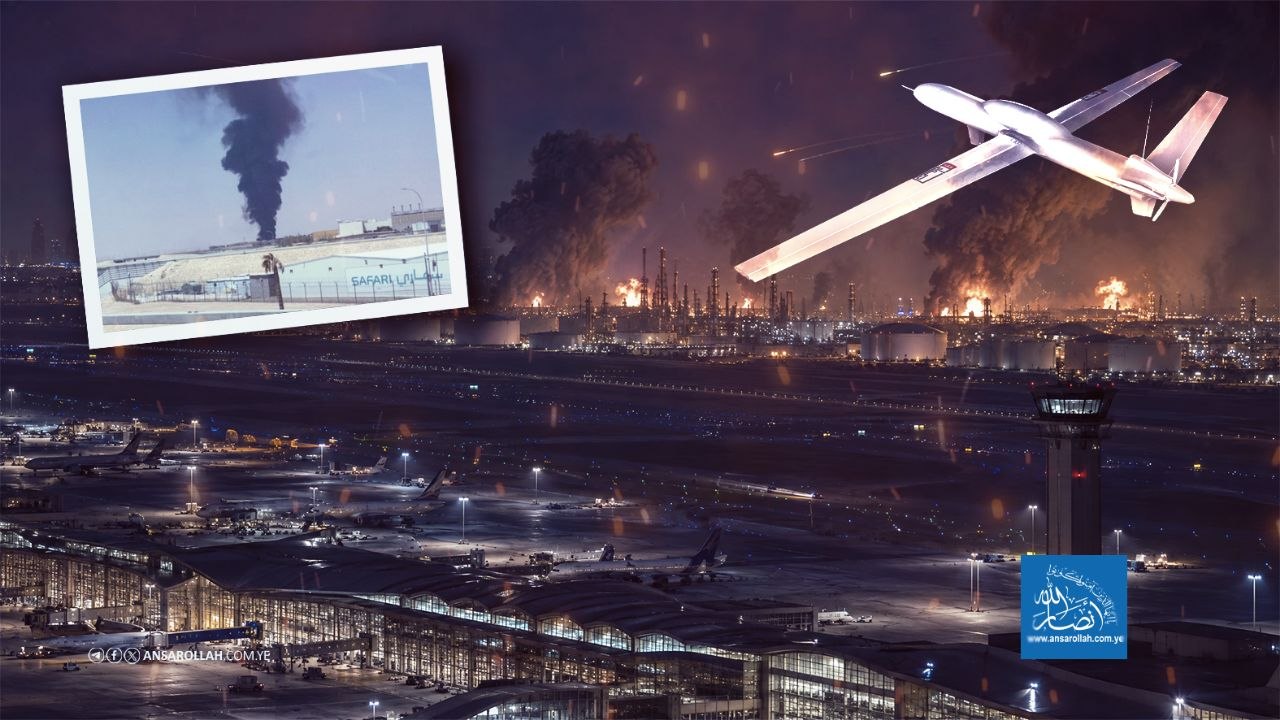
On October 3, the Yemeni Armed Forces carried out a military operation using a number of ballistic missiles and drones targeting Aramco in Riyadh, announcing that they had achieved precise and direct hits that caused fires to erupt at the targeted sites.
Then came the data captured by satellites to give the event an additional dimension. Images published by Reuters showed a massive cloud of smoke and flames rising from the vicinity of an Aramco facility in the Saudi capital, while Sentinel-2 imagery showed fires burning in fuel storage tanks inside the Aramco refinery in Riyadh.
According to the available data, the column of smoke extended over several areas north of Riyadh, reaching approximately 107 kilometers at the height of its rise, with disturbances detected in air traffic over the Riyadh area coinciding with the incident. The data also indicated that three oil-storage tanks had burned, while the intensity of the fires was estimated at approximately 200 megawatts. These details are important because they move discussion of the strike from the level of the military announcement to the level of the visible impact captured by satellites.
The smoke that rose over Riyadh is an image of what it means for a missile and a drone to reach a facility located inside one of the most sensitive areas of the Saudi economy. Aramco is at the heart of Saudi Arabia’s energy system, and any strike against its facilities carries economic, security and political significance because it touches the infrastructure on which the Kingdom depends for the production, storage, processing and export of oil.
October 4.. Strikes Expand and the Oil Depth Enters the Targeting Circle
On October 4, the Yemeni Armed Forces announced that they had carried out two qualitative operations targeting Aramco in Riyadh and the Khurais area, confirming precise hits and the outbreak of major fires at the targeted sites.
Here, a recurring pattern emerged in the operations: the targeting is not limited to a single site, and Saudi geography is becoming a multi-axis operational space.
At the same time, the ground fronts witnessed intensive operations against Saudi buildups in Al-Jawf, Taiz and the western coast, meaning that the Yemeni force is moving along two parallel tracks: exerting pressure on the buildups inside Yemen, and striking the depth from which the military decision and the logistical and economic support for the war originate.
In Taiz, the Armed Forces succeeded in expelling the Saudi buildups from Al-Turbah, Al-Shamayatain and Sama', while two Saudi F-15 formations were confronted and forced to leave the governorate’s airspace using locally manufactured surface-to-air missiles.
This development carries an important technical significance, because it adds to the ground operations and long-range strikes an ability to deal with hostile aircraft, thereby expanding the deterrence system and making the airspace itself part of the equation of confrontation.
October 5.. The Ban on Saudi Airports Enters Into Effect
On October 5, operations expanded further, as the Yemeni Armed Forces announced three military operations using ballistic and cruise missiles and drones.
The first targeted King Khalid Airport in Riyadh and resulted in the disruption of air traffic there. The second targeted the Aramco refinery in Rabigh, and the strike caused fires to erupt at the site. The third included Abha Airport, Khamis Mushait Air Base, Akafah Camp and other sensitive sites in Najran and Jizan, with precise hits announced.
Here, a highly significant point emerges in the development of the battle, namely the entry of airports into the circle of sustained pressure.
When airports become part of the theater of operations, the impact of the strike goes beyond the targeted site to air traffic, airlines, navigation networks, insurance calculations, and the decision concerning the continuation of flights.
This is why the Yemeni warning to global airlines against using Saudi airspace was issued, with the exception of the airspace over Mecca and Medina, and why the Armed Forces announced that Saudi airspace had become a theater of military operations.
This message places the Kingdom before a new equation: the war that began on Yemeni soil has become capable of affecting air traffic inside Saudi Arabia itself.
Shawaz.. A New Development in the Tools of the Battle
Also on October 5, qualitative footage was broadcast by the war media showing operations targeting Saudi buildups using locally produced “Shawaz” attack drones, in the first disclosure of this type of drone. The footage included 18 direct and documented strikes against vehicles and concentrations belonging to the Saudi enemy.
Other footage also showed the targeting of buildups in Ras Al-Arah with a number of locally manufactured ballistic missiles, while a military source announced the execution of more than 20 strikes, involving missiles and drones, against Saudi buildups between Ras Al-Arah and Al-Suqya. The strikes resulted in dozens of dead and wounded and the destruction of a number of vehicles.
These scenes are not only about the number of strikes; their greatest significance lies in revealing the diversity of tools that have become available in the battle, and the transition of Yemeni military industry toward producing multi-purpose systems capable of operating in different combat environments.
On October 6, the Armed Forces announced that more than 200 members of the Saudi buildups had been killed or wounded, with dozens of strikes targeting their movements in Ras Al-Arah and Al-Suqya. The losses among personnel and vehicles were unprecedented compared with previous confrontations.
In another development, the Yemeni Armed Forces succeeded in shooting down a Saudi armed reconnaissance aircraft of the “Wing Loong II” type while it was carrying out hostile missions in the skies of Taiz Governorate, using an appropriate weapon. This operation adds another layer to the confrontation, as the latest operations combine the targeting of fighter aircraft, the downing of drones, the striking of ground buildups, and the targeting of vital facilities deep inside Saudi Arabia.
Thus, a multi-domain engagement system is taking shape: land, air, missiles, drones, oil facilities and airports.
Rabigh and Khurais.. Satellites Capture the Traces of Fire
The most prominent impact of the Yemeni strikes appeared again on October 5, with satellite imagery showing a massive column of smoke resulting from a fire at the Rabigh/Petro Rabigh refinery complex on the Red Sea coast, extending for more than 60 kilometers.
According to the data, the MTG-I1 satellite detected a fire with a radiative power of approximately 410 megawatts, while FIRMS data showed a high reading for the fire radiative power index, reaching approximately 126.94 megawatts, with the possibility that one or more oil tanks had caught fire inside the site.
The importance of Rabigh lies in its location and function; the industrial complex overlooking the Red Sea is connected to the refining and petrochemical sector, and any shutdown or damage affecting its facilities could have repercussions extending into other sectors of the economy and energy.

At the same time, satellite imagery showed that the Saudi East-West oil pipeline had been struck again, with smoke extending for 50 kilometers from Pumping Station No. 2 east of Riyadh. Sentinel-2L imagery also showed dense columns of smoke rising from the Khurais oil and gas project operated by Aramco.
On October 4, satellites also detected fires and unusually elevated thermal signatures at the Khurais oil field and the Northern Yanbu crude oil terminal, through the VIIRS sensor and NASA’s FIRMS system.
Here, the picture becomes clearer: fires are appearing at more than one point within Saudi Arabia’s oil infrastructure, while military operations continue on the ground fronts, at airports and at military sites.
Blockade for Blockade.. An Equation Moving from Slogan to Battlefield
The political and military message accompanying these operations was clear in the statements of the Armed Forces, as well as in statements by President Mahdi Al-Mashat, where emphasis was placed on maintaining the equations until their objectives are achieved, namely ending the Saudi aggression and blockade. The central phrase repeated in the statements was: “Blockade for blockade and escalation for escalation.”
Reading the successive developments, this equation appears to have acquired a broad operational dimension. The blockade is no longer connected to a single front, and the escalation is not taking place within one geographical area. The response has become directed at the instruments of pressure and centers of gravity associated with the aggression, from military buildups to oil facilities, airports and sensitive sites.
In this context came the statement by the military source that the Yemeni Armed Forces possess the readiness and leverage necessary to force the Saudi regime to end its aggression and blockade, with the assertion that the strikes deep inside Saudi Arabia are defensive according to the position stated in the material.
Three Days That Changed the Shape of the Scene
If the developments between October 3 and 6 are considered together, we are facing a series of operations interconnected in time and on the battlefield:
In Taiz, the Armed Forces advanced in Sama', Al-Turbah, Al-Shamayatain, Al-Mawaset and Al-Ma'afer, before reaching Al-Salw, pursuing Saudi buildups and driving them from several positions.
In Al-Jawf, the buildups came under strikes that burned their vehicles, inflicted human losses and forced their elements to flee.
On the western coast, the buildups were subjected to intensive missile and drone strikes, with documented footage showing direct targeting operations.
In the air, F-15 fighters were confronted and a Wing Loong II aircraft was shot down.
Deep inside Saudi Arabia, Aramco facilities in Riyadh, Khurais and Rabigh were subjected to a series of operations, alongside strikes targeting King Khalid Airport, Abha Airport, Khamis Mushait Air Base, Akafah Camp and sites in Najran and Jizan. Then satellite imagery came to reveal fires and massive columns of smoke at multiple Saudi oil facilities.
Yemen Writes a New Equation of Deterrence
The most important thing revealed by these developments is that the Yemeni military force is operating within a concept based on multiple fronts and diversified response tools, such that ground operations coincide with long-range strikes, the expulsion of buildups is accompanied by targeting the depth, and missile power intersects with drones and air defenses.
In return, the expansion of targets inside Saudi Arabia forces Riyadh to redistribute its security and military resources across a vast area, from the southern border to Riyadh, and from energy facilities to airports, from buildup sites to transportation lines and industrial facilities.
This is the essence of the transformation revealed by these three days. The aggression that sought to impose a long and open war on Yemen found itself facing a multi-directional battle in which it must protect its depth, facilities, airports and oil installations, while simultaneously attempting to maintain its buildups inside Yemen.
With every new strike, the list of sites requiring protection expands, the cost of error doubles, and the distance between the front and the decision-making center becomes shorter in military calculations.
Riyadh Is Part of the Front
The greatest significance of the latest operations lies in the arrival of fire in Riyadh and the targeting of Aramco and King Khalid Airport, alongside strikes in Rabigh, Khurais, Yanbu, Abha, Khamis Mushait, Najran and Jizan.
The Saudi depth that once represented a safe space for managing the war is, according to the developments reported here, becoming an area in which the possibility of a strike must be taken into account. The scene that appeared over Riyadh, with columns of smoke stretching for tens of kilometers, encapsulates many of the transformations in this battle.
The strike has become visible from space, and the fire has become a visible witness to the conflict reaching sensitive facilities at the heart of the Kingdom.
From here, the Yemeni warning to airlines can be understood as part of the deterrence system; when airports and airspace become part of the operational range, security and economic calculations automatically move to another level.
The Battlefield Has the Final Say
Amid all these developments, the clearest Yemeni message remained that the battle is decided on the ground. The Armed Forces announced that they possessed the readiness and capabilities necessary to confront the escalation, and affirmed that they had sufficient leverage to continue operations.
On October 6, they announced the continuation of their field gains, with confirmation of large numbers of casualties among the Saudi buildups and the destruction of their vehicles, alongside the continued pursuit of the buildups in Taiz.
Thus, the threads of the scene converge into a single picture: Taiz advances, Al-Jawf strikes, Marib drains the buildups, the western coast burns, the Yemeni skies confront hostile aircraft, and the Saudi depth comes under strikes in Riyadh, Rabigh, Khurais, Yanbu, Abha, Jizan and Najran.
This is the picture drawn by the developments of these three days.
It is a confrontation whose fronts are expanding, whose tools are multiplying, and whose targets are changing in nature. It is a confrontation in which Sana'a is saying, through the battlefield, that targeting Yemen carries a cost, and that vital facilities and centers of gravity inside the Kingdom enter the circle of response when the bombing of Yemeni cities and facilities continues.
In the end, numbers alone are not enough to describe the scale of the transformation. Behind every number is a front, behind every strike is a message, and behind every column of smoke is a major question about Riyadh’s ability to continue a war whose reach is expanding from Yemeni territory into its economic, military and aerial depth.
Just three days were enough to reveal an intensely concentrated scene: a Yemeni field advance, strikes deep inside Saudi Arabia, oil facilities on fire, airports disrupted, buildups retreating, aircraft forced to withdraw and others shot down, and satellite imagery documenting the traces of fire at the heart of the Saudi oil system.
When all these developments coincide at the same moment, they give the battle a defining headline: Yemen is expanding the battlefield, Saudi Arabia is paying the price for taking the war to a broader level, and the final word, as the Yemeni Armed Forces have said, remains with the battlefield.


