
Ansarollah Website. Report | Yahya Al-Shami
There is no clear reason for the American expression of admiration for the ingenuity displayed by Yemeni operations during the engagement with the US Navy. However, it is known that the American mind, burdened by technological arrogance, suddenly found itself confronted with a unique experience in terms of tools, innovative methods, and unconventional thinking and execution. This forced them—while expressing their shock and moving beyond simply admitting their failure—to admire the Yemenis' methods and innovative tactics.
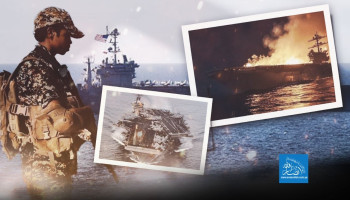
In this context, which is constantly renewed by leaders, experts, and specialists, one admission is followed by another, even greater one, culminating in the US Marine Corps Association's release of an analytical opinion. The lengthy analysis on the Marine Corps Association website elaborates with astonishment on the Yemeni naval operations and the lessons learned from the recent confrontation, which they termed "unexpected operational lessons" that drew the US Navy into an unconventional conflict and inflicted untold losses.
The analysis points—with admiration—to the Yemenis' use of unprecedented tactics and new methods that forced the US Navy into an asymmetric war. It explains how the Yemeni operations—lacking major strategic assets—succeeded in pushing the US military into a secondary scene.
The Marine Corps Association elaborates on the lessons of the naval confrontation with the Yemenis, highlighting the significance and uniqueness of what transpired and establishing it as a turning point in the history of naval warfare. "The Yemenis, operating with modest means and simplicity, achieved strategic results," the report asserts, urging those concerned to move beyond mere admiration to ideological reflection that leads to change.
What surprises the US Navy, according to the analysis, is not that the Yemenis used low-cost means, but that they transformed these means into strategic tools. While US destroyers were launching $4 million worth of missiles to intercept a $10,000 drone—a clear disparity in terms of both finance and military capabilities—the Yemenis presented a war philosophy based on "more for less," ironically the very motto the US Marine Corps has championed for decades.
What worries US military planners most is not just the effectiveness of the Yemeni means, but their adaptability and survivability. The Yemenis, the report states, rely on "simplicity, mobility, and rapid disappearance after each launch"—principles that may seem rudimentary but are effective in a conflict zone. In this context, the report acknowledges that "operational innovation does not require massive resources, but rather a flexible and unconventional mindset."
Amidst the ongoing acknowledgments from Western circles, experts, and specialists, one recognition barely ends before another, even more significant one begins. Following the publications of Globes and Task & Purpose, the U.S. Marine Corps Association asserted that the Yemenis “provided unexpected operational lessons” and “engaged the U.S. Navy in an unconventional confrontation, inflicting untold losses.”
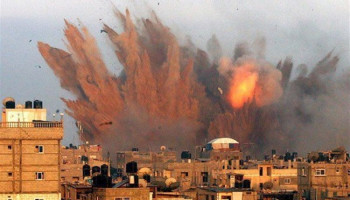
While the U.S. deployed aircraft carriers and B-2 stealth bombers to strike targets in Yemen, the Yemenis forced them to resort to “evading enemy detection,” as identifying the source of the attack became “much more difficult.”
“The Yemenis provided unexpected operational lessons and, without naval vessels or air power, were able to challenge the U.S. Navy, imposing billions of dollars in costs.”
The association added that “the Yemenis demonstrated the effectiveness of low-cost tools during attacks on ships,” noting that “the United States failed to target Houthi launch sites despite advanced ISR capabilities.”
The association emphasized that “the multiple Yemeni threats are forcing U.S. destroyers to use extremely expensive precision munitions,” and that “U.S. destroyers are firing $4 million worth of missiles to intercept a drone that costs $10,000.” The association also quoted the Marines as saying, “MLR forces should learn from the Yemenis’ ability to operate in contested environments with low-cost means,” adding, “The Yemenis represent an unexpected source of tactical insights, and the Marine Corps should study their effective tactics and adapt them to a doctrine capable of confronting superpowers.”
The American analysis concludes its astonished account with a question directed at the military establishment and decision-makers: “The lessons the Yemenis have demonstrated are now available, but do we have the humility to learn them?” the Marine captain asks, advocating in his article for the application of the Yemeni experience.
Globes Reveals the Failure of "Prosperity Guardian" and Admitting Yemeni Naval Capabilities
The Israeli newspaper Globes published a lengthy report quoting a retired US admiral who stated unequivocally: "The Houthis have conducted naval operations that the United States and other countries have found difficult to counter." The admiral added, "In Israel, you have succeeded in intercepting missiles from various directions, including Yemen, which is a positive thing, but the Yemenis have demonstrated capabilities that many did not anticipate."
Globes explained that the Biden administration established the "Prosperity Guardian" coalition in December 2013, with the participation of Britain and France, with the aim of securing maritime navigation in the Red Sea, but it "suffered a resounding failure." Last May, President Donald Trump was forced to announce a ceasefire with the Yemenis, brokered by Oman.
The newspaper quoted the American expert as saying that “the attacks carried out by Israel and the United States were completely disproportionate in terms of cost,” citing the downing of 14 American MQ-9 Reaper drones by the Yemenis, each costing approximately $30 million.
Globes quoted the former US Navy commander as saying that two key lessons should be learned: first, the Yemenis’ naval capabilities should not be underestimated, and second, “the threats will not be limited to missile and drone attacks, but will extend to new technologies above and below the sea.” He warned that “countries that rely on maritime trade are required to invest in systems capable of defending against threats of the type possessed by the Yemenis. This threat will not disappear; rather, it will evolve thanks to what the Yemenis have learned.”
Task & Purpose: Yemeni Defenses Are Stronger Than We Imagined
The US-based military affairs website Task & Purpose, in a report published on November 14, 2025, quoted retired US Air Force Colonel Mark Jonesinger, a former B-52 test pilot and director of future concepts at the Mitchell Institute for Aerospace Studies, acknowledging that “operations in Yemen have revealed more advanced Yemeni air defenses than anticipated, making attacks by non-stealth aircraft more dangerous.”
Jonzinger stated in the analysis published by the website: “Because the B-2 is a stealth aircraft, it is capable of striking targets within heavily protected airspace.” He added, “Everyone can see the aircraft carrier in the Red Sea, but identifying an attack coming from a Whiteman or a Minuteman is much more difficult,” emphasizing that the B-2’s long range gives the US military the ability to “evade enemy detection.”
The American website explained that this assessment came after the US Department of Defense released three photos of a squadron of B-2 Spirit bombers taking off on April 19 from Diego Garcia Air Force Base to carry out Operation Rough Rider, a three-month operation that included more than a thousand airstrikes in Yemen. Jonesinger said, "We have B-2s capable of carrying enhanced weapons to strike hardened and deeply buried targets."
#The_Zionist_enemy #The_American_British_aggression_against_Yemen
#US_is_the_mother_of_terrorism
#Al_Aqsa_flood