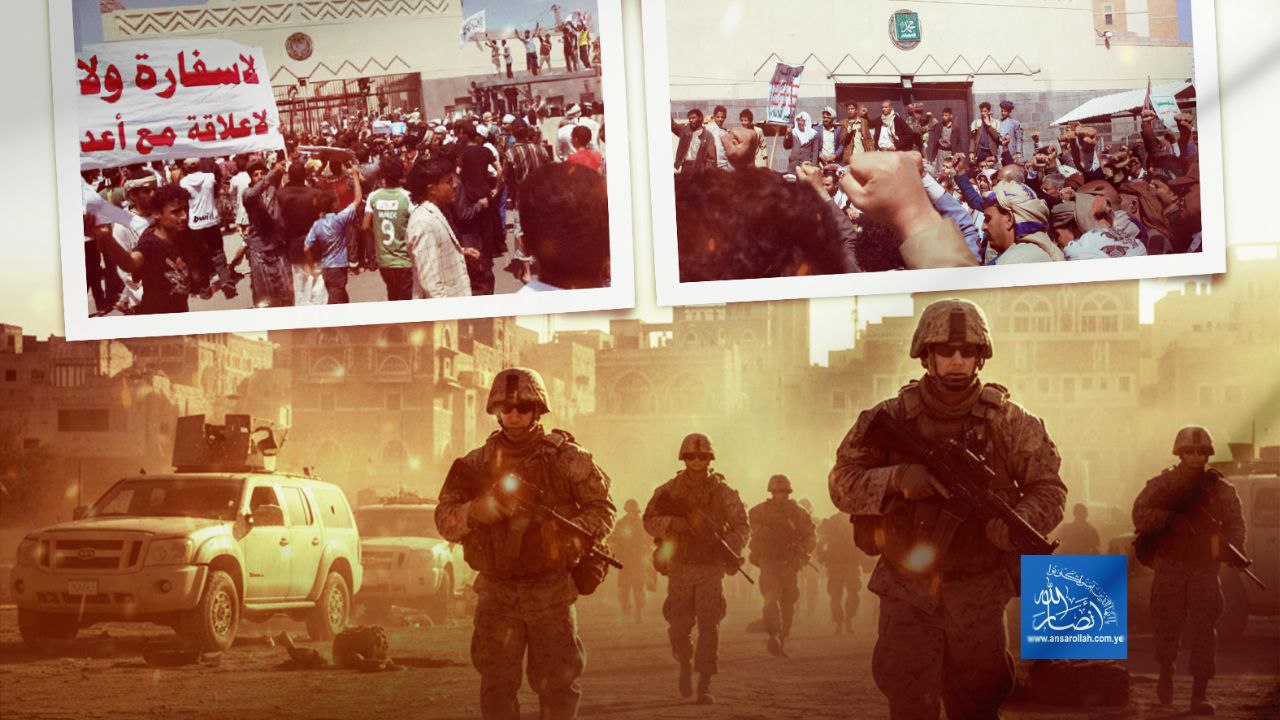
On February 11, 2015, the scene at Sana’a International Airport marked a historic turning point, reshaping Yemen’s political landscape and American influence in the country. On that day, U.S. Marines departed the Yemeni capital in haste, leaving behind damaged equipment, burned documents, and an embassy reduced to ashes—an explicit signal of the end of a phase of direct dominance over Yemen’s political decision-making.
For years, the U.S. Embassy in the Sawaan district of Sana’a had functioned as a center of gravity that exceeded diplomatic norms. Rather than serving solely as a venue for bilateral relations, it operated as a command room for managing political, security, and economic files. The U.S. ambassador became an influential figure in the country’s internal affairs—building relationships with tribal and political forces, supporting some parties against others, and intervening in sensitive state matters.
The heavy deployment of Marines around the embassy, its fortification with armored vehicles, and its transformation into military barracks conveyed a clear message that the American presence was not symbolic. U.S. aircraft carried out strikes inside Yemeni territory while official objections were absent, and operations were justified under various titles. Meanwhile, voices calling for sovereignty and an end to foreign intervention were marginalized.
February 11, 2015, overturned that equation. U.S. personnel burned documents, destroyed devices and servers, and submitted to inspections before departure—an unusual scene for a power accustomed to leaving through gates of victory rather than exits of confusion. That day was seen as the culmination of a trajectory that began with the September 21, 2014 revolution, when calls for liberation transformed into political action that ended the direct guardianship over decision-making in Sana’a.
From the Liberation of the Capital to the Battles at Sea
The departure of the Marines marked the beginning of an escalating path that reshaped Yemen’s regional position. In the following years, major transformations unfolded. After Washington had managed complex security files—including the use of the Al-Qaeda file and the construction of data networks linked to state institutions—it found itself outside the direct scene, attempting to restore influence through regional tools and multiple alliances.
The military campaign that began in March 2015 was a reaction to the loss of direct influence and an attempt to reproduce guardianship through regional fronts. However, the course of the confrontation revealed a gradual shift in the balance of power. Over a full decade of war and blockade, Yemeni military capabilities developed significantly, moving from defending the capital to imposing deterrence equations in the Red Sea, the Arabian Sea, and the Bab al-Mandab Strait.
In recent years, amid escalating regional tensions, Yemen has emerged as an influential actor in the Red Sea equation. Western reports have pointed to the high financial costs incurred by the United States in its naval operations and to unprecedented challenges faced by its forces against evolving Yemeni missile, aerial, and naval capabilities. The long-standing image of a sea under unilateral dominance began to fracture, along with the erosion of traditional deterrence prestige.
Between 2015 and 2026, a different narrative took shape—from a hurried departure at Sana’a airport to repeated withdrawals of major naval forces from Bab al-Mandab. Alliances announced under various labels—regional, European, or joint—encountered a complex field reality, while Yemen continued to position itself not as a marginal security file but as a force imposing new equations.
The Cost of Hegemony and the Defeat of Its Tools
The pre-2015 period was not limited to political and security influence; dependency extended to nearly all state institutions, including the economy. Development projects stalled, productive sectors weakened, strategic institutions were pushed toward privatization, and plans to expand the cultivation of essential crops such as wheat declined—despite Yemen’s broad agricultural, mineral, and maritime resources. The state followed a path that tied its economic decision-making to external networks, leaving its capabilities subject to recommendations and conditions.
In the security sphere, multiple tools were employed—from drone strikes targeting Yemeni areas to the establishment of extensive information networks. With the Marines’ departure and the embassy’s closure, the fragility of that structure became apparent, especially in light of previous acknowledgments of intelligence offices operating within the diplomatic mission. Suddenly, Washington found itself without a cohesive field intelligence network—a difficulty later referenced by American officials when explaining subsequent operational challenges.
Experiences from recent history—from Vietnam to Iraq and Afghanistan—continued to shadow the image of American power. In Yemen, another chapter was added to that series, one that underscored that military superiority is insufficient when confronted with a society that views sovereignty as an existential cause.
A Decade of Transformations and Consolidated Sovereignty
Eleven years after that day, February 11, 2015 is no longer merely a memory of withdrawal but a marker of a new political phase in Yemeni consciousness—associated with ending guardianship and establishing independent national decision-making. In a broader strategic reading, it stands as a milestone revealing the limits of hegemony when faced with a liberation project grounded in a solid social base.
From the burning of documents in the U.S. embassy to the echoes of naval confrontations in the Red Sea, a single line can be traced—a trajectory moving from reclaiming internal decision-making to influencing the regional sphere. Assessments may differ regarding the magnitude and outcomes of this transformation, but what appears constant is that Yemen is no longer simply an arena for hegemonic powers.
The experience of the past decade suggests that when people redefine themselves outside the equation of guardianship, they can alter the rules of the game, no matter how imbalanced the power equation may seem. In this context, February 11, 2015 remains a defining date: the day U.S. Marines left Sana’a, and Yemen entered a new phase defined by sovereignty—one whose equation asserts that when willpower takes root, geography itself becomes resistant to defeat.