
Ansarollah Website Official Report
Military confrontations and Iranian operations against what is described as the American–Israeli enemy are escalating at a noticeable pace.
Whenever the aggressors attempt to pressure Iran by targeting economic and sensitive facilities, the Islamic Revolutionary Guard Corps and the Iranian army carry out military operations that overturn the aggressors’ calculations.
On Saturday, the Atomic Energy Organization of Iran announced that the Israeli enemy and the United States had launched a new attack on the Natanz Nuclear Facility, a major uranium enrichment complex.
However, due to precautionary measures, pre-planned safeguards, and data recorded by monitoring systems, no leakage of radioactive materials was reported at the site, and there is no danger to residents in the surrounding areas.
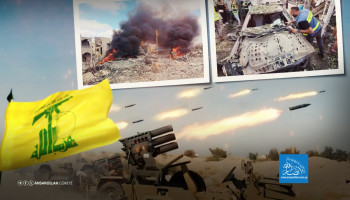
Iran responded swiftly by carrying out what the text describes as punitive and escalatory operations. The Islamic Revolutionary Guard Corps launched a wave of intense missile strikes targeting strategic locations inside the occupied Palestinian territories, extending to a remote U.S.–British military base in the Indian Ocean, as well as American bases across the region.
The attacks reportedly resulted in dozens of casualties and the destruction of entire residential neighborhoods.
According to the narrative presented, the latest Iranian operations were not merely a military response but also carried clear strategic messages reflected in the diversity of targets and the vast distances involved.
Just hours after the Iranian atomic agency announced that the attack on the Natanz complex had been thwarted thanks to precautionary measures and that no radiation leak had occurred, missiles launched by the Revolutionary Guard struck targets across three geographically separate theaters.
The First Strike: Targeting Israel’s Strategic Depth
The strikes were concentrated on the areas of Dimona and Arad in the Negev Desert. Dimona carries particular significance as it hosts Israel’s undeclared nuclear reactor at the Negev Nuclear Research Center, making its targeting a direct message in response to the attack on Natanz Nuclear Facility in Iran.
Meanwhile, Arad became the scene of a more devastating strike, where a missile hit a residential complex, causing heavy human losses.
According to Hebrew media reports, the number of injuries in Dimona exceeded 51 wounded, while the toll in Arad reached at least eight fatalities and around 100 injured. The Israeli side acknowledged that its air defense systems failed to intercept the missiles heading toward the two cities.
Following the attacks, the authorities in Israel declared a state of emergency and suspended school activities in the affected areas—an indication of the scale of the breach in its defensive systems.
The Second Strike: Extending the Range of Deterrence
The attacks were not confined to the occupied territories but extended far beyond them, reaching the U.S.–British military base at Naval Support Facility Diego Garcia on Diego Garcia in the Indian Ocean—roughly 4,000 kilometers from the shores of Iran.
Western intelligence reports indicated that Iran employed an intercontinental ballistic missile (ICBM) in carrying out the strike.
Strategically, the attack carries a deeper significance: it moves beyond the notion of a direct retaliatory response to deliver a message to United States that the “safe havens” it relies upon to manage its distant military operations are no longer beyond the reach of Iranian retaliation.
A Diverse Arsenal and New Tactics
The operations revealed a qualitative evolution in Iran’s missile arsenal in terms of both diversity and operational tactics. In addition to the intercontinental ballistic missile reportedly used to strike Naval Support Facility Diego Garcia, Iran deployed a combination of medium-range ballistic missiles such as Khorramshahr missile and Emad missile, alongside precision-guided cruise missiles of the Paveh cruise missile type, as well as swarms of loitering munitions from the Shahed drone series.
This mix reflects what analysts describe as Tehran’s adoption of a “saturation” tactic, designed to overwhelm and confuse advanced air defense systems.
The approach aims to flood defensive networks with multiple threats simultaneously—an operational strategy that has demonstrated effectiveness in achieving breakthroughs against layered air defenses.
A Shift in the Doctrine of Confrontation: From Defense to Offense
The developments on the battlefield were not the only indicator of changing rules of engagement. They were accompanied by a new Iranian discourse suggesting that the country’s armed forces are moving from a defensive doctrine toward a more offensive posture.
In a statement, Major General Ali Abdollahi, commander of the central headquarters of Khatam al-Anbiya Central Headquarters, announced that the armed forces would employ new advanced weapons capable of overturning the enemy’s calculations.
This approach was echoed by the Speaker of the Islamic Consultative Assembly, Mohammad Bagher Ghalibaf, who described the Israeli failure to intercept missiles over Dimona—despite its heavy fortification—as evidence that “the skies of the Zionist entity have become exposed and defenseless.”
He added that the time had come to implement additional plans that had been prepared in advance.
On the Brink of a New Phase
The ongoing escalation appears to carry the hallmarks of a structural shift in the nature of the conflict. Between strikes targeting sensitive nuclear-related sites and others reaching military bases as far away as the Indian Ocean, and amid diverging narratives and political rhetoric, a new reality is taking shape: the deterrence balance that prevailed for decades is now being tested—perhaps even overturned.
Iran’s move to showcase its long-range missile capabilities while diversifying its offensive tactics, coupled with acknowledgments by its adversaries of significant defensive gaps, places the region at a critical crossroads.
The emerging equation suggests that any attack on Iranian infrastructure will no longer be met with a confined or symbolic response. Instead, retaliation could extend far beyond the boundaries of the occupied territories, targeting far more sensitive nodes within the strategic architecture of Iran’s adversaries.
In Conclusion
In the emerging picture, Iran’s latest operations were not merely another episode in a cycle of reciprocal responses. Rather, they carried the hallmarks of a strategic shift that could redefine the rules of engagement across the region.
Iran appears to be moving beyond traditional deterrence toward consolidating a new equation—one in which the capability to deliver precise, simultaneous long-range strikes against targets once considered “untouchable” becomes the primary language of deterrence in the coming phase.
What the attacks on the nuclear-linked site in Dimona and the distant U.S.–British military facility at Diego Garcia signal is that Tehran has effectively pushed the confrontation beyond the conventional geographic boundaries of the conflict, declaring that the lines of engagement are now open to multiple possibilities.
At the same time, the strikes have exposed what analysts describe as an unprecedented fragility in the defensive systems of its adversaries—placing both Tel Aviv and Washington before a difficult test: either adapt to a new set of rules of engagement or risk entering a spiral of escalation that could prove far more costly than anticipated.
Ultimately, the region appears to have entered a phase in which the arenas of confrontation are expanding while the notion of “safe havens” is steadily shrinking.
Military responses are no longer confined to symmetrical retaliation but are increasingly shaped by a new logic that links strikes and counterstrikes across widely separated theaters.
The question that now remains open is whether this emerging equation will succeed in establishing a form of mutual deterrence—or whether it is merely the prelude to a broader and far more complex escalation.