
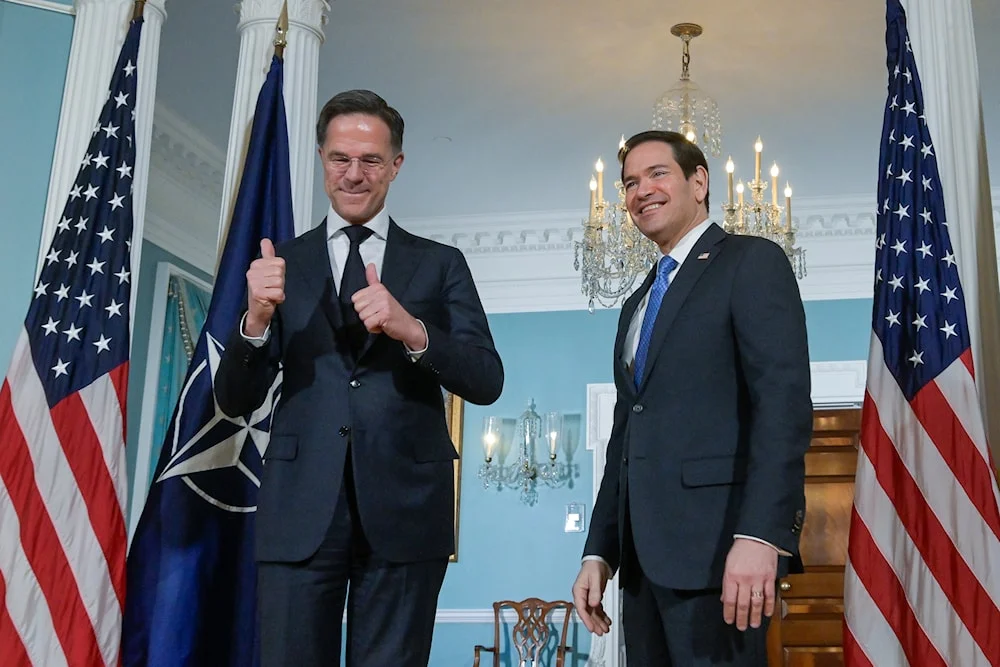
NATO Secretary General Mark Rutte said that United States President Donald Trump was “clearly disappointed” by the refusal of Washington’s allies to participate in the US-led war on Iran, following a closed-door meeting between the two in Washington on Wednesday.
Speaking to CNN after the meeting, Rutte described the discussions as “very frank, very open” between “two good friends”, while declining to confirm whether Trump raised his repeated threat to withdraw from NATO over the dispute.
“He clearly told me what he thought of what happened over the last couple of weeks,” Rutte said, adding that the situation presents a “nuanced picture.”
Tensions rise after Iran war fallout
The meeting came less than a day after Washington and Tehran agreed to a two-week ceasefire that includes reopening the Strait of Hormuz and an end to hostilities in Lebanon, following weeks of US-Israeli aggression. However, the ceasefire is fragile and a key clause, a ceasefire in Lebanon, has been breached, with Washington claiming it was never part of the agreement.
Trump had previously threatened to bomb Iran’s civilian infrastructure, warning that a “whole civilization will die” if Tehran did not comply with US demands regarding Hormuz.
The US president sharply criticized NATO allies for declining to support military operations aimed at reopening the strait, describing the alliance as a “paper tiger” and suggesting Washington could reconsider its membership.
In a post published after the meeting, Trump wrote, “NATO WASN’T THERE WHEN WE NEEDED THEM, AND THEY WON’T BE THERE IF WE NEED THEM AGAIN.”
White House signals NATO withdrawal discussions
White House Press Secretary Karoline Leavitt confirmed earlier on Wednesday that Trump had discussed the possibility of leaving NATO, saying the issue would be raised during his meeting with Rutte.
Trump has repeatedly criticized the alliance, arguing that it fails to equitably share defense burdens. During his first term, he also suggested he had the authority to withdraw unilaterally, although US law passed in 2023 requires congressional approval for any such move.
Allies reject direct military involvement
Several NATO members declined to participate in US military attacks against Iran, with countries such as France and Spain restricting or forbidding the use of their airspace and military facilities for the campaign. Despite this, some allies have signaled willingness to contribute to a post-conflict international effort in the Strait of Hormuz.
UK Prime Minister Keir Starmer is expected to travel to the Gulf in support of the ceasefire, as London works on a broader security plan for the waterway.
Republican voices defend alliance
The NATO alliance, comprising 32 member states, is built on a mutual defense clause under which an attack on one member is considered an attack on all. The clause has only been invoked once, following the September 11 attacks.
US Senator Mitch McConnell voiced support for NATO, emphasizing its role in supporting the United States after the September 11 attacks.
“Following the September 11 attacks, NATO allies sent their young servicemembers to fight and die alongside America’s own,” McConnell said, urging the administration to remain “clear and consistent” in its approach and warning against deepening divisions with allied states.
Meanwhile, US Secretary of State Marco Rubio met separately with Rutte, with discussions covering the war on Iran, the Russia-Ukraine war, and coordination within NATO.
Source:Websites


