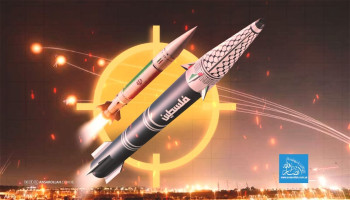

Contrary to the wishes of the axis of evil, which targeted Yemen to destroy any chance of its resurgence, history has recorded its emergence as a powerful force with a dynamic impact on the regional and international levels.
The signs of this sudden shift became apparent on October 31, 2023, when the Yemeni Armed Forces announced the launch of the first phase of support operations for the Gaza Strip against the Israeli entity. This involved a military operation that included launching ballistic and cruise missiles and drones at targets in Umm al-Rashrash, south of occupied Palestine. Days earlier, the Israeli enemy had been acting with unprecedented aggression, demonstrating its clear intention to exterminate the Palestinian people in the Gaza Strip and depopulate it of all life.
At that time, the world, as usual, confirmed the hypocrisy it lives in, between the slogans it proclaims and the positions it takes regarding the egregious violations perpetrated by the Israeli enemy against all values, norms, and the human rights of the Palestinian people, who seek to live in peace on their land.
What necessitated serious practical action against the enemy?
Massacres multiplied in just a few days, and the Gaza Strip began to witness all kinds of crimes against women, children, and civilians. The American-Israeli killing machine claimed the lives of tens of thousands of Palestinians, in addition to causing injuries and displacement, destroying infrastructure and all means of livelihood, burning farms, and killing livestock. Meanwhile, the world witnessed horrific forms of criminality, such as cold-blooded murder, the sniping of children, the targeting of hospitals, and the cutting off of electricity and the prevention of access to water, food, and medicine. This escalation of diabolical crimes hastened Yemen's move to restrain and punish the enemy.
The Palestinian cause and the suffering of the Palestinian people due to the practices of the Zionists—who are morally and humanly depraved, and whose psyches are crushed by feelings of inferiority and inadequacy, considering themselves illegitimate beings established to create their own entity, with no belonging to any land and no honorable history, unlike all other peoples of the world—all of this remained present in the consciousness of the Yemeni people.
For this reason, Yemen’s view of the Israeli enemy, even before the war of extermination it launched on Gaza, remained that of a cancerous tumor in need of excision. Rather, the aggression came as confirmation of what the leader, Abdul-Malik Badr al-Din al-Houthi, repeatedly emphasized, and before him, the martyr of the Qur’an, Sayyed Hussein Badr al-Din al-Houthi, may Allah be pleased with him, that this enemy sees the extermination of the entire human race as a goal for world domination and control over the destinies of peoples, which necessitates a serious practical move to save humanity from this scourge. For this reason, the Yemeni move came in proportion to the danger that the Israeli enemy represents, and what it practices in violating the lives of the Palestinians.
The prominent shift in the course of Yemeni power
The first indication of the support operations was the reaffirmation of the principle of confronting the forces of tyranny—the US and "Israel—as a liberation project concerning the entire nation. The second indication was the expansion of the confrontation beyond Yemen's southern borders to the northern reaches of the Arabian Peninsula, where the Israeli enemy occupies land and inflicts severe suffering upon the Palestinian and Lebanese peoples.
The operations unfolded in five phases, dictated by the evolving confrontation and the enemy's escalation. These five phases followed an escalating trajectory that surprised the world, from the operations of the first phase to the fifth phase, which targeted what is called "Tel Aviv" with "Yafa" drone on July 19, 2024—an unprecedented event against "Israel", a thunderbolt that struck the entity.
An Israeli settler was killed in the operation, and the Hebrew newspaper Calcalist stated at the time, "Every patent that the Jewish mind managed to invent and the Jewish pocket managed to purchase was breached by a Yemeni drone in a clever operation." The operations continued, targeting all the cities of the Zionist entity and its most vital and strategic institutions.
The enemy's capital was also targeted with the hypersonic ballistic missile "Palestine 2," which traveled approximately 2,000 kilometers in 11.5 minutes, bypassing multiple layers of air defense systems, including "David's Sling," "Arrow 2," "Arrow 3," "Arrow," and the American THAAD system.
With this operation, the Yemeni Armed Forces achieved a new and significant milestone in Yemen's military capabilities. A military spokesperson stated that the operation was carried out using a new hypersonic ballistic missile that successfully reached its target. Enemy defenses failed to intercept or counter it. The missile traveled an estimated 2,040 kilometers in 11.5 minutes, causing widespread fear and panic among Israelis, with more than two million Israelis taking shelter – a first in the history of the Israeli enemy.
The missile reached a speed of Mach 13, equivalent to 15,000 kilometers per hour. According to military experts, this is an overwhelming speed that no defense system, equipment, or technology can intercept or match. The missile delivered a decisive message, demonstrating the significant advancement of Yemeni weaponry and exposing the enemy's defensive capabilities. Following the unveiling of the "Palestine 2" missile, Yemen joined the ranks of the very few countries possessing this type of missile. Experts say that these hypersonic missiles pose a significant challenge to air defense systems because they can evade radar by flying at shorter wavelengths and shifting towards lower radar bands, in addition to their unpredictable trajectories. Therefore, there are currently no air defense systems capable of intercepting these missiles.
Yemeni Missiles with Cluster Warheads
Hundreds of missiles were launched by Yemen in its support operations, reaching deep into the heart of the Zionist entity. These included ballistic and cruise missiles, hypersonic missiles, cluster missiles with multiple warheads, and long-range drones.
These Yemeni missiles and drones shattered the aura of deterrence surrounding "Israel"'s supposed military might. Observers explained that the Yemeni missiles' advanced capabilities, equipped with cluster warheads and projectiles, make interception extremely complex and transform each missile into a multi-stage missile platform, thus depriving the Israeli enemy of the ability to effectively counter these threats.
In addition to the closure of Umm al-Rashrash port caused by the Yemeni attacks, Yemeni weaponry has frequently targeted vital military and civilian sites within the Zionist entity, most notably Nevatim Airbase and Ben Gurion Airport (formerly Lod Airport). News fact-checking centers have documented more than 40 instances of international flight disruptions at the airport, following the suspension of flights by dozens of airlines to the enemy entity after its airspace was closed due to missile strikes by the armed forces. This occurred during the first half of last year alone.
Furthermore, the attacks disrupted train services and damaged more than 300 meters of the power grid, reflecting the success of the strikes in achieving their field and logistical objectives. The American war website "The War Zone" stated that Yemeni forces possess "an air defense and drone arsenal that poses a real threat, as evidenced by the increasing number of downings of American MQ-9 Reaper drones."
Stages of the Siege to Strangulation
The imposition of a naval blockade on the Zionist entity in the second phase of the escalation represented one of the most significant achievements of the Yemeni Armed Forces in the "Promised Victory and Holy Jihad" battle. This was an act the world had come to expect only the United States would impose, but Yemen broke this monopoly, albeit on a humanitarian level, by imposing a ban on the passage of ships bound for the ports of occupied Palestine.
This was followed by the direct targeting of ships owned or operated by Israeli companies, before expanding the scope of operations in the third phase of escalation to include all ships linked to the United States and Britain. This was in response to Western military intervention and the formation of alliances to neutralize the Yemeni front in order to protect the Zionist entity.
The repercussions for the enemy intensified, and the situation at the port of Umm al-Rashrash began to deteriorate, supply chains were disrupted, and the port was eventually closed completely.
The American “tension” was of no use with the Yemeni insistence on imposing a blockade on the movement of the Israeli enemy’s shipping in the Red Sea until the aggression against Gaza was stopped and the blockade was lifted. The military operations and multi-ethnic and multi-capable alliances against Yemen did not achieve any breakthrough in the blockade, even to the point of closing the port of Umm al-Rashrash and declaring it bankrupt.
Ships Burn and others Sink
In compliance with the Yemeni decision to ban enemy navigation, the armed forces carried out dozens of operations targeting ships belonging to the "axis of evil"—the US, Britain, and "Israel"—and all ships attempting to break the blockade. This constituted a terrifying event that created a global economic crisis and drew attention to the suffering of Palestinians in Gaza. The situation in the Red Sea then escalated further with the sinking of several ships violating the ban.
Among the most prominent ships targeted in 2024 was the British vessel "Marlin Luanda," which was struck by several missiles in the Gulf of Aden, resulting in the ship catching fire. This was followed by the sinking of the British ship "Rubemar" after it was targeted by several naval missiles in the Gulf of Aden. The British ship "Islander" was also struck by several naval missiles in the Gulf of Aden, causing a fire on board.
Likewise, the storming and bombing of the Greek oil tanker (Sunion) on August 29, 2024, after it violated Yemen’s decision to prevent ships from passing to the ports of occupied Palestine.
In June of last year, the director of Umm al-Rashrash port, Gideon Golber, stated, "There are no solutions for reopening the port, and given the weakness of the coalition forces in the Red Sea, we are prepared to pay a ransom to the Houthis for passage through Bab al-Mandab."
The Yemeni success in imposing the blockade was a natural consequence of the series of successes achieved by the armed forces in the theater of operations stretching from the Mediterranean Sea in the north, through the Red and Arabian Seas, to the Indian Ocean in the south.