Ansarollah Website Official Report
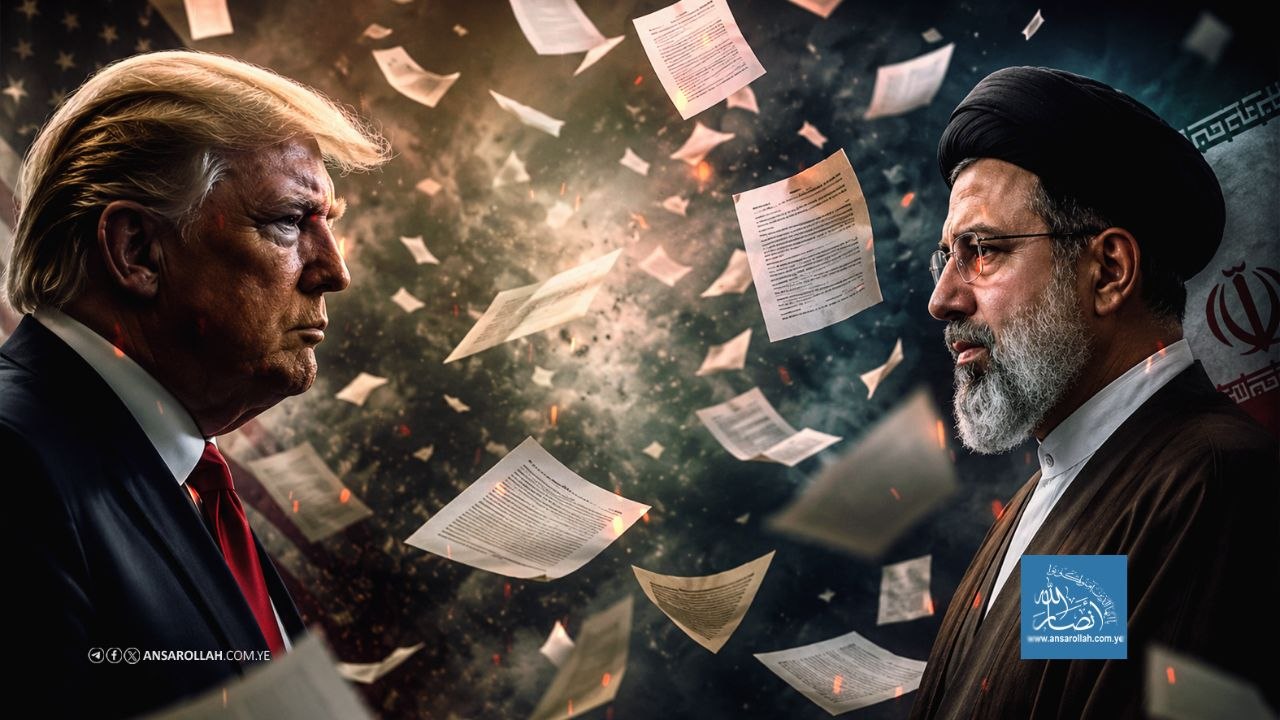
No one expects the American entity to meet the standards of normal states that abide by the law and honor their commitments and obligations. Trump’s latest childish outburst is therefore entirely consistent with this approach to conducting diplomacy and managing foreign relations.
Through his conduct, Trump continues to project the image of the victory he had hoped for but failed to achieve—or, at the very least, of emerging from the aggression against the Islamic Republic without suffering losses.
As signs of failure close in on him from every direction, and with the Strait of Hormuz standing as the clearest testament to America's retreat, and further evidence that the country has in fact been on a path of decline for more than a decade.
It was only natural for him to surprise the world with inflammatory posts and combative statements that push the already fragile atmosphere of de-escalation back toward confrontation, even though he knows better than anyone that such moves amount to nothing more than rowing against the current.
The Obsession with Restoring Prestige
A growing conviction continues to take hold within U.S. decision-making circles that the Memorandum of Understanding and the diplomatic track projected the United States as being in a weaker position—less capable of imposing its terms and dictating its will as the world's dominant superpower.
This perception has come to shape the outlook of the White House hawks, driven by ill intent and an overriding desire to reshape the strategic landscape in a way that allows Washington to salvage an acceptable measure of face before those who still believe in its absolute ability to steer events and dictate their course.
A broad and influential current within the Trump administration argues that previous agreements and understandings constrained the United States' hard-power instruments, directly undermining Washington's international prestige.
Trump's suspension of the Memorandum of Understanding is therefore seen as an attempt to restore deterrence and reclaim that lost prestige, driven by the pragmatic mindset embedded in the traditional American approach—one that has repeatedly shown little hesitation in walking away from international commitments and breaching agreements and treaties whenever administrations change or interests shift, in keeping with the 'America First' doctrine, which seeks to preserve the absolute primacy of U.S. policy regardless of the legal continuity of international accords.
By contrast, critics and international analysts contend that this rush to project strength and repudiate commitments, driven by calculations of prestige and domestic political considerations, only deepens the global crisis of confidence in U.S. guarantees.
It also erodes the legal framework ostensibly relied upon to contain the conflict, pushing the entire region toward a direct and open military confrontation with no viable political mechanisms for managing the crisis, while the United States defies the established rules of engagement.
The Master Who Taught Them the Craft of Killing and 'Theft'
Iranian officials have repeatedly declared—with resolve and unwavering confidence, backed by the Axis of Resistance—that the situation today is no longer what it once was; that the Strait of Hormuz will henceforth be governed solely in accordance with the vision of the Islamic Republic and in a manner that serves the interests of the region's states; and that neither the United States nor the Zionist entity has any say over how it is managed. That position has provoked American arrogance, which views it as an act of defiance against its expected obedience.
For that reason, the White House hawks do not rule out launching a second—or even a third—act of aggression in an effort to restore what they see as lost prestige on the shores of the Strait of Hormuz. The gang that built its power on killing, repression, and the plunder of other peoples' rights for more than two centuries—and turned those practices into a doctrine for imposing its hegemony on the world—now appears to be the weakest link among the world's outlaw forces.
This is a position the United States refuses to accept after long portraying itself as the leader, the one who taught others the craft of evil, extinguished the last traces of human conscience, and elevated 'theft' above the rights and security of nations.
Confronting American Recklessness
Trump's threats to return to war are nothing new, nor is Iran's position. What is new, however, is the Islamic Republic's decision to escalate its response this time, with the stated aim of disciplining the arrogant United States should it repeat its aggression, and deterring it from continuing to fuel conflicts and threaten the security of the region's peoples.
Against this backdrop, Iran's warnings cast a shadow over the future of U.S. military bases across the Gulf. Observers believe the consequences could be far-reaching, carrying strategic implications that extend well beyond the immediate parties to the conflict.
Their military and economic impact would not be confined to the direct belligerents but could instead reshape the region's geopolitical landscape in ways that impose heavy costs on the United States and undermine the stability of the global order as a whole.
In the face of what it describes as Trump's recklessness—and rhetoric that, in its view, falls far short of the conduct expected of a responsible and civilized state—Iran's official and popular response has grown markedly more resolute.
The country's political and military leadership has declared that Iran will not, under any circumstances, tolerate any violation of its national sovereignty or infringement of its territorial boundaries, affirming its full readiness to defend its people and national capabilities against what it calls "American bullying and threats."
Iran's position is presented not merely as a matter of national dignity, but also as a reflection of its conviction that yielding to Washington at this stage would hand Trump a green light to impose terms amounting to unconditional surrender.
From this perspective, safeguarding sovereignty and defending the nation constitute both a matter of principle and a clear message to domestic and international audiences alike: any future U.S. military adventure will be met with a direct and severe response that goes beyond the traditional rules of engagement, turning any attack on Iranian territory into a cost too high for either the U.S. administration or its regional allies to bear, while further reinforcing Tehran's posture of defiance and resilience in the face of maximum pressure.
The Non-Negotiable Card
Against the backdrop of rapidly unfolding developments surrounding the security of the Strait of Hormuz and the Gulf's vital international shipping lanes, a complex equation is taking shape on the ground, pitting Washington's determined drive to break free from what it sees as a position of weakness against Iran's unwavering insistence on safeguarding its sovereignty.
Within this equation, the Strait has emerged as a decisive strategic asset—one that is not open to compromise—serving as a sovereign symbol of the Islamic Republic.
Tehran has already translated this position into action through its closure of the Strait, the escalation of its naval operations, and the targeting of commercial vessels and oil tankers deemed to be in violation of its decisions.
These measures, it argues, are intended to protect its national security while establishing a new strategic equation: depriving Iran of its security and sovereignty will, by necessity, deprive everyone else of security along this vital economic artery.
The Consequences of American Conduct
On the political and diplomatic front, this shift—and the accompanying breach of previous understandings—has triggered a deep rift in international positions.
European allies, particularly France, Germany, and the United Kingdom, have voiced profound concern over the collapse of diplomatic channels, blaming what they described as Washington's failure to honor its commitments, and calling for immediate de-escalation to prevent the region from sliding into a devastating regional war.
Meanwhile, Beijing and Moscow condemned the U.S. military strikes that followed Trump's announcement terminating the Memorandum of Understanding, describing them as a flagrant violation of Iran's national sovereignty.
Both reaffirmed Tehran's right to defend its borders while warning that Washington's unilateral conduct could have serious repercussions for international stability, as they seek to safeguard their extensive geopolitical and economic interests across the Middle East.
At the regional level, fears continue to mount over the prospect of the confrontation widening into a conflict engulfing the entire region, particularly in light of Iran's explicit warnings that it will target any source it considers responsible for threatening its security or launching attacks against its territory and people.
The Principle of "Distributed and Deep Defense"
In this context, Tehran has placed a strong emphasis on enhancing its ground and air defense capabilities to protect Iran's strategic depth. Air defense systems have been placed on alert, while early-warning networks have been activated to safeguard vital, oil, and nuclear facilities from any potential waves of U.S. bombardment.
Iran's defense doctrine is based on what is known as the principle of "distributed and deep defense." While underground, fortified facilities—known as "missile cities"—are being constructed to house ballistic missiles and unmanned aerial vehicles, command-and-control centers are dispersed in a manner designed to prevent their paralysis by swift preemptive strikes.
This approach strengthens the ability of the domestic front to withstand and absorb concentrated U.S. air attacks, while allowing retaliation to continue as an ongoing process unaffected by the destruction of above-ground facilities.
This internal fortification provides the Iranian leadership with greater political confidence to maintain its defiant rhetoric. It also reinforces among the Iranian public the belief that the confrontation with the United States and the Israeli entity is a battle to defend sovereignty and national existence against external aggression, contributing to greater internal cohesion and easing the impact of economic pressures resulting from the escalation.