
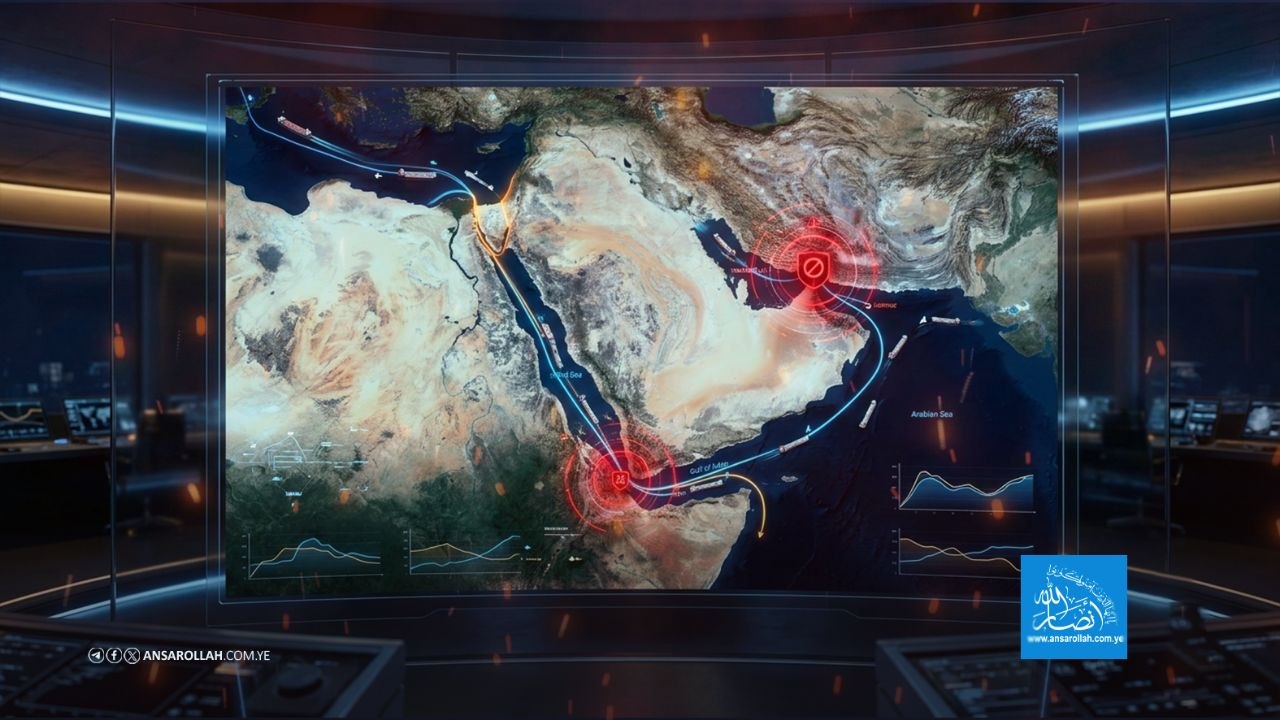
The regional landscape, amid what has become an increasingly aggressive campaign led by the United States and its allies, reveals how maritime geography has emerged as a source of political power and an influential instrument of pressure in shaping the course of the confrontation.
Within this equation, Iran and Yemen appear to have proven more capable of leveraging their geographic positions than Washington had anticipated, while the United States finds itself confronted with new realities that undermine its military and political calculations.
Taken together, these realities suggest that Washington’s long-standing narrative about the need to protect the region’s maritime routes may, in fact, have little to do with its own interests—either directly or indirectly.
The picture becomes even more sensitive when the Strait of Hormuz and the Bab el-Mandeb are viewed as integral components of a single strategic system.
The former serves as the gateway to the Gulf and the principal route through which a substantial share of the region’s oil and gas reaches global markets.
The latter, meanwhile, constitutes the southern gateway to the Red Sea and a vital maritime route for Saudi oil exports bound for Asian markets.
The Cost of Activating the Straits of Hormuz and Bab el-Mandeb
When pressure is exerted on both maritime chokepoints simultaneously, its consequences are no longer confined to Iran and Yemen, or to the Gulf and the Red Sea. Instead, the impact extends to energy, shipping, and insurance markets, as well as to countries that depend on oil supplies originating from the region.
This is where the significance of the Iranian and Yemeni cards comes into focus. Washington, having chosen aggression, siege, and military pressure against Iran, has found itself facing the Strait of Hormuz as a strategic arena through which Tehran can shift part of the cost of that aggression onto the heart of American interests.
At the same time, Yemen has found in the Bab el-Mandeb a direct pressure point against its Saudi adversary, aimed at compelling Riyadh to change its hostile policy toward the Yemeni people.
This makes the cost of maintaining the blockade and keeping Yemen’s airports and ports shut directly tied to Saudi oil and commercial interests—not merely to military calculations within Yemeni territory.
Washington’s Allies Pay the Price for Its Recklessness
In its attempt to expand its policy of containment with the aim of bringing down regimes that reject its policies, the United States bet on the assumption that a combination of military force, sanctions, and siege would compel Iran to submit, and that its overwhelming superiority would allow it to keep the confrontation under control.
What unfolded, however, pushed the conflict into an entirely different and unforeseen dimension, as Washington discovered that it was not confronting Iran on a single battlefield, but was instead being forced to reckon with the war’s impact on energy and global markets.
Before the war, nearly one-fifth of the world’s crude oil and liquefied natural gas shipments passed through the Strait of Hormuz, with Asian markets serving as the primary destination for much of the oil transiting the waterway.
This reality gives Iran a strategic lever that extends far beyond its direct confrontation with the United States, because disruptions to energy flows impose mounting costs on economies allied with Washington—and, in turn, raise the price those allies must pay for the war.
International Shipping Resumes—Except for Saudi Arabia
The second card is no less significant, although it is different in nature. Yemen does not need to target global shipping in order to turn the Bab el-Mandeb into a source of pressure with international repercussions.
What its armed forces are targeting is shipping linked to Saudi interests, above all the flow of oil through the Red Sea. This is the key to understanding the global impact of the Yemeni card: Yemen is targeting Saudi Arabia, but Saudi Arabia is not an ordinary oil-producing country whose export disruptions can be contained within its own borders.
It is one of the world’s leading oil producers and exporters. Consequently, disrupting the passage of its oil through the Bab el-Mandeb does not mean that Yemen has decided to close the sea to the world; rather, it means that a critical artery of Saudi oil exports has come under pressure.
Once that artery is disrupted, the repercussions spread to Asian buyers, shipping companies, insurers, oil prices, and ultimately the global market.
This is not merely a theoretical assessment. Reuters reported on August 19 that global shipping traffic through the Bab el-Mandeb had increased compared with previous levels, with the notable exception of Saudi oil shipments, which had yet to resume passage through the strait since Yemen’s armed forces announced a maritime blockade targeting Riyadh-bound shipping on July 20.
It is precisely here that the strength of the Yemeni card becomes apparent. If the issue involved commercial vessels merely transiting the waterway with no connection to Saudi Arabia, the impact could be portrayed as a limited shipping crisis.
But when the pressure is directed at Saudi oil exports, the equation changes. Disrupting those exports—or forcing Saudi tankers to reroute—means greater distances, longer transit times, and higher costs to reach Asian consumers, while leaving the volume of oil available on the market more vulnerable to disruption.
Energy Security Cannot Be Guaranteed by Military Force
From the Strait of Hormuz to the Bab el-Mandeb, a new equation is taking shape: maritime security cannot be separated from political security, and energy stability cannot be guaranteed through military force alone.
The more Washington escalates its aggression against Iran, the greater the value of Hormuz becomes as an Iranian deterrent.
Likewise, the longer Saudi Arabia persists in its intransigence, refusing to end its aggression against the Yemeni people and lift the blockade, the greater the value of the Bab el-Mandeb becomes as a Yemeni pressure point against Saudi interests—one capable of compelling Riyadh to meet the demands of the Yemeni people.
More importantly, the two cards are not isolated from one another. When Iran exerts pressure in Hormuz, one of the world’s most vital energy arteries is affected.
When Yemen applies pressure in the Bab el-Mandeb, a major route for Saudi oil exports comes under strain. In both cases, international markets become the arena in which the consequences of American recklessness and Saudi Arabia’s insistence on continuing its policy of slowly killing Yemenis are felt.
For this reason, Washington cannot treat each issue in isolation. It cannot wage war on Iran and expect the consequences to remain confined within Iranian territory, just as Saudi Arabia cannot continue its aggression against Yemen—maintaining the blockade and violating its sovereignty—while expecting the cost to remain confined to Yemen.
Washington at the Heart of the Dilemma
The United States has long based its aggressive policies on the assumption that its military and economic superiority gives it the ability to control the course of a confrontation and dictate the terms of any settlement.
Yet developments in the conflict with the Islamic Republic have demonstrated that possessing such an overwhelming array of instruments of power does not necessarily translate into the ability to determine the outcome.
The blockade, sanctions, and military pressure—tools Washington has routinely deployed against states and peoples—are now confronting countervailing instruments capable of shifting the cost of prolonging the confrontation into the very sphere the United States claims to be protecting: energy, maritime shipping, and trade.
And the longer the confrontation continues, the greater the importance of factors that aircraft carriers cannot resolve—such as oil prices, maritime security, insurance costs, supply chains, the positions taken by international companies, and the ability of Washington’s allies to withstand prolonged disruption.
This is where a paradox emerges, placing Washington in an increasingly difficult predicament. In seeking to use its military power to impose a new political equation on Iran, the United States has instead helped create another equation in which energy security itself has become part of the conflict.
Washington is consequently being confronted with growing demands to stem the international fallout caused by the rising cost of its regional gamble—costs increasingly borne by its allies and energy markets.
Yemen and Iran: Shifting to the Power to Impose Costs
The most significant outcome of the ongoing confrontation is the shift of Iran and Yemen from a position of absorbing pressure to one in which they are capable of imposing costs.
Iran no longer views the Strait of Hormuz merely as a maritime passage, but as part of a deterrence framework through which it can influence American and international calculations.
Yemen, for its part, no longer treats the Bab el-Mandeb as an international waterway detached from the aggression and blockade it is enduring; rather, it sees the strait as a strategic space through which pressure can be brought to bear on Saudi Arabia to bring the current situation to an end.
It is this shift that has disrupted American and Saudi calculations. Power is no longer confined to aircraft, missiles, and military bases; geography itself has become an instrument of confrontation.
This is where Yemen and Iran hold an advantage in the equation: they do not need to possess American military might to force Washington to take their capabilities into account.
They need only the ability to threaten critical nodes in the energy and maritime systems—and to keep that threat firmly embedded in the calculations of companies, governments, and markets.
Part of the Deterrence Equation
The future of the confrontation, therefore, will not be determined by the weapons Washington possesses, but by Iran’s and Yemen’s ability to withstand the pressure and leverage their strategic cards.
As long as the war continues, both cards will remain in play: Iran can exert pressure on the Gulf’s energy lifeline, while Yemen can put pressure on the artery carrying Saudi oil.
This is what Washington and Riyadh, above all, must understand. Maritime stability does not begin with protecting ships; it begins with ending the aggression that turns those ships into participants in an open-ended confrontation.
As long as the U.S. aggression against Iran continues, and as long as Saudi Arabia persists in its aggression and blockade of Yemen, the Strait of Hormuz and the Bab el-Mandeb will remain part of a deterrence equation whose rules Washington can no longer dictate on its own.
The Spell That Backfired on the Sorcerer
The United States sought to make the region revolve around its military power, only for the confrontation to restore the strategic weight of geography.
Saudi Arabia, meanwhile, sought to turn the war against the Yemeni people into an internal conflict whose consequences would not spill over into its own interests. Yemen, however, has demonstrated that its maritime position is itself part of its capacity to respond.
Thus, a new equation has taken shape: maritime geography has become an integral component of the balance of power, forcing Washington and its allies to deal with Iran and Yemen as actors capable of imposing calculations that cannot simply be ignored.
A confrontation that began with the American assumption that force would compel everyone to submit has instead produced a very different reality—one in which the spell has backfired on the sorcerer, and the cost of war has shifted onto those who chose to ignite it, as well as onto their allies, markets, and interests.
It is the striking paradox born of arrogance and hubris: the more Washington attempts to subjugate the region through force, the greater the strategic value of the cards held by Iran and Yemen becomes.