Ansar Allah website - Report - 4 Rabi' al-Awwal 1448 AH
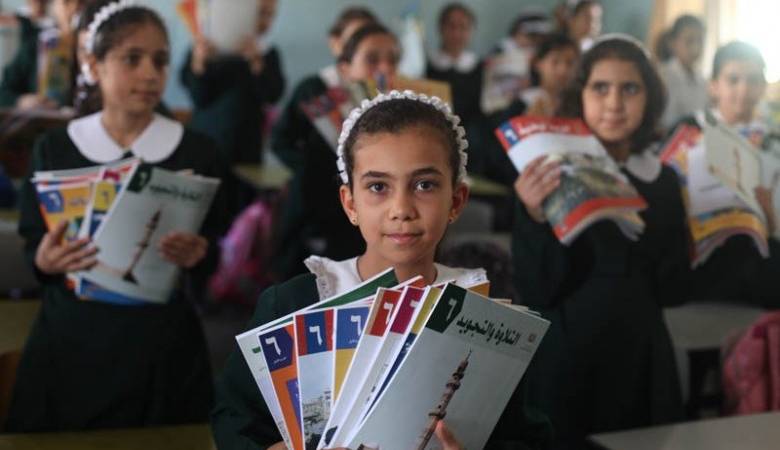
Marouf Al-Rifai, spokesperson for Al-Quds Governorate, warned on Monday of the serious repercussions of the decision by the Zionist enemy authorities to impose the Zionist curriculum on schools in Al-Quds, considering the decision a dangerous and unprecedented escalation since 1967 and a direct targeting of the national and cultural identity of Al-Quds generations.
In a press statement, Al-Rifai explained that the decision comes within the context of a systematic policy targeting the Palestinian education sector in Al-Quds and seeking to replace the Palestinian curriculum with the Zionist narrative.
Al-Rifai stressed that this constitutes an assault on the right of Al-Quds students to education according to curricula that reflect their history, identity, and national culture.
The Zionist decision will apply to all new grades opening next Tuesday in official schools in Al-Quds, including the first and seventh grades.
According to what was published by the Zionist newspaper "Haaretz", the number of Palestinian students who will study under the Zionist curriculum during the upcoming academic year will reach 39,363 students in 105 schools affiliated with the enemy municipality in occupied Al-Quds, in addition to 5,085 students in “recognized and unofficial” institutions.
The decision brings the total number of students covered by this policy to more than 45,000, or around 38% of approximately 120,000 Palestinian students in Al-Quds.
Al-Rifai explained that these figures reveal a “rapid and dangerous escalation” in the imposition of the Zionist curriculum, as the number of students studying under it rose from 10,347 in the 2020/2021 academic year to 19,402 in 2024/2025, and then to 27,041 in 2025/2026.
The number of students studying under the Zionist curriculum was fewer than 13,000 six years ago and did not exceed a few hundred around 15 years ago.
Al-Rifai said that this escalation represents a new stage in a long course of Zionist pressure on Palestinian educational institutions.
These pressures have included pressure on school administrations and linking some budgets to conditions related to curricula, culminating in the seizure of two educational complexes belonging to the United Nations Relief and Works Agency for Palestine Refugees (UNRWA) in the Shuafat and Kafr Aqab refugee camps.
He added that, according to available information, the enemy authorities intend to open 14 secondary classes, an elementary school, and five kindergartens in the Shuafat complex, in addition to opening a secondary school for boys in the Kafr Aqab complex.
Al-Rifai considered these measures part of an attempt to “re-engineer the educational environment in Al-Quds” in a manner serving the enemy’s policies.
Al-Rifai stressed that imposing the curriculum of the enemy authority on the Palestinian population in an occupied city constitutes a serious violation of international humanitarian law.
He explained that the Fourth Geneva Convention imposes clear obligations on the occupying enemy power toward the civilian population, including protecting children, ensuring the continued operation of educational institutions, and preventing education from being used as a tool to erase the identity of the population or impose a political narrative upon them.
Al-Rifai considered the targeting of school curricula to go beyond being an administrative or educational measure, constituting a direct targeting of the consciousness, memory, and national identity of Al-Quds generations, through an attempt to erase the Palestinian curriculum and replace it with a Zionist curriculum that entrenches the enemy’s narrative.
This coincides with the removal or marginalization of key subjects from the Palestinian narrative and history, foremost among them the Nakba, prisoners, and Al-Quds.
Al-Rifai said that “education is one of the most important arenas for preserving the identity of Al-Quds, and the attempt to control students’ minds and curricula represents an extension of policies of annexation, Judaization, and erasure of the city’s Palestinian Arab character.”
Al-Rifai affirmed that the imposition of the Zionist curriculum comes as part of an integrated system of policies aimed at entrenching the annexation of Al-Quds and separating it from its Palestinian surroundings.
He pointed out that the separation wall and checkpoints have isolated tens of thousands of people of Al-Quds from the center of their city and its institutions, as part of a policy seeking to dismantle the natural relationship between Al-Quds and its Palestinian surroundings.
Al-Rifai warned that the continuation of these policies, alongside control over education and curricula, threatens the future of Al-Quds generations and targets the city’s collective memory, calling on families of Al-Quds, educational institutions, and the local community to strengthen the resilience of students and teachers and defend their right to education according to the Palestinian curriculum.
Al-Rifai condemned the international community’s silence toward the “cultural and educational crime” being perpetrated against Al-Quds.
He called on the United Nations Educational, Scientific and Cultural Organization (UNESCO), UN organizations, and relevant international institutions to intervene urgently to halt measures imposing the Zionist curriculum, protect Palestinian educational institutions and the right to education, and preserve the city’s cultural and historical identity.
Al-Rifai called on the international community to assume its legal and moral responsibilities toward the city of Al-Quds, as a city under occupation, and not to treat the enemy’s measures as a fait accompli or an internal administrative matter.
Al-Rifai concluded by stressing that the adherence of Al-Quds residents, teachers, and students to the Palestinian curriculum is not merely adherence to a school textbook, but rather a defense of memory, identity, history, and the right to determine the national narrative.
Al-Rifai stressed that education will remain one of the most important lines of defense for the Arab, Islamic, and Christian identity of Al-Quds, and for the right of its generations to know the history of their city and preserve its heritage and identity.