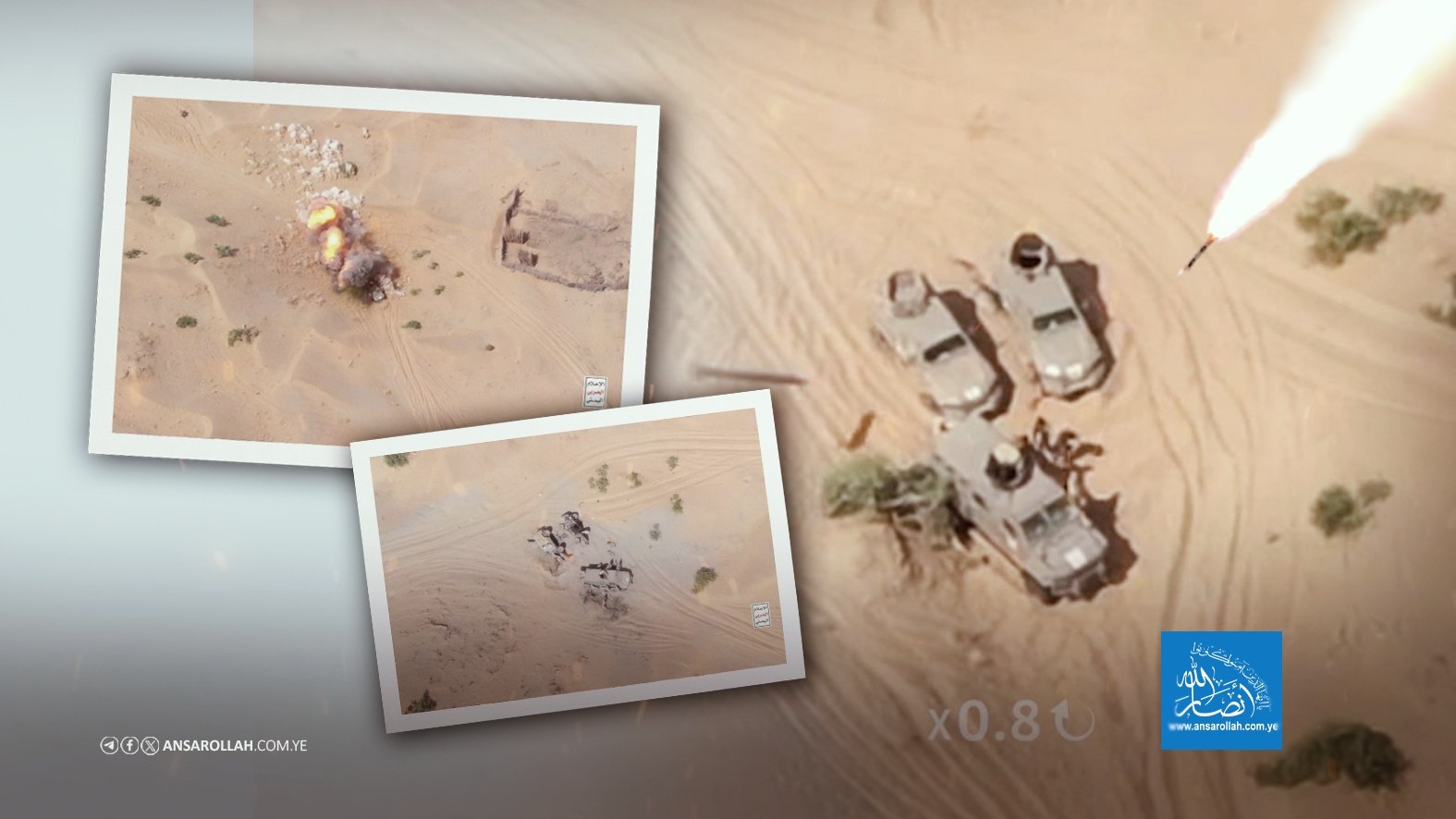
As part of the Yemeni Armed Forces’ operations against the Saudi mobilizations, the War Media publishes new and notable footage showing the missile force targeting a meeting of a number of Saudi mobilization leaders as they gathered to manage the aggression against Yemen, amid an escalation attempting to thwart the “blockade with blockade” equation imposed by the Armed Forces on the Saudi enemy and its maritime navigation.
The footage documents the precise monitoring of the movements of the mercenary leaders by a reconnaissance aircraft, which documented the targeting operation with a high degree of accuracy using a suitable missile that struck its target precisely. The footage distributed by the War Media showed the complete destruction of armored vehicles belonging to the mercenary leaders and the death of everyone aboard them or in their vicinity at the meeting site, without specifying precisely the location or date of that gathering, which, judging by its title, appears to fall within the timeframe of the announced notable operations in this context.
0:00
/ 2:15
This precise missile strike represents a peak point at which the reconnaissance, intelligence, information, and operational-execution cycles converge in their fastest cycle of resolution. It begins with continuous aerial and human tracking and surveillance of the movements and mobilizations of the Saudi enemy, with the aim of deterring enemy movements, proceeds through the analysis and real-time updating of data and information and the identification of the enemy’s command concentration point, and culminates in making a decision with the fastest possible response time.
The ability to shorten the time gap between detecting an enemy command target operating within a changing environment and issuing the launch order and carrying out a swift, rapid, and decisive strike constitutes an important indicator of the high level of coordination and real-time linkage between the intelligence mind and the operational military arm, depriving the enemy of an opportunity to maneuver or escape.
At the technical and tactical level, this footage reflects the pinpoint accuracy of Yemen’s domestically manufactured missiles and demonstrates a qualitative development in missile guidance and control systems, whereby the missile is transformed from merely an indiscriminate destructive force into a ballistic sniper, or a “surgical needle,” delivering a direct hit against the most sensitive point.
This success and missile accuracy, according to military experts, rely on advanced navigation systems capable of overcoming electronic jamming and dealing with changing weather and field conditions in order to achieve an accurate hit on the target with the smallest possible margin of error. This turns enemy mobilizations, command centers, military reinforcements, and armored vehicles into scattered debris, wiping out their armed military mass in a single moment of impact that leaves the opposing side with neither room to maneuver nor the ability to flee and hide, or even to react.
Targeting command mobilizations through tactics aimed at “decapitating” field execution would cause disruption in the enemy’s command and control rooms, as its impact goes beyond the physical destruction of vehicles and equipment to reach structural paralysis in the field chain of command. This type of strike severs the communication link between field command and executive and tactical bases, generating a state of chaos and panic among personnel and soldiers, depriving mobilized groups of any ability to organize or complete their assigned missions, in addition to the profound psychological effects that sow doubt over the security of rear lines and fortified assembly areas.
The documentation and media dissemination of these strikes comes as an integral part of managing the psychological and strategic battle, whereby the media lens transforms classified military information into a public and influential deterrence message for both public opinion and the enemy alike. This footage indicates the Yemeni Armed Forces’ dominance of the field and the imposition of field control through force, going beyond misleading narratives or attempts to conceal losses, to affirm to the viewer and recipient—particularly among the enemy ranks—that the scope of coverage and targeting extends beyond traditional tactical calculations, and that every movement will be destined for destruction so long as it falls under the watchful eyes of vigilant surveillance and reconnaissance and active military intelligence.

Ultimately, these surgical strikes contribute to redrawing the rules of engagement and altering the balance of power on the ground, as they force the enemy to reconsider its positions, restrict its movement, and reassess its calculations when mobilizing its forces or moving its leaders freely. They transform the battlefield into an exposed space governed by missile accuracy and speed of decision-making. This means that the initiative and management of the battlefield have shifted into the hands of the party capable of transforming intelligence data into decisive strikes, narrowing the space and options available to the Saudi enemy’s mobilizations and making the continuation of any mobilization—whether command-level or otherwise—a risk with unforeseen consequences.