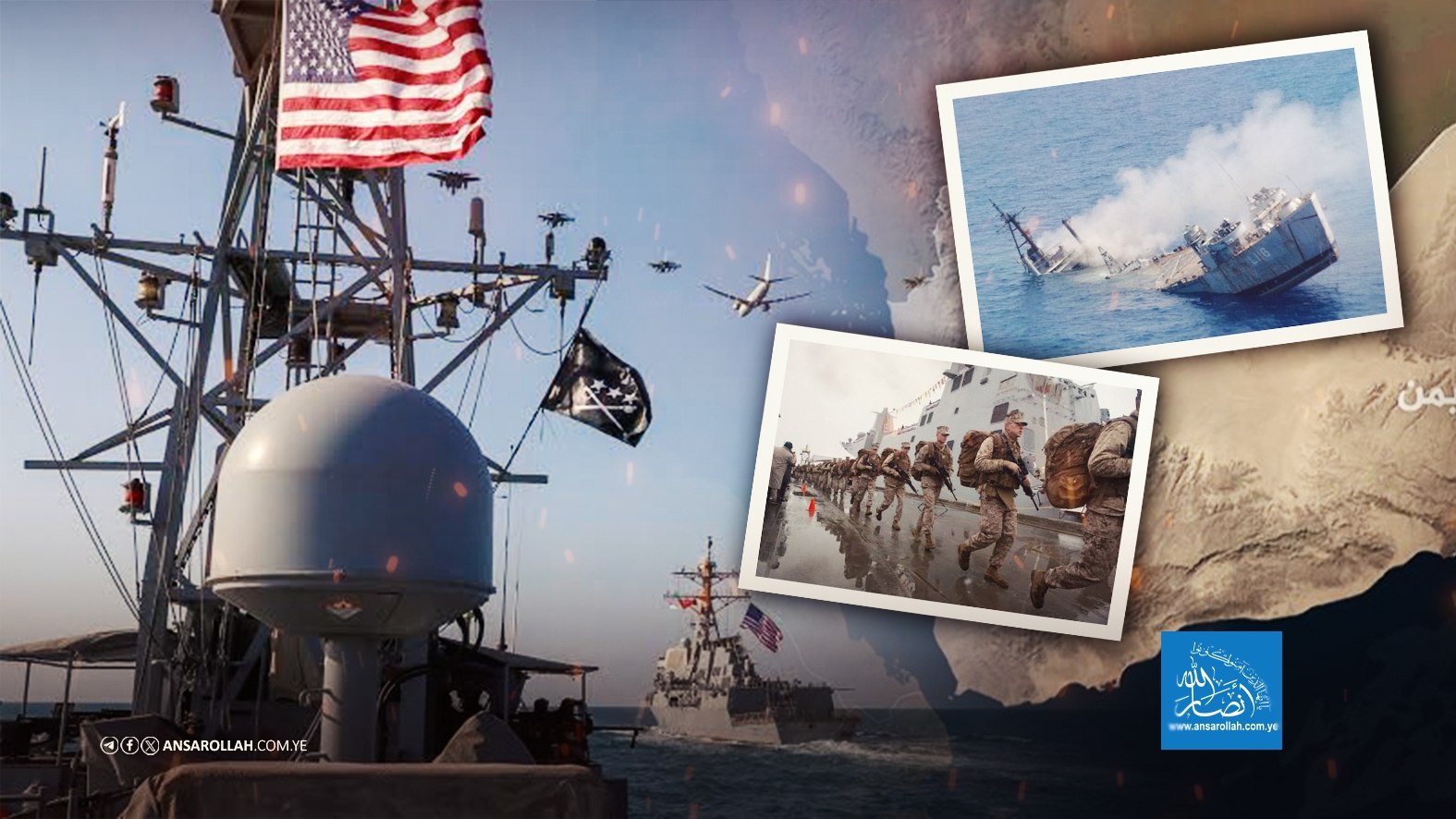
Recent shifts in the U.S. military footprint across the Middle East reveal an interconnected regional context with direct implications for Yemen and the Red Sea. Rather than executing a total withdrawal from the region, the United States is repositioning its forces by downsizing its ground presence in Iraq and Syria while reinforcing deployments directly linked to Iran, the Gulf, and strategic maritime corridors. This realignment elevates the strategic importance of Yemen, the Red Sea, Bab al-Mandab Strait, and the Arabian Sea within American military and security calculations.
Recent U.S. statements confirm that Washington has set no timeline to end its Iran-focused posture, even as it scales down its presence in other theaters. With over 50,000 U.S. troops remaining in the region—backed by sustained naval, air, and missile defense assets—a drawdown from Iraq and Syria does not signal a decline in American offensive capabilities toward Yemen. Instead, it may enable a heavier concentration of force in the Gulf and adjoining maritime choke points. Nevertheless, the Yemeni people remain prepared to defend their sovereignty, steadfast in their support of the Armed Forces as they carry out these sacred national duties.
U.S. Stance on Sustaining Its Military Presence in the Region
Recent U.S. official statements reveal that the Trump administration is not pursuing a total military withdrawal from the region. Instead, it is reshaping its deployments across various theaters by ending or downsizing its ground presence in Iraq and Syria, while maintaining forces dedicated to operations against Iran and the protection of U.S. bases and regional allies in the Gulf.
On September 3, 2026, U.S. Vice President JD Vance declined to set a timeline for ending operations against Iran, conditioning any termination on Tehran halting attacks on shipping and maritime traffic affiliated with the U.S. and its allies. He emphasized that Washington is not holding negotiations with Tehran while these attacks persist.
This followed a statement on September 1 by U.S. Central Command, which noted that "more than 50,000 U.S. military personnel are operating across the Middle East, standing ready to carry out operations ordered by the President." Issued after new strikes against Iranian targets, the announcement framed this deployment as an ongoing operational force rather than a temporary posture slated for drawdown. Furthermore, on July 30, the U.S. administration rejected a Senate resolution calling for the withdrawal of U.S. forces from hostilities against Iran, expressing firm opposition to the measure and reiterating that troops remain positioned to address threats facing Americans, along with Washington’s regional allies and partners.
These stances indicate that the U.S. administration does not tie forces assigned to the Iranian confrontation to a fixed withdrawal timeline. Instead, it calibrates deployment levels based on what it terms the ongoing "Iranian threat, navigation security in the Strait of Hormuz," and the protection of U.S. and Israeli bases and strategic interests.
Withdrawal from Iraq
The U.S. posture toward Iraq is taking a distinct trajectory. In July, Donald Trump declared that the United States no longer saw a need for a continued U.S. military presence there, framing the move within arrangements to complete the troop exit by the end of September 2026. This marks a withdrawal from a specific theater whose operational utility for Washington has diminished. However, it unfolds alongside the continued presence of tens of thousands of U.S. service members across the broader region, particularly in the Gulf and at sites tied to operations against Iran.
The pullout from Iraq does not necessarily signify a complete return of all forces to the United States. Instead, the withdrawal process may be accompanied by a redistribution of select units and capabilities within U.S. Central Command's area of responsibility, tailored to the demands of the broader regional confrontation.
Downsizing the Presence in Syria
The U.S. presence in Syria is likewise moving toward a drawdown, as greater responsibilities transition to the new authorities advancing the American agenda following the Syrian regime change, coupled with Washington's diminished need for a broad, open-ended ground presence. In contrast, Washington retains the capacity to intervene from outside Syrian territory using its regional bases, air power, naval assets, and special operations forces as required. Consequently, a withdrawal from ground positions does not equate to relinquishing military capability relative to the Syrian theater. Together, the Iraqi and Syrian trajectories reflect a broader U.S. push to reduce land forces deployed inside sovereign nations without surrendering regional military influence.
Iran Reshapes U.S. Deployment
Iran currently serves as the single most influential factor shaping the future of the U.S. military footprint in the Middle East. The confrontation with Tehran has driven Washington to bolster troop numbers, reinforce air and missile defenses, scale up naval and air deployments, and maintain rapid-reaction forces within U.S. Central Command's domain. As a result, Washington faces a dual dynamic: while its global strategy aims to alleviate burdens in the Middle East to concentrate greater resources on the Indo-Pacific, the active confrontation with Iran mandates a sustained, elevated military posture across the Gulf and key maritime corridors.
This dynamic explains the stark contrast between American messaging regarding Iraq and its rhetoric toward Iran. In Iraq, the talk centers on a completed mission and no further need for troops, whereas the administration refuses to set a timeline for concluding deployments tied to the confrontation with Iran. Should tensions with Tehran de-escalate, the drawdown of surge forces, extra naval assets, and units whose tours were extended due to the conflict could begin. However, this would represent a transition from a wartime stance to a "deterrence posture," rather than an end to the U.S. military presence in the Gulf.
Under this framework, air and naval bases, the Fifth Fleet, air defense batteries, and command-and-control intelligence networks will endure as a permanent strategic foundation serving U.S. interests across the region.
The Saudi Position
Public Saudi declarations show no explicit, formal request asking Washington to extend the U.S. military presence. However, Riyadh’s security interests remain deeply intertwined with the functions historically fulfilled by U.S. deployments in the Gulf, which have long served as a protective shield.
Saudi Arabia benefits from U.S. early-warning systems, air and missile defense, intelligence, surveillance, and reconnaissance (ISR), command-and-control networks, as well as American naval and air coverage. This includes Washington’s capacity to intervene should the Kingdom or its key infrastructure come under major attack—even if that commitment and operational efficacy have waned following the war on Iran, which exposed diminished U.S. capabilities. Simultaneously, Riyadh seeks to prevent Saudi territory from becoming a launchpad for an open-ended U.S. war against Iran, which would leave its oil infrastructure, cities, and military bases vulnerable to direct Iranian retaliation.
Consequently, the Saudi posture rests on a dual equation: maintaining the U.S. umbrella as a deterrent while urging Washington to exercise restraint in its offensive operations to prevent the war from spilling onto Saudi soil. This strategy does not conflict with Riyadh’s push to expand defense partnerships with Turkey and Pakistan; rather, Saudi Arabia aims to reduce its exclusive reliance on the United States and diversify its options without relinquishing American assets, which remain the most advanced component of the regional defense architecture—and whose operational deployment, evidence suggests, remains under American, rather than Saudi, command.
Implications of U.S. Repositioning for Yemen
The restructuring of U.S. deployments carries direct ramifications for Yemen and the Red Sea. A troop drawdown in Iraq and Syria does not necessarily equate to reduced American capabilities in the Red Sea, as the military center of gravity shifts toward the Gulf, the Strait of Hormuz, the Arabian Sea, and maritime corridors tied to the confrontation with Iran. However, the sustained depletion of U.S. naval assets, personnel, and munitions in the clash with Tehran raises the cost of launching a broad, prolonged campaign against Yemen. This renders Washington more inclined to offload operational burdens onto Saudi Arabia and its affiliated proxy forces.
Under this scenario, the United States retains strategic high-end capabilities—such as ISR, air defense, naval command, protection of American shipping, and long-range strike capacity—while shifting a greater share of ground, coastal, and localized operations onto Saudi Arabia and its aligned forces. This approach intersects with Saudi efforts to build broader regional security arrangements, reinforce its local coalition forces, and construct maritime frameworks that minimize the need for direct U.S. involvement at every level of confrontation.
Outlook
The U.S. military footprint in the Middle East is likely to remain elevated in the near term, despite the withdrawal from Iraq and troop reductions in Syria, as the ongoing conflict with Iran prevents Washington from scaling back forces in the Gulf and strategic sea lanes. Any U.S. drawdown will thus remain selective, with naval assets, air power, missile defense systems, and Gulf bases staying at the core of American deployment.
If the confrontation with Tehran continues without a resolution, Washington will be forced to extend current surge deployments and rotate naval vessels and units rather than withdrawing them. This will heighten strains on operational readiness and munition stockpiles, rendering Washington more cautious about opening a prolonged new front in Yemen, though not preventing it from carrying out targeted strikes under specific circumstances. Conversely, if tensions with Iran abate, Washington will likely pull back a portion of the forces deployed during the conflict while retaining the core bases, air defenses, and naval presence necessary to protect its Gulf allies and monitor Iranian activities.
In either scenario, U.S. pressure on Saudi Arabia to assume greater military and security responsibilities in the Red Sea and Yemen is expected to mount. This will likely be paired with increased intelligence and technical support for Saudi-backed forces, alongside efforts to bolster their naval, coastal, and defensive capabilities. Consequently, the most immediate threat to Yemen is not necessarily a full-scale return to previous levels of direct U.S. military operations, but rather intensified pressure applied through Saudi Arabia and its local proxy forces, underwritten by American surveillance, intelligence, command-and-control, and air and naval defense capabilities. Nevertheless, the Yemeni Armed Forces remain fully prepared for all contingencies, backed by the Yemeni people in safeguarding national sovereignty and pursuing the struggle for defense and liberation.