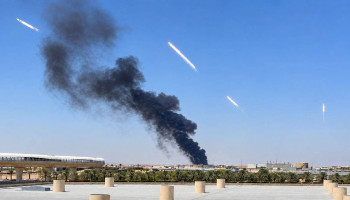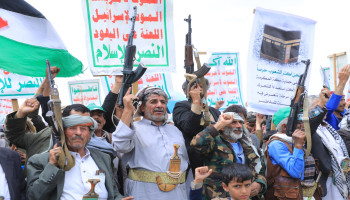

Yemen’s war media continues to document the qualitative operations carried out by the Yemeni armed forces using drones and missile capabilities against Saudi-backed forces mobilizing in the occupied governorates.
The footage offers a stark picture of the scale of the attacks on enemy gatherings, which have inflicted heavy losses in personnel and military equipment.
Military experts and analysts say the continuation of these sustained strikes is establishing a preemptive-response equation aimed at curbing the enemy’s military movements before they advance to operational stages. This, they argue, limits its ability to reorganize its ranks and keeps its aggressive and conspiratorial plans under constant battlefield pressure.
According to the experts, the impact of these operations goes far beyond the severe material and human losses inflicted on the enemy. They have also disrupted its calculations and derailed its mobilization efforts aimed at continuing the occupation of Yemeni territory and keeping the country under the weight of a blockade that has been imposed for more than 12 years.
The documented footage demonstrates the level of advancement achieved by the armed forces in developing their indigenous capabilities and operational expertise.
It also highlights the effectiveness of their intelligence work in tracking enemy movements and identifying the locations of its concentrations. This has enabled precise targeting, disrupted the aggression’s calculations, and thwarted its plans.
In this context, military expert Major General Khaled Ghorab said: “The footage released by the war media demonstrates the rapid response capability of the missile operations, the result of accumulated experience, extensive testing, and the high level of professionalism within the missile forces.
This has been accompanied by the development of weapons and launch platforms to suit the nature of the confrontation with the American and Israeli enemy and those aligned with them, foremost among them Saudi Arabia.”
Speaking to Ansar Allah’s website, Ghorab explained that the launch platforms have become less complex and better suited to the possibility of being targeted before, during, or after deployment. This allows missiles to be launched quickly and smoothly and directed according to available coordinates and intelligence.
He attributed the speed of execution to the multiplicity of intelligence and reconnaissance sources, stressing that information does not reach the leadership until it has been cross-checked and corroborated against data from multiple sources, ultimately confirming the target before the information is passed on to the firepower units.
He said that dispatching a drone to document the operation demonstrates the level of confidence in the intelligence and the importance of the target. He noted that missions are carried out by small teams with a high degree of professionalism, with the launch process taking as little as two to three minutes.
This, he said, enables rapid engagement of moving targets. Ghorab attributed the success of the strikes to selecting weapons suited to the nature of the target and the size of the engagement area, allowing for precision strikes without unnecessarily expanding the damage to the surrounding area.
According to his assessment, the ability to reach a command-level meeting in a remote area, far from surveillance and information leaks, demonstrates the diversity of intelligence sources available to the Yemeni armed forces, including both digital and human sources, as well as their ability to collect, analyze, and corroborate intelligence.
He pointed out that the enemy is no longer operating from a position of security, having been forced to rely on mobile command and operations centers after central and secondary command rooms were targeted. Leadership gatherings, he added, are now being held for short periods at designated points while on the move.
Ghorab further noted that the war-media footage confirms that the Yemeni military operations combine intelligence accuracy, rapid response, and the selection of appropriate weaponry. He stressed that this represents the accumulated experience of the Yemeni armed forces over many years of confrontation.
Regarding Saudi military movements, Ghorab assessed that the mission of Saudi commanders has shifted from attempting to achieve offensive objectives to seeking survival, absorbing strikes, and holding ground. He warned that any escalation would result in the battlefield being carried into Saudi territory.
He concluded that Saudi Arabia’s vital and strategic targets—including economic facilities, Aramco installations, and ports—remain among the available options for retaliation.
He stressed that the Yemeni armed forces deal with Saudi enemy movements according to pre-prepared plans, adding that what has taken place so far represents only the minimum level of confrontation.
Rajoom Drones Reveal the Advancement of Yemeni Capabilities
Among the most notable footage documented by the war media are the striking scenes of operations carried out by “Rajoom” drones against forces mobilizing for the battlefronts. Military experts have described these operations as sophisticated and unprecedented, citing them as evidence of the continued advancement in the performance of Yemen’s unmanned aviation unit.
The experts view these operations as an indication of the steady progress being made in the local manufacture of drones, reaching a level that, in their assessment, places Yemen among the more advanced countries in this field, despite years of aggression and blockade and the constraints they have imposed on available capabilities and resources.
On this matter, military expert Brigadier General Abdulghani al-Zubaidi said: “The capabilities achieved by these drones represent a major and highly significant leap, perhaps even an unprecedented one, in the field of this type of aircraft.”
He noted that their ability to fly distances of up to 10 kilometers and carry more than 40 kilograms of explosives demonstrates that the leadership has developed a clear vision tailored to the nature of the direct confrontation.
Speaking to Ansar Allah’s website, al-Zubaidi explained that these capabilities enable the drones to strike targets behind enemy lines and target barracks, positions, and troop movements. He said that intensifying this type of operation and targeting could have a major impact on the battle and impede the enemy’s movements.
On the psychological front, the military expert said the impact of these operations could be particularly significant among personnel who escape injury or survive the attacks. Such operations, he argued, could place them under severe psychological strain and undermine their readiness for any subsequent confrontation.
On this basis, al-Zubaidi asserted that the strategy of employing these drones has been highly successful in both surveillance and combat. He explained that the enemy’s movements in the next phase would expose it to this type of sophisticated operation.
He also pointed out that the drones currently in use represent the third generation of this system, and that their large numbers could give them a significant role on the battlefield, in addition to their ability to carry out missions at night.
He added: “The cameras mounted on these aircraft are advanced and operate using infrared technology, allowing them to fly at night and conduct precision operations, as well as surveillance and targeting missions.”
He stressed that the Saudi enemy and its forces are facing a genuine predicament, particularly in any potential confrontations along the western coast or in areas such as Marib and Al Abr, among others, predicting that this type of operation could have a direct impact on military performance.
Al-Zubaidi also identified psychological pressure as one of the potential consequences of drone operations, explaining that their impact could extend to military capabilities and resources, as well as decision-makers, operations-room commanders, command-and-control structures, officers, and personnel.
According to the military expert, the uncertainty that may accompany enemy personnel as they move toward confrontation—and their lack of knowledge about what they may face from these drones and the capabilities they possess—could become a significant factor weighing on military decision-making and battlefield readiness in any future confrontation.
For his part, military expert Brigadier General Abed al-Thawr believes that the latest footage released by the war media conveyed multiple battlefield and political messages to the forces of aggression and lays the groundwork for a new phase of confrontation.
He points to the advanced capabilities demonstrated by the military operations in planning, execution, and decision-making at the tactical, operational, and strategic levels.
Speaking to Ansar Allah’s website, he explained that the operations carried out by the armed forces using ballistic missiles, drones, and other weapons reinforce their ability to identify and select targets with precision across diverse terrain—from deserts and coastlines to mountainous areas and valleys—and to strike enemy targets, silence its weapons, and thwart its military movements.
The military expert discussed the enemy’s attempts to assemble forces for offensive operations in Mokha, Marib, and other areas where Saudi-backed forces are deployed. He said the latest strikes demonstrated the armed forces’ ability to detect such movements and engage them before they could achieve their objectives.
Al-Thawr placed these operations within the broader context of the growing capabilities of Yemen’s military intelligence apparatus under the Ministry of Defense in Sana’a.
He noted that documenting the strikes with drones reflects the accuracy of the intelligence and the validity of the targets on which the operations were based, emphasizing that accurate intelligence is the foundation of a successful military operation.
On the ground war, the military expert said the developments have laid the groundwork for a new phase of ground operations, noting that the armed forces possess capabilities that qualify them to operate at the tactical, force-assembly, operational, and strategic levels, whether confronting the Saudi enemy or any other adversary.
He said the armed forces are now prepared to conduct a wide range of operations across multiple fronts, pointing to their deployment along the western coast and the axes facing the Saudi enemy, as well as in Taiz, al-Bayda, Shabwa, Marib, and al-Jawf.
Al-Thawr also recalled the experience of the Yemeni armed forces in previous battles, explaining that they fought on nearly 100 fronts, around 50 of them major fronts and an equal number secondary ones. He stressed that the armed forces in 2026 are markedly different from those of 2015–2018, having completed major aspects of their weaponry, equipment, manpower, qualification, and training.
He further emphasized that the General Mobilization Forces constitute a reserve force numbering close to one million personnel and can join the battlefronts within the first hours of a confrontation. He said that organizational structures, coordination, and training enable them to reach combat formations within approximately 15 hours.
He concluded that the level of readiness has reached a high degree in terms of weapons, equipment, and manpower, with logistical stockpiles and administrative structures prepared to sustain operations even under the most difficult conditions of battle.