Ansarollah Website — Report
Amid a long Arab night, heavy with wounds and consumed by external tutelage, where complacency and dependency festered, the dawn of September 21, 2014, emerged in Yemen as a defining moment that rewrote the history of an entire nation. This revolution was not born of a fleeting impulse, nor of a desire for superficial change; rather, it burst forth from the depths of suffering and out of the ultimate national necessity. The country was being driven toward an abyss, directed by foreign remote control, its sovereignty and decision-making stripped away in front of the eyes of its people. The United States Ambassador had become the defacto ruler, while local leaders settled for the role of delegates executing foreign directives.
Yemen Before the Revolution: A Nation Bound in Shackles
The landscape prior to September 21 was starkly grim by all measures. Foreign custodianship was explicit and overt under Chapter VII of the United Nations Charter, leaving foreign ambassadors as the primary and final decision-makers. The nation faced a catastrophic, tragic, and genuinely perilous situation. Opponents planned for Yemenis to walk willingly into the abyss, leading the country into formal and declared submission.
Under Chapter VII, the nation was officially subjected to foreign tutelage. Consequently, the ambassadors of the Group of Ten in Sana’a—led by the United States Ambassador—served as the primary overseers of all state affairs, superseding any domestic Yemeni authority. Every aspect of national governance was scrutinized and reviewed alongside the United States Ambassador by responsible state institutions.
Was it natural for the Yemeni people to accept the continuation of such conditions? Should the United States Ambassador and his foreign counterparts dictate national affairs, shape the future, and control both the present and destiny of the country? Upon what basis could this be justified?
First, regarding identity and affiliation, foreign diplomats naturally disregarded Yemeni identity and heritage when formulating their directives and blueprints. Second, regarding national rights as an independent state, foreign nations possess no legal right to interfere in internal matters. Such external interference, as conducted during that era, constituted a clear violation of national sovereignty and independence, as well as an affront to human dignity under international custom.
At that time, the economy was collapsing, with international indicators characterizing Yemen as being on the brink of bankruptcy. Security was at its lowest ebb, assassinations struck the heart of the capital, and chaos prevailed across the land. National unity was threatened as regionalization and federalism projects were promoted as miraculous remedies, despite serving as gateways to fragmentation and division.
Yemenis were not a people divided by identity or torn by ethnic strife; they remained a cohesive population unified by faith, language, and shared history. However, foreign powers sought to exploit minor differences to fuel perpetual conflict, utilizing divisions to weaken the country and reduce it to fragile cantons.
The Revolution: Historical Inevitability and Existential Necessity
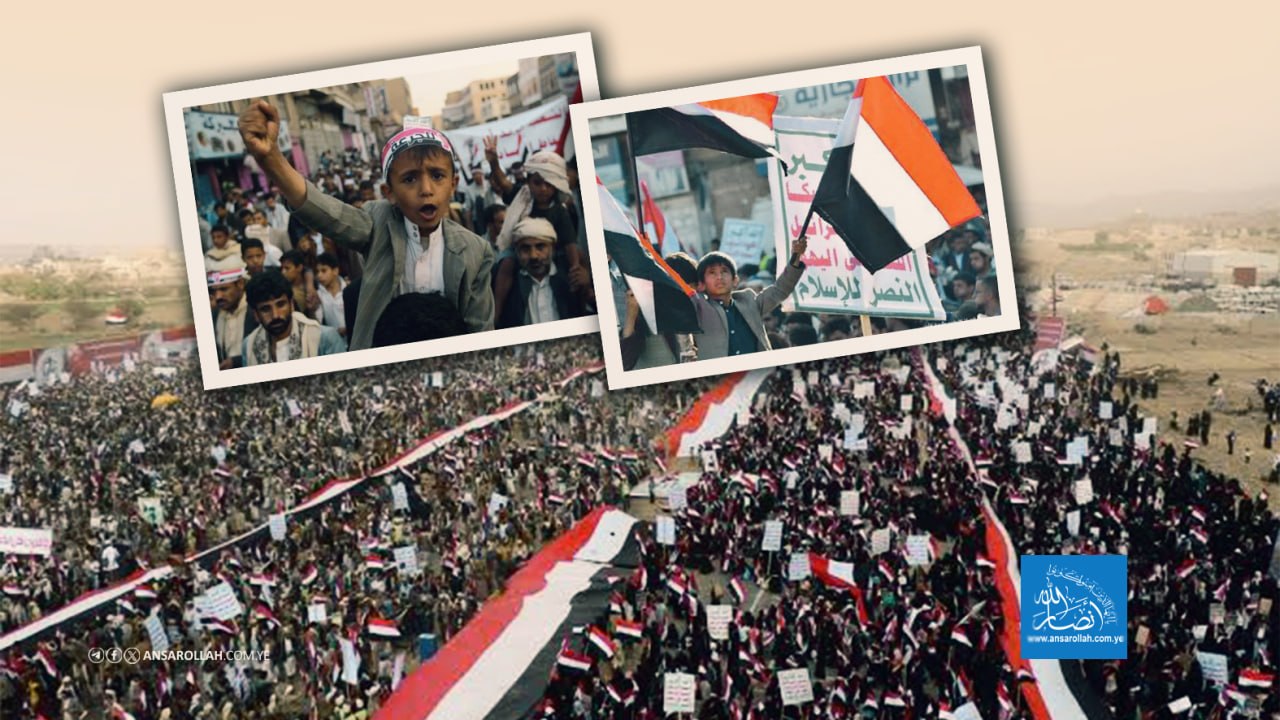
Confronting this tragic reality, the events of September 21 became a national and existential necessity. Masses representing all segments of society marched together, declaring with a unified voice that foreign custodianship had come to an end. The revolutionary movement was not the domain of any single sect, tribe, or region; it reflected a comprehensive national consensus that expressed the collective will of Yemenis longing for freedom and sovereignty.
This mobilization served the interests of all Yemenis. It stood as a powerful, effective, and influential movement that restored the dignity of a populace refusing to be subjugated to foreign dominance. The nation demonstrated that it would not submit to external adversaries attempting to crush, humiliate, and destroy its heritage while it remained passive or submissive. It revealed a society still vibrant with spiritual, national, and human vitality—a populace possessing deep-rooted dignity that responded with steadfast resolve when insulted.
In September 2014, the Yemeni people forged an extraordinary chapter in history. Sit-in camps gathered citizens from every region, while tribal generosity provided food and resources, fostering solidarity and honor. Furthermore, the military and security institutions aligned themselves with the popular movement, preserving the peaceful nature of the uprising and preventing a descent into chaos.
The result was a remarkable revolution that astonished observers worldwide. No financial institutions were looted, and no state infrastructure was destroyed. Instead, the events demonstrated unprecedented public discipline that commanded respect across the political spectrum.
The Aftermath: Challenges and Confrontations
The path following the victory of the revolution was not smooth. External and regional forces moved swiftly to conspire against the Yemeni people, attempting to reverse the progress achieved. The Peace and National Partnership Agreement was signed to offer an opportunity for constructing an inclusive state, yet foreign-backed entities sought to undermine and overturn the accord, culminating in direct external aggression in 2015 that continues to this day.
Nevertheless, the revolution established a new reality, re-establishing Yemen as a nation that refuses submission. It catalyzed the capabilities of the people in domains of resilience and military manufacturing, sending a clear message that Yemen is neither governed by foreign embassies nor directed by external tutelage.
In contrast, the situation in the southern and eastern regions—under the authority of occupying forces—reveals the true objectives of foreign intervention. The absence of state authority has transformed cities into militia-controlled cantons, accompanied by the plunder of oil and gas resources for external benefit.
Significance and Messages of the Revolution
The Revolution of September 21, 2014, stands as a testament to dignity and determination. It delivers the message that nations clinging to freedom cannot be crushed, that faith and humanity demand honor rather than servitude, and that sacrifices—no matter how great—remain far superior to the losses incurred through surrender.
Therefore, this revolution remains an ongoing endeavor, reminding successive generations of their duty to defend national identity and sovereignty, while utilizing every anniversary as an impetus to press forward.
Born out of necessity, the September 21 Revolution emerged as the voice of the vulnerable against tyranny, a cry for freedom against external tutelage, and a shield of sovereignty against projects of fragmentation. It represents a chapter in the history of the nation, a living pulse for the present and future, and the declaration of a people resolved to demonstrate to the world that Yemen bows to no one except Allah Almighty.