Ansarollah Website - Report
Targeting the Saudi capital's international airport—along with its repercussions on aviation, air navigation, and the economy—reveals dimensions that extend far beyond a direct military strike. It opens a wide window for reading shifts in the balance of power and the limits of the security protection upon which the Kingdom relies.
The implications of the confrontation between Yemen and Saudi Arabia are no longer confined to border lines or the scope of military sites near the theater of operations. When fire reaches King Khalid International Airport in Riyadh and King Fahd Airport in Dammam, paralyzing air traffic and prompting international airlines to suspend flights out of security concerns, the confrontation faces a different test. This test relates to the state's ability to protect its political and economic center, ensure the continuity of its connectivity with the world, and preserve its image as a stable environment for business, investment, and international transport.
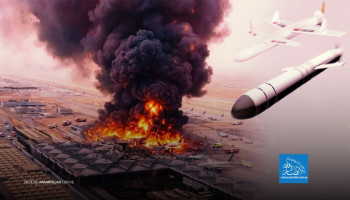
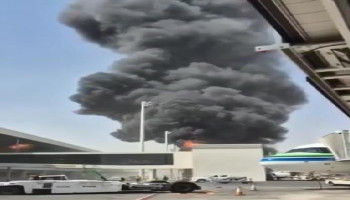
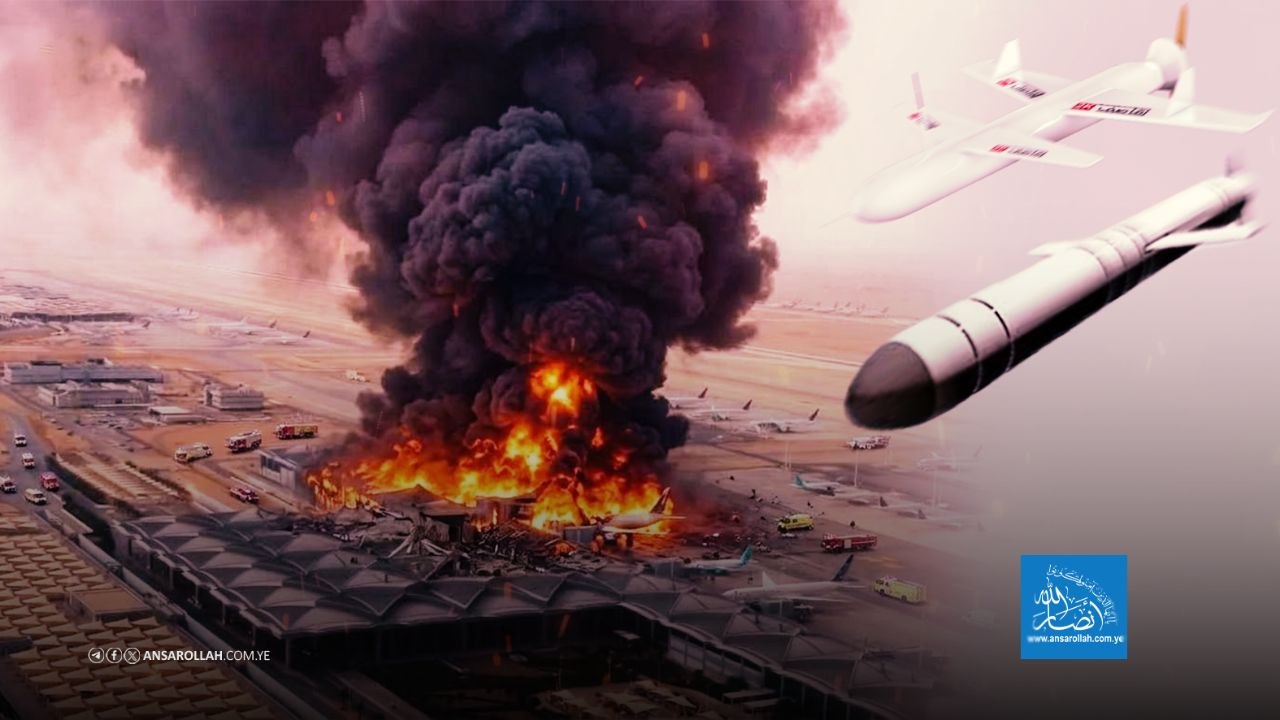
The developments announced in the past few days acquire special importance in this context. The Armed Forces carried out targeting operations against King Khalid International Airport using missiles and drones, which reached their targets, disrupted navigation at the airport, and damaged several aircraft. Furthermore, more than 15 airlines announced the suspension of their flights to Riyadh Airport, while the European Union Aviation Safety Agency (EASA) announced an expansion of warnings concerning Saudi airspace, based on escalating risks associated with missiles, drones, potential air interceptions, and falling debris.
The United States, Britain, Canada, Germany, Spain, Australia, and Ireland urged their nationals to stay away from King Khalid International Airport in Riyadh. Meanwhile, Saudi authorities announced the suspension of operations at the Riyadh International Airport as a result of significant damage inflicted upon it by Yemeni missiles.
Here, the strategic issue unfolds in its broader dimensions. A strike hitting a vital facility in the heart of the capital derives its impact from the target's location, its repercussions on air traffic, security confidence, and the cost of crisis management, in addition to the military message it carries regarding the attacking party's ability to threaten areas far from traditional confrontation lines.
Nevertheless, accurate reading requires distinguishing between the announcement of targeting the airport, the documentation of the damage sustained, the estimation of how successfully defense systems intercepted the attacks, and the subsequent measurement of the economic and security impact. These are interconnected levels, yet they differ in the nature of the evidence proving each one.
The Capital’s Airport: From a Transport Facility to a Symbol of Security and Sovereignty
The strategic importance of King Khalid International Airport stems from its position within the Saudi state apparatus and the role it plays in connecting the capital to the world. Major international airports represent core nodes in transport, economic, and diplomatic networks, facilitating the movement of officials, businesspeople, delegations, investments, and tourists, alongside their role in logistics and the transport of individuals and goods.
This importance is heightened in Riyadh, where Saudi Arabia seeks to solidify its position as a regional hub for business, investment, and international events. The airport here is part of the infrastructure underpinning the capital's image as a city open to the world and capable of regularly receiving international traffic.
Therefore, subjecting the airport to attacks and disrupting its air traffic poses a challenge to Saudi authorities that goes beyond repairing physical damage and restoring runways and facilities. The issue is also tied to the state's ability to ensure the continuity of vital services under pressure, and to convince airlines and travelers that risks are manageable. Data cited by Reuters indicates that King Khalid Airport handled approximately 296,800 flights during 2025, with an average of nearly 813 flights daily, making it one of the most vital air transport hubs in the Kingdom.
These figures illustrate the volume of reliance on the airport and help explain why the impacts of any disruption affecting it are so widespread. When a facility of this magnitude is affected, repercussions extend beyond passengers inside its terminals to airlines, air connectivity networks, flight schedules, freight operations, and economic sectors tied to travel.
Flight Suspensions: How Security Risk Translates into Economic Pressure
One of the most significant outcomes of the announced attacks is that airlines make their decisions based on risk calculations rather than political statements alone. An air carrier is responsible for the safety of its crew, passengers, and aircraft, balancing the feasibility of continuing flights against the likelihood of danger, insurance costs, the viability of alternative routes, and the clarity of security information.
When attacks recur in the vicinity of an international airport, the mere prospect of casualties or additional damage may prompt companies to suspend flights temporarily, even before a complete picture emerges regarding the extent of the damage or the capability of air defenses to prevent recurrence.
This mechanism appeared clearly in recent developments with the surge in canceled flights to Riyadh Airport: more than 300 flights were canceled on October 8, 131 flights on October 9, and 221 flights on October 10, prior to the airport's complete closure on October 11.
Here, the nature of the pressure generated by these developments becomes clear. A military strike can occur within minutes, while its operational impacts extend for days or longer, depending on the evolution of the security situation and the decisions of companies and regulatory bodies. Airlines may require a fresh risk assessment before resuming flights, and travelers may be forced to alter schedules or use alternative destinations.
Potential costs are distributed across several levels: operational losses tied to canceled flights; rebooking, accommodation, and compensation costs under applicable contracts and regulations; disruption of crew and aircraft schedules; and declining revenues for services linked to passenger movement. More importantly, hotels, tourism, business, and events reliant on regular air arrivals to the capital can also be affected.
Crucially, the persistence of this situation may raise risk management costs for companies, tying the restoration of confidence more closely to field developments. This represents one facet of strategic pressure: the spillover of confrontation impacts from the engagement theater into the commercial and operational decisions of international institutions dealing with Riyadh.
International Air Warnings: When Attack Repercussions Transcend Airport Borders
The significance of these developments grows when aviation safety regulatory bodies enter the crisis. While a single airline suspending flights might relate to a specific commercial or security assessment, expanding air warnings signals that risks have become a broader concern for institutions tasked with navigation safety.
On October 9, 2026, Reuters reported that the European Union Aviation Safety Agency (EASA) expanded its warnings regarding Saudi airspace, citing risks linked to missile and drone attacks, the potential for misidentifying civilian aircraft during the activation of air defense systems, and the risks of air interception and falling debris. The agency also cited recommendations from the OPSGROUP association of aviation professionals advising the avoidance of air operations in Saudi Arabia amid escalating risks.
Prior to that, on October 8, Philippine Airlines and Air India announced the temporary suspension of flights to and from Riyadh. Reuters reported that three Indian airlines suspended flights to the Saudi capital, while Germany's Lufthansa Group announced the suspension of flights to and from Saudi Arabia until October 16. On Sunday, October 11, EgyptAir, its affiliate Air Cairo, and SriLankan Airlines announced the suspension of flights to Riyadh. Meanwhile, France, Canada, and Germany warned airlines that flying over Saudi Arabia or large parts of its airspace was no longer safe, coinciding with the OPSGROUP aviation safety association recommending that airlines avoid flying at all altitudes within Saudi airspace.
These warnings deserve special attention because aviation safety relies on an operating environment where risks can be assessed and managed through clear procedures. When civilian aircraft traffic intertwines with missile alerts, interception operations, and frequent airspace closures, executing flight operations becomes considerably more complex.
Strategically, the impact of these warnings extends beyond the airspace surrounding the targeted airport, affecting route planning, alternative airport selection, fuel calculations for flights, arrival time estimations, and the reorganization of aircraft and crew schedules.
Thus, a reciprocal pressure loop arises: security risks lead to further warnings and restrictions, diminishing air traffic flexibility and driving up operating costs. Restoring normal traffic then becomes contingent upon the receding of risks and the stabilization of the security environment.
What the Strike Means for the Yemeni Deterrence Equation
From a military and strategic standpoint, the extension of Yemeni military operations to Riyadh carries deep significance regarding the scope of the threat Saudi Arabia is now forced to factor in. The geographical distance between Yemen and the Saudi capital, the importance of the targeted facility, and the volume of air traffic it relies on make this event distinct in implication from targeting a limited site in a border region.
Reuters noted in its coverage on October 9 that recent developments demonstrated, per the European safety agency's assessment, the capability and resolve of Yemenis to target deeper sites within Saudi territory, including the capital. But what can be concluded from this regarding Yemeni military capabilities?
First: The recurrence of announced attacks on geographically distant targets raises important questions about the evolution of long-range reach capabilities and the capacity to sustain pressure over an extended period. The strategic indicator here relates to the breadth of the threat the opposing party must handle, rather than merely the distance separating the launch point from the target.
Second: Operational repercussions reveal that the impact of an attack can extend far beyond direct physical damage. Even when physical damage is relatively limited, uncertainty regarding the likelihood of recurring attacks can prompt airlines to take costly precautions, illustrating the importance of psychological and operational impact in deterrence calculations—while distinguishing this impact from verifying physical damage or evaluating weapon technical performance.
Third: A scientific evaluation of Yemeni military developments requires examining a set of cumulative indicators: the frequency of reaching announced targets, the accuracy of available information on attack results, the attacking forces' ability to sustain operations, the success rate of defenses in intercepting projectiles, and the verifiable volume of damage—rather than merely defining the weapon type.
Consequently, targeting the capital's airport represents a significant development in the scope of the confrontation and its repercussions. This is especially true given that targeting King Khalid Airport came within an escalation initiated by the Armed Forces targeting oil tankers in the Red Sea, subsequently expanding to oil facilities in Abqaiq, Khurais, and Yanbu. Amid Saudi escalation and intransigence, the Yemeni Armed Forces raised the ceiling of their operations to the point of disrupting the capital's Riyadh airport following a series of precise military operations that bypassed American and Western air defense systems. This indicates that the Yemeni Armed Forces have well-prepared themselves to handle all developments accordingly—reiterating, as the Armed Forces have affirmed, that they possess sufficient levers of power to compel the Saudi enemy into submission.
Saudi Arabia Faces a More Complex Security and Economic Equation
States typically rely on multiple systems to protect vital facilities: air defenses, early warning, field security procedures, service continuity, crisis management, and coordination with transport companies and regulatory bodies. Yet these systems, regardless of efficiency, operate in an environment where risks constantly shift, and the cost of protection remains tied to the nature, recurrence, and breadth of threats.
In the Saudi case, the importance of King Khalid International Airport stands out as a facility with a strategic function for the capital. Managing a threat targeting this airport imposes additional requirements to protect passengers, aircraft, and facilities, restore flight regularity, communicate with international companies, and limit economic and operational fallout.
One paradox facing states striving to establish themselves as regional business hubs is that the more vital the transport and communication network becomes in supporting economic activity, the more sensitive that activity becomes to security disruptions affecting the network.
The issue grows more complex when a state is engaged in a protracted armed conflict, as risks are not confined to a single facility but enter into broader calculations concerning the protection of airports, vital installations, economic infrastructure, and daily life continuity.
Within this framework, Yemeni strikes on Riyadh Airport can be understood as an added pressure on Saudi calculations, expanding protection requirements and raising the cost of threat management, alongside repercussions affecting traveler and airline confidence. As for the extent and duration of this pressure, the Yemeni Armed Forces have set its ceiling: the cessation of aggression and the lifting of the siege, meaning Riyadh faces difficult days ahead marked by multiplying material and moral losses.
The Yemeni Position and the Message of Pressure in Regional Confrontation
These developments acquire an additional political dimension amid continuing Yemeni positions regarding the confrontation with Saudi Arabia and regional developments. Attacks on targets deep within Saudi territory, when coupled with political and military statements affirming the continuation of the confrontation, fit into an effort to influence the opposing party's calculations and demonstrate that prolonged military operations carry security and economic costs.
From a deterrence analysis perspective, this equation links military capability with the adversary's perception of the risks entailed by their decisions. As the probability of vital facilities facing threats becomes more prominent in security calculations, the need grows to balance the objectives and costs of continued military operations against escalation options and de-escalation pathways.
A Test of Capability to Protect the Strategic Depth and Sustain Services
The strategic importance of targeting King Khalid International Airport in Riyadh is embodied in the convergence of three dimensions: the sensitivity of the targeted facility, the disruption inflicted on air traffic, and the broadening international attention toward aviation safety risks inside Saudi Arabia.
The airport represents a core node in the transport network tied to the capital, and disrupting its movement reverberates across passengers, airlines, and related economic sectors. Furthermore, the suspension of flights by certain companies and the expansion of air warnings highlight how security risks can transform into operational and economic burdens exceeding the location of the attack itself.
On the military level, the arrival of Yemeni attacks to the Saudi capital sheds light on the expanding scope of threats protection systems must handle, offering noteworthy indicators regarding the evolution of Yemeni capabilities and their capacity to generate impact beyond direct engagement.