The strikes targeting Saudi Arabia’s capital airport and their repercussions for aviation, air navigation, and the economy reveal dimensions that extend far beyond the immediate military strike. They also open the door to a broader assessment of shifting power dynamics and the limits of the Kingdom’s security defenses.
The implications of the confrontation between Yemen and Saudi Arabia are no longer confined to border lines or military positions near the theater of operations.
When strikes reach King Khalid International Airport in Riyadh and King Fahd International Airport in Dammam, disrupting air traffic and prompting international airlines to suspend flights over security concerns, the confrontation presents a different kind of test—one that concerns the state’s ability to protect its political and economic hub, ensure uninterrupted connectivity with the outside world, and preserve its image as a stable environment for business, investment, and international transportation.
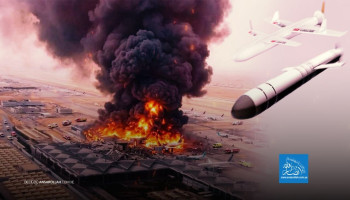
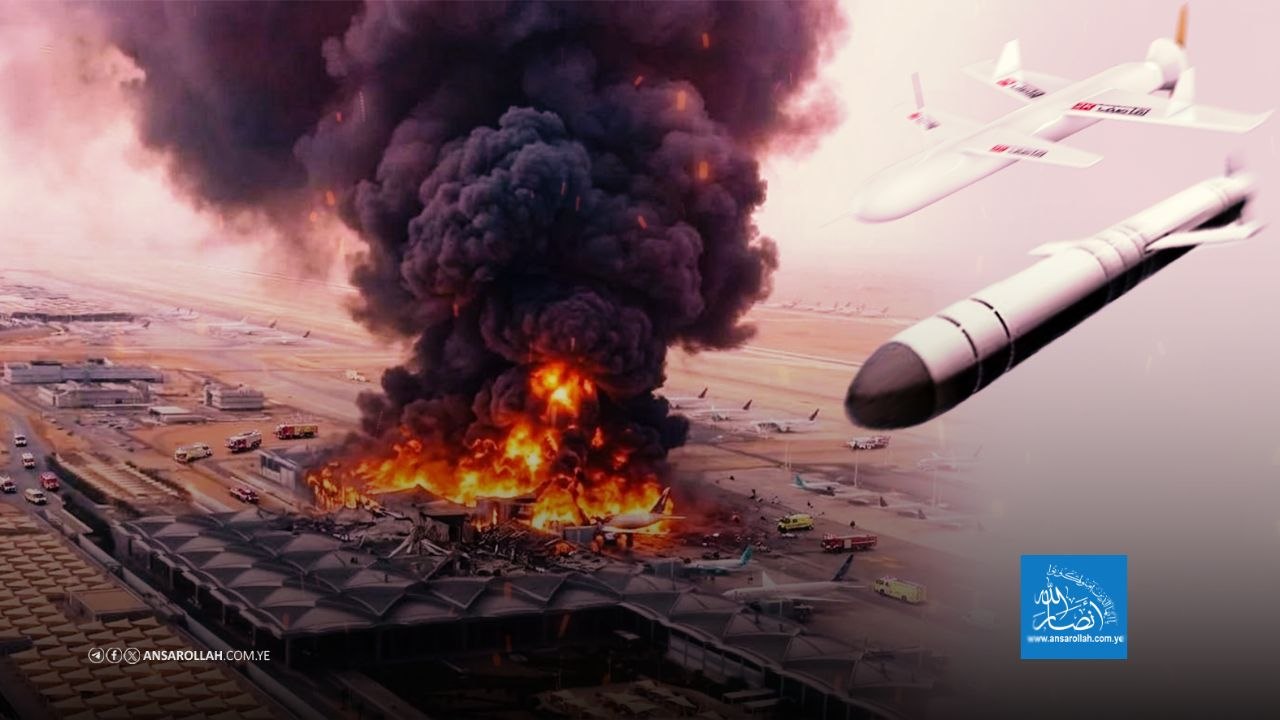
Developments reported over the past several days have taken on particular significance in this context. The armed forces carried out missile and drone strikes targeting King Khalid International Airport, hitting their intended targets, disrupting air traffic at the airport, and damaging several aircraft.
More than 15 airlines have announced the suspension of flights to Riyadh Airport, while the European Union Aviation Safety Agency (EASA) announced an expansion of its warnings concerning Saudi airspace, citing escalating risks associated with missiles and drones, the possibility of aerial interception, and the threat posed by falling debris.
The United States, the United Kingdom, Canada, Germany, Spain, Australia, and Ireland have urged their nationals to stay away from King Khalid International Airport in Riyadh. Meanwhile, Saudi authorities have announced the suspension of operations at Riyadh’s international airport following extensive damage sustained in Yemeni missile strikes.
This is where the strategic issue comes into sharper focus in its broader dimensions. A strike that reaches a critical facility at the heart of the capital derives its impact from the location of the target, its repercussions for air traffic, security confidence, and the cost of managing the crisis, as well as the military message it conveys about the attacking party’s ability to threaten areas far removed from conventional front lines.
Nevertheless, a rigorous assessment requires distinguishing between the announcement of an attack targeting the airport, the documentation of the damage it sustained, an evaluation of how effectively air defense systems intercepted the attacks, and an assessment of the resulting economic and security impact. These dimensions are interconnected, but each requires a different type of evidence to substantiate it.
The Capital’s Airport: From a Transportation Hub to a Symbol of Security and Sovereignty
The strategic significance of King Khalid International Airport stems from its place within Saudi Arabia’s state infrastructure and its role in connecting the capital to the rest of the world.
Major international airports serve as critical hubs in global transportation, economic, and diplomatic networks, facilitating the movement of government officials, business leaders, delegations, investors, and tourists, while also supporting logistics, passenger transport, and cargo operations.
This significance is all the more pronounced in Riyadh, as Saudi Arabia seeks to consolidate the city’s position as a regional hub for business, investment, and international events. The airport is an integral part of the infrastructure underpinning the capital’s image as a city open to the world and capable of accommodating international traffic on a regular basis.
Consequently, attacks on the airport and disruptions to its air traffic pose a challenge to Saudi authorities that extends beyond repairing physical damage and restoring runways and facilities to operation.
The issue also concerns the state’s ability to maintain essential services under pressure and reassure airlines and passengers that the risks remain manageable.
According to figures cited by Reuters, King Khalid International Airport handled approximately 296,800 flights in 2025, averaging around 813 flights per day, making it one of the Kingdom’s most important air transport hubs.
These figures illustrate the extent of reliance on the airport and help explain why any disruption can have far-reaching consequences. When a facility of this scale is affected, the repercussions extend beyond passengers inside its terminals to encompass airlines, air connectivity networks, flight schedules, cargo operations, and the economic sectors linked to air travel.
Flight Suspensions: How Security Risks Translate into Economic Pressure
One of the most significant consequences of the reported attacks is that airlines make decisions based on risk assessments, not political statements alone.
Air carriers are responsible for the safety of their crews, passengers, and aircraft, and must weigh the merits of continuing operations against the likelihood of exposure to danger, insurance costs, the availability of alternative routes, and the clarity of security information.
When attacks recur in the vicinity of an international airport, even the possibility of further casualties or damage may prompt airlines to suspend flights temporarily, before a full picture emerges of the extent of the damage or the ability of air defense systems to prevent further attacks.
This dynamic has become evident in recent developments, as flight cancellations to Riyadh Airport have mounted. More than 300 flights were canceled on October 8, followed by 131 cancellations on October 9 and 221 on October 10, before the airport was completely shut down on October 11.
These developments illustrate the nature of the pressure such events can generate. A military strike may take place within minutes, while its operational repercussions can last for days or longer, depending on security developments and decisions by airlines and regulatory authorities.
Airlines may need to reassess the risks before resuming services, while passengers may be forced to change their travel plans or seek alternative destinations.
The potential costs are spread across several areas: operational losses resulting from canceled flights; rebooking, accommodation, and compensation costs, subject to applicable contracts and regulations; disruptions to crew and aircraft schedules; and declining revenues for certain services linked to passenger traffic. Hotels, tourism, businesses, and events that depend on reliable air links to the capital may also be affected.
More importantly, if these conditions persist, the cost of risk management for airlines may rise, making the restoration of confidence increasingly dependent on developments on the ground.
This is one dimension of the strategic pressure involved: the effects of the confrontation extend beyond the battlefield to influence the commercial and operational decisions of international companies serving Riyadh.
International Aviation Warnings: When the Fallout from an Attack Extends Beyond the Airport
The significance of these developments grows when aviation safety regulators become directly involved in the crisis. While an individual airline’s decision to suspend flights may reflect its own commercial or security assessment, the expansion of aviation warnings signals that the risks have become a broader concern for institutions responsible for the safety of air navigation.
On October 9, 2026, Reuters reported that the European Union Aviation Safety Agency (EASA) had expanded its warnings concerning Saudi airspace, citing risks associated with missile and drone attacks, as well as the possibility of civilian aircraft being misidentified during air defense operations, the threat of aerial interception, and falling debris.
Reuters also reported that OPSGROUP, an organization comprising aviation professionals, had recommended avoiding flight operations in Saudi Arabia in light of the escalating risks.
A day earlier, on October 8, Philippine Airlines and Air India had announced the temporary suspension of flights to and from Riyadh. Reuters also reported that three Indian airlines had suspended services to the Saudi capital, while Germany’s Lufthansa Group announced the suspension of flights to and from Saudi Arabia until October 16.
On October 11, EgyptAir, Egypt’s Air Cairo, and SriLankan Airlines announced the suspension of flights to Riyadh. Meanwhile, France, Canada, and Germany warned airlines that flying over Saudi Arabia or large portions of its airspace was no longer safe.
These warnings coincided with an announcement by OPSGROUP that it had recommended airlines avoid flying at all altitudes within Saudi airspace.
These warnings warrant particular attention because aviation safety depends on an operating environment in which risks can be assessed and managed through clearly defined procedures.
When civilian air traffic intersects with missile alerts, interception operations, and repeated airspace closures, decisions about whether to operate a flight become considerably more complex.
Strategically, the repercussions of these warnings extend beyond the airspace surrounding the targeted airport. They can affect flight routing, the selection of alternative airports, fuel requirements, estimated arrival times, and the rescheduling of aircraft and flight crews.
This creates a cycle of mutually reinforcing pressure: security risks trigger further warnings and restrictions, reducing the flexibility of air traffic and driving up operating costs. The restoration of normal operations then becomes increasingly dependent on the abatement of those risks and the stabilization of the security environment.
What Does the Strike Mean for Yemen’s Deterrence Equation?
From a military and strategic perspective, the reach of Yemeni military operations into Riyadh carries implications for the scope of the threat Saudi Arabia must now take into account.
The geographical distance between Yemen and the Saudi capital, the strategic importance of the targeted facility, and the scale of air traffic that depends on it make this development fundamentally different in significance from an attack on a limited target in a border area.
In its October 9 report, Reuters noted that recent developments had demonstrated, according to an assessment by the European Union Aviation Safety Agency, the Yemenis’ capability and determination to target locations deeper inside Saudi territory, including the capital. But what conclusions can be drawn from this about Yemen’s military capabilities?
First, repeated reported attacks on geographically distant targets raise important questions about the development of long-range strike capabilities and the ability to sustain pressure over an extended period.
The strategic indicator here is the extent to which the threat has expanded and the opposing side must now contend with it, rather than simply the distance between the launch point and the target.
Second, the operational repercussions demonstrate that the impact of an attack can extend well beyond the immediate physical damage. Even when the damage is relatively limited, uncertainty over the possibility of further attacks may prompt airlines to take costly precautionary measures.
This illustrates the significance of psychological and operational effects in deterrence calculations, while underscoring the need to distinguish those effects from evidence of the extent of physical damage or assessments of the technical performance of the weapons used.
Third, a rigorous assessment of the development of Yemen’s military capabilities requires examining a range of cumulative indicators: repeated strikes reaching their declared targets, the reliability of available information about the outcomes of those attacks, the attacking forces’ ability to sustain operations, the effectiveness of air defenses in intercepting incoming projectiles, and the extent of the damage that can be independently verified—not merely the type of weapon employed.
Against this backdrop, the targeting of the capital’s airport represents a significant development in both the scope of the confrontation and its repercussions.
The strike on King Khalid International Airport came amid an escalating campaign of operations that began with attacks by the armed forces on oil tankers in the Red Sea before expanding to include oil facilities in Abqaiq, Khurais, and Yanbu.
As Saudi Arabia escalated its actions and maintained its hard-line stance, the Yemeni Armed Forces began raising the stakes of their operations, ultimately disrupting air traffic at Riyadh’s airport after a series of military operations that, according to their own account, struck their targets with precision.
The U.S. and Western air defense systems, the account maintains, failed to intercept the missiles. This, in turn, is presented as evidence that the Yemeni Armed Forces have thoroughly prepared to respond to a range of potential developments with measures suited to each scenario.
The armed forces have reiterated that they possess leverage capable of forcing what they describe as the Saudi enemy into submission.
Saudi Arabia Faces an Increasingly Complex Security and Economic Equation
States typically rely on multiple layers of protection to safeguard critical infrastructure, including air defense systems, early-warning capabilities, on-the-ground security measures, service continuity plans, crisis management mechanisms, and coordination with transportation companies and regulatory authorities.
Yet no matter how effective these systems may be, they operate in an environment where risks are constantly evolving, and the cost of protection remains tied to the nature, frequency, and geographic scope of the threat.
In Saudi Arabia’s case, King Khalid International Airport is particularly significant given its strategic role in serving the capital. Addressing a threat to an airport of this importance imposes additional requirements: protecting passengers, aircraft, and facilities; restoring regular flight operations; maintaining communication with international airlines; and limiting the resulting economic and operational repercussions.
This highlights a paradox facing countries seeking to consolidate their position as regional business hubs: the more important transportation and connectivity networks become to economic activity, the more vulnerable that activity becomes to security disruptions affecting those networks.
The situation becomes even more complex when a state is involved in a protracted armed conflict. The risks are no longer confined to a single facility but become part of broader calculations involving the protection of airports, critical infrastructure, economic facilities, and the continuity of everyday life.
Against this backdrop, the Yemeni strikes on Riyadh Airport can be understood as an additional source of pressure on Saudi Arabia’s strategic calculations, expanding its security requirements and increasing the cost of addressing the threats it faces, while also undermining the confidence of passengers and airlines.
The Yemeni Armed Forces, however, have made clear the conditions they seek to impose to bring this pressure to an end: a cessation of the military aggression and the lifting of the blockade. This means that Riyadh faces the prospect of difficult days ahead, with its material and psychological losses potentially mounting.
Yemen’s Position and the Message of Pressure Amid the Regional Confrontation
These developments take on an additional political dimension amid the continued public statements outlining Yemen’s position on the confrontation with Saudi Arabia and the broader regional situation.
Attacks on targets deep inside Saudi territory, when accompanied by political and military statements affirming the continuation of the confrontation, form part of an effort to influence the opposing side’s strategic calculations and demonstrate that the continuation of military operations carries security and economic costs.
From a deterrence perspective, this equation rests on linking military capability to the other side’s perception of the risks that may arise from its decisions.
The more prominently the threat to critical infrastructure figures in security calculations, the greater the need to weigh the objectives of military operations against the costs of sustaining them, while balancing the options of escalation against potential paths toward de-escalation.
A Test of the Ability to Protect the Strategic Heartland and Maintain Essential Services
The strategic significance of the strike targeting King Khalid International Airport in Riyadh lies in the convergence of three factors: the sensitivity of the targeted facility, the disruption to air traffic, and the growing international concern over the risks to air navigation within Saudi Arabia.
The airport is a major hub in the transportation network serving the capital, and disruptions to its operations have repercussions for passengers, airlines, and related economic sectors.
The suspension of flights by some airlines and the expansion of aviation warnings also highlight how security risks can translate into operational and economic burdens extending far beyond the site of the attack itself.
On the military front, the reach of Yemeni attacks into the Saudi capital underscores the expanding scope of the threat that Saudi Arabia’s security systems must address.
It also raises questions warranting closer examination regarding the development of Yemeni military capabilities and their ability to produce effects extending beyond the immediate theater of combat.