Ansarollah Website | Mohammed Nasser Hatroush
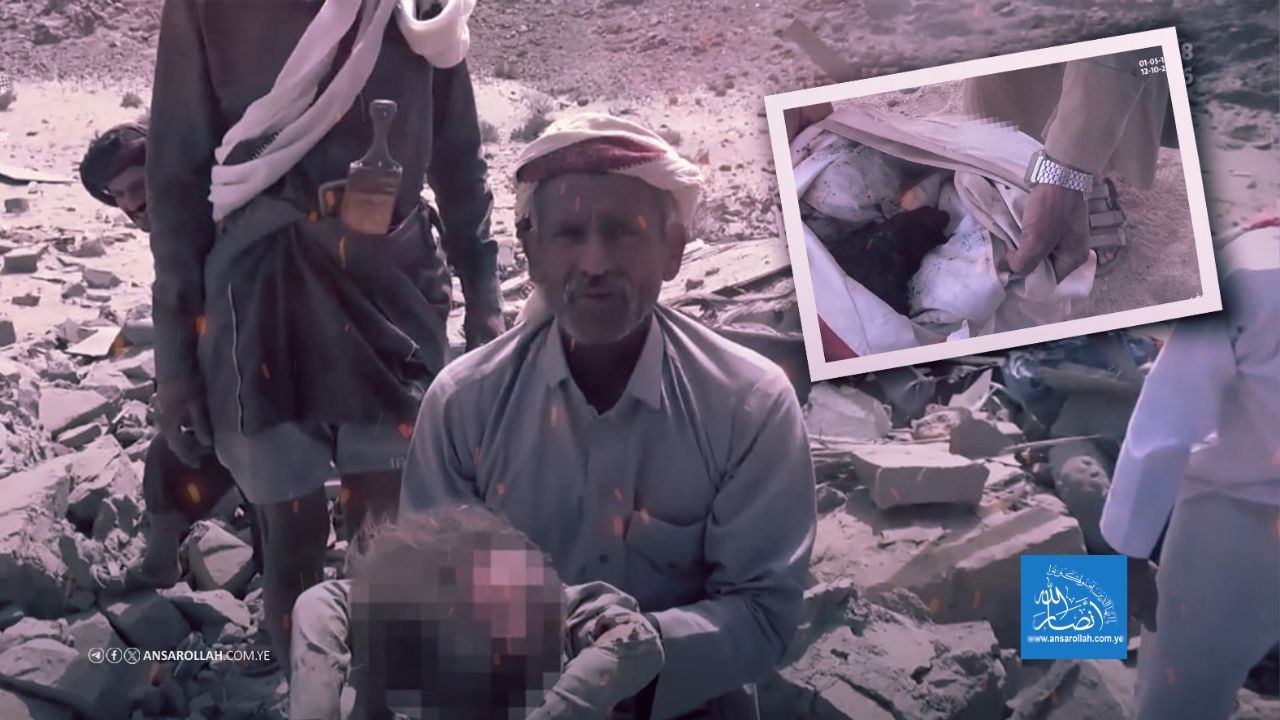
International silence regarding the massacres committed by the Saudi enemy in Yemen has become a cover that perpetuates impunity. From the end of the de-escalation phase on July 13th until October 10th, the civilian casualty toll rose to 259 martyrs and wounded, including 91 martyrs and 168 wounded, with women and children making up approximately 60% of them. Alongside daily killings, the aggression continues to destroy the essentials of life: 1,400 schools and educational centers, and 436 hospitals and health facilities, in a blatant violation of the Geneva Conventions and international humanitarian law. In the face of this recklessness, Yemen firmly upholds its legitimate right to self-defense in accordance with Article 51 of the United Nations Charter, and the equation of a blockade for a blockade and escalation for escalation, until the aggression stops, the blockade is lifted, and international accountability is achieved.
Since the end of the de-escalation phase on July 13th of this year and the entry into the phase of enforcing the equation of "a blockade for a blockade and escalation for escalation," the casualty toll of the Saudi aggression rose to 259 martyrs and wounded by October 10th, according to a statement by the official spokesperson for the Ministry of Public Health, Population, and Environment, Dr. Anis Al-Asbahi. Al-Asbahi explains that the toll includes 91 martyrs and 168 wounded, while women and children constitute about 60% of the total casualties.
In his remarks to Ansarollah website, Al-Asbahi affirms that the systematic targeting of markets, weddings, and civilian gatherings in Yemen over 12 years of Saudi aggression reveals a policy of mass intimidation aimed at inflicting the maximum possible human losses among civilians, including women and children. These constitute grave violations of international humanitarian law that necessitate an international investigation and legal accountability.
In the context of documenting the damage inflicted on civilian and service objects, Al-Asbahi mentions that schools and educational centers were subjected to destruction or damage, totaling 1,400 schools and educational centers during ten years of aggression. This deprived thousands of children of education, contributed to an increase in school dropout rates and internal displacement, and involved targeting some schools while students were present, leading to casualties among children and teachers.
He notes that shelling and destruction affected 436 hospitals and health facilities, coinciding with the blocking of imports of medicines and medical supplies due to the blockade. This contributed to a near-total collapse of the health system and a rise in mortality rates resulting from a lack of medical care.
These violations pose a double danger—according to Al-Asbahi—because they affect the right of civilians to education and health, which are fundamental rights protected by the rules of international humanitarian law and the Geneva Conventions that guarantee the protection of hospitals and civilian objects. He concluded that targeting schools, hospitals, homes, residential neighborhoods, markets, and civilian gatherings does not limit its impact to human and material losses, but extends to paralyzing society by depriving it of education and health care, and complicating reconstruction efforts. This calls for investigating these incidents and holding those responsible legally accountable.
For his part, the head of the "Ain Al-Insaniah" Center for Rights and Development, Ahmed Abu Hamrah, confirmed that the total number of direct victims of the aggression and the blockade has reached 54,219 civilians, including 19,446 martyrs and 34,773 wounded.
Repelling the Aggression is a Guaranteed Right
While the world remains silent regarding the crimes of the Saudi enemy in Yemen, the people of Yemen mandate the Yemeni Armed Forces to respond to those massacres as a legitimate right enjoying a popular consensus. They affirm their full support for the armed forces with money and men to cement the equation of a blockade for a blockade and escalation for escalation, which was imposed by the armed forces to end the aggression and lift the unjust Saudi blockade imposed on Yemen for more than a decade.
Regarding this matter, the legal consultant at the Ministry of Justice and Human Rights, Hameed Yahya Al-Rafiq, affirms that the repeated armed attacks launched by the Saudi enemy on Yemeni territory provide a legal basis for Yemen to uphold its right to self-defense, based on Article 51 of the United Nations Charter, which recognizes the right of states to defend themselves when an armed attack occurs.
He explains—in his interview with Ansarollah website—that the evaluation of the legality of the Yemeni response is based on the rules of international law concerning the use of force, particularly the prohibition of attacking the territorial integrity and political independence of states, alongside the rules of international humanitarian law governing military operations. He emphasizes that the legality of each operation is linked to the availability of necessity and proportionality, and the legitimacy of the objectives and means used. He points out that the repetition and continuation of Saudi attacks, and the human losses and damage to objects and facilities they have left behind, require evaluating Yemeni operations within the framework of the right to self-defense, with the aim of stopping, repelling, and averting the danger of armed attacks, rather than as acts of retaliation or punishment.
Al-Rafiq indicates that the legal controls for a military response include the occurrence of an armed attack, the necessity of using force to repel the aggression, proportionality with the defensive purpose, defining legitimate military objectives, distinguishing between civilians and combatants and between civilian objects and military objectives, as well as taking all feasible precautions to minimize harm to civilians. He stresses that evaluating the legality of a response is not done by issuing blanket judgments on all operations, but rather by looking at the circumstances of each operation and the extent of its connection to the defensive purpose and compliance with the rules of international humanitarian law. He confirms that the establishment of the right to self-defense does not automatically render every military operation legal; rather, this remains contingent upon the availability of necessity, proportionality, and respect for the legal rules governing the use of force.
Saudi Money Silences Humanitarian Organizations
Despite international organizations documenting hundreds of crimes committed in Yemen by the Saudi enemy, and former UN Secretary-General Ban Ki-moon placing the Saudi regime on the blacklist in 2016 following violations and horrific crimes against women and children in Yemen, followed by its re-listing in 2017 by current Secretary-General António Guterres for the same reasons, the United Nations continues to deal with the Yemeni crisis using double standards. At a time when it condemns the legitimate Yemeni response against the Saudi enemy, it turns a blind eye to the escalation of aggression and its targeting of civilians. This puts the credibility of the United Nations to the test and raises questions about its commitment to the principles of justice and human rights it claims to defend.
Commenting on this detail, human rights activist Sanad Al-Sayyadi affirms that the Saudi-American aggression has committed hundreds of crimes documented locally and internationally over the years of aggression against Yemen, targeting purely civilian objects and gatherings, including popular markets, wedding halls and processions, funeral gatherings, and residential areas. These actions constitute violations of international humanitarian law that in many instances amount to war crimes.
In his interview with Ansarollah website, Al-Sayyadi reviews the most prominent massacres addressed in reports by the UN Panel of Eminent Experts and international human rights organizations, including the Great Hall massacre in Sana'a on October 8, 2016, Wahija wedding near Al-Mokha in September 2015, Sanban wedding in Dhamar, and Bani Qais wedding in Hajjah, in addition to the targeting of the markets of Khamis Mustaba, Dhihan, Al-Maqna', and Allaf. Regarding the educational sector, he explains that bombing and destruction put more than 2,500 educational facilities out of service, citing the targeting of Juma'at bin Fadl School in Sa'ada, Al-Ra'i Girls School in Sana'a, and Al-Falah School in Nehm, and the casualties and deprivation of education inflicted on students by those events. He points out that statistics have exceeded 60,000 martyrs and wounded, mostly women and children, alongside permanent disabilities and economic damage affecting weekly markets and rural areas.
Al-Sayyadi holds Western arms companies, particularly American and British ones, responsible for partnership in arming the aggression, criticizing the political and financial pressures that have prevented justice for Yemeni victims. He calls for an independent and transparent international investigation and the establishment of an international criminal investigative mechanism to ensure the accountability of those responsible for these crimes and prevent their impunity, emphasizing that the dossiers of the massacres will remain incriminating documents pursuing their perpetrators, financiers, and arms suppliers.
Documented Crimes
According to Amal Al-Makhdhi, Vice President of "Ensan" Organization for Rights and Freedoms, the continuous violations committed by Saudi Arabia in Yemen were not limited to markets and homes, but extended to detention facilities. She reviewed the massacre at the Central Reformatory in Al-Hazm District, Al-Jawf Governorate, which took place on September 7, 2026, during a visit by inmates' families, resulting in dozens of martyrs and wounded, including visiting women and children.
In her interview with Ansarollah website, Al-Makhdhi affirms that many local human rights organizations, spearheaded by Ensan Organization, have worked to document numerous crimes committed by the Saudi enemy in Yemen. She explained that these organizations possess a comprehensive dossier, which empowers Yemen to legally hold the Saudi enemy accountable. According to Al-Makhdhi, human rights organizations documented a series of serious crimes during the current escalation phase in Yemen in the Western Coast and Taiz, most notably the massacre witnessed at Mafraq Mawiya market in Al-Ta'iziyyah district, south of Taiz, after it was targeted by warplanes, resulting in between 47 and 50 civilian martyrs and wounded.
As part of documenting violations, the Vice President of Ensan Organization for Rights and Freedoms confirmed the issuance of a monitoring report detailing 85 violation incidents during the period from January 2018 to September 2026. These included 80 incidents linked to Saudi and Emirati forces, encompassing killings, injuries, enforced disappearances, arbitrary detention, forced displacement, and the targeting of fishermen.