Between October 8 and 12, 2026, Yemen’s military operations against Saudi Arabia took shape as a clearly defined escalation campaign targeting airports, oil facilities, and economic infrastructure, disrupting international air traffic and reshaping the Kingdom’s security and investment calculus.
The operations unfolded within a strategic equation articulated by the Yemeni Armed Forces: “An airport for an airport, a blockade for a blockade, and escalation for escalation.”
The consequences were quickly felt, as several airports were shut down, hundreds of flights were canceled, diplomatic warnings mounted, oil prices surged, and Riyadh’s image as a safe financial and commercial hub came under strain.
The Escalation Trajectory: From Flight Disruptions to Airport Shutdowns
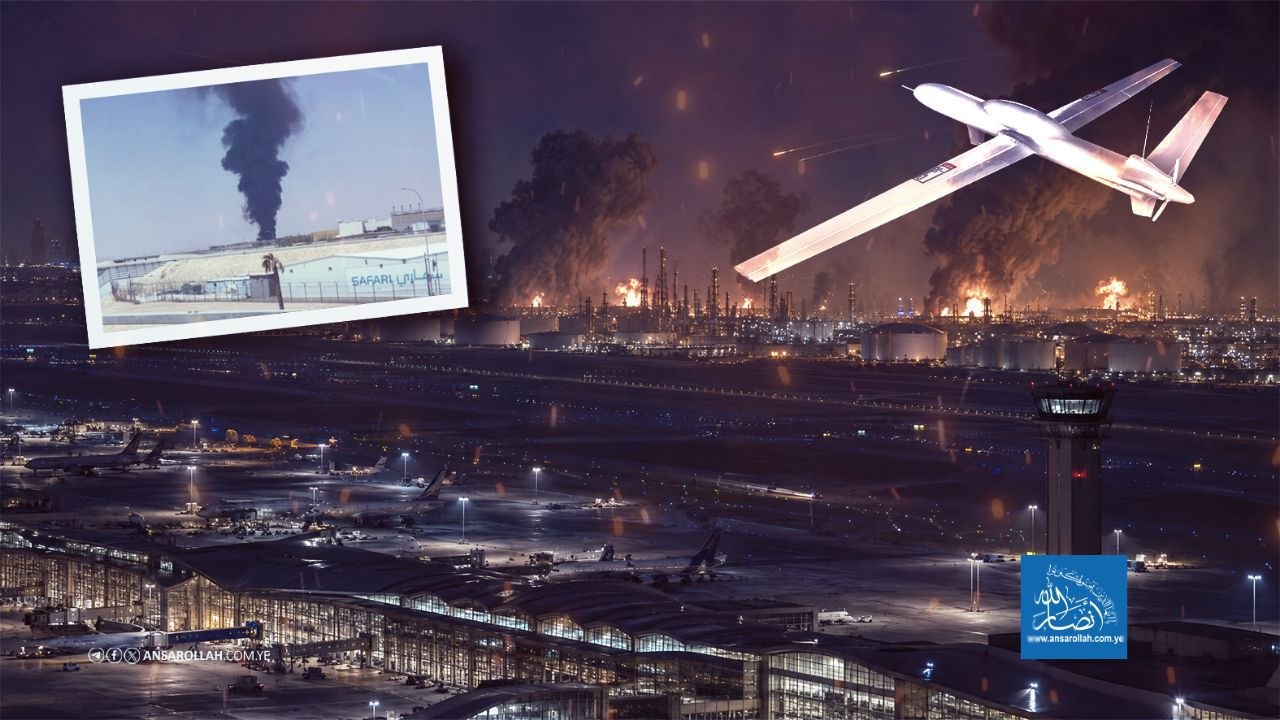
The picture began to take shape on October 8, when the Yemeni Armed Forces announced that they had targeted King Khalid International Airport in Riyadh with a ballistic missile that struck its target and disrupted air traffic.
That evening, the airport was targeted again with two cruise missiles. The Yemeni forces also struck Najran Airport with a ballistic missile and the airbase in Khamis Mushait with another ballistic missile.
These attacks coincided with reports from flight-tracking platforms that operations at King Khalid International Airport had come to a halt, with the airport closed to flights and ranking among the world’s most disrupted airports.
On October 9, cancellations accelerated. The European Union Aviation Safety Agency (EASA) advised airlines to avoid additional sections of Saudi airspace, while the Humanitarian Operations Coordination Center declared that Saudi airspace had become an operational theater for Yemeni missile forces, with Mecca and Medina excluded, until the aggression and blockade came to an end.
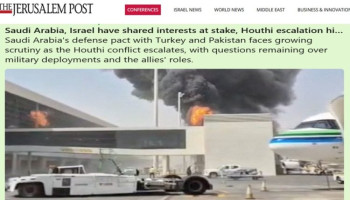
October 10 marked a major turning point. King Khalid International Airport came under a direct attack that struck the passenger terminal, prompting the Saudi General Authority of Civil Aviation to suspend operations and evacuate passengers. Reports indicated that Terminal 3 had been hit, while the number of canceled flights climbed to 221.
On October 11, the Yemeni Armed Forces announced that they had carried out four high-impact operations within 24 hours. The targets included King Khalid International Airport in three successive waves, the Shuqdam gas processing facility, Aramco’s Tanajib oil facility, and King Fahd International Airport in Dammam, in addition to Saudi military build-ups in Ras al-Arah and Al-Suqya.
By October 12, the cumulative impact had become even more pronounced. Riyadh Airport reportedly recorded the cancellation of 99.7% of its scheduled Sunday flights, while Flightradar24 put the cancellation rate at approximately 78%.
The escalation had thus evolved from temporary flight disruptions into a near-total shutdown, expanding from a single airport to a network of airports stretching from Riyadh to Dammam, Abha, Najran, and Jizan.
Air Traffic: A Gradual Paralysis and International Warnings
The cancellation figures offered a direct reflection of the collapse in confidence in the security of Saudi airspace. On October 8, Reuters reported, citing aviation analytics firm Cirium, that 49.7% of flights departing from Riyadh Airport had been canceled.
The Financial Times reported that more than 100 flights had been canceled in Riyadh, while Bloomberg, also citing Cirium, put the number of flights scheduled to depart from or arrive at King Khalid International Airport that were canceled at approximately 300.
On October 9, the number of canceled flights rose to 335 before reaching 221 on October 10, as dozens of aircraft were rerouted and more than 1,000 flights were canceled, according to The Wall Street Journal.
Airlines continued to announce suspensions and cancellations. Lufthansa suspended flights through October 16; Air India and Air India Express through October 10; KLM and Air France through October 24, subsequently extending the suspensions through the end of the month; Cathay Pacific through January 31, 2027; and Philippine Airlines through October 11. Pakistan International Airlines suspended flights to Riyadh, while flydubai canceled services to Riyadh, Yanbu, and Abha.
Etihad Airways canceled Abu Dhabi–Riyadh flights, Kuwait Airways canceled two flights, and EgyptAir and Air Cairo suspended services from Cairo, Alexandria, and Sohag.
SriLankan Airlines suspended flights through October 18, Emirates through the following Monday, and Delta Air Lines postponed its flights until March 2027.
Meanwhile, the US, Canadian, British, and Australian foreign ministries warned their nationals of possible airspace closures, flight cancellations, and security risks. The US, British, Canadian, German, and Spanish embassies also urged their citizens to stay away from Riyadh Airport.
The British Embassy went further, advising against all but essential travel to Jeddah, Dammam, and all other airports except Medina Airport.
From an analytical perspective, this disruption was one of the central objectives of the operations: to strike at Saudi Arabia’s economic and psychological resilience, undermining confidence in the Kingdom’s ability to maintain control over one of its most critical sovereign assets.
Oil Facilities and the Economy: Striking at the Center of Gravity
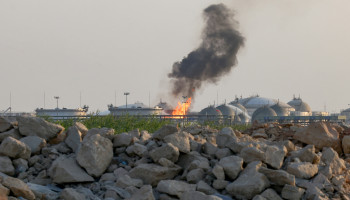
Yemen’s military operations also extended to oil facilities that form the backbone of the Saudi economy. Satellite imagery documented fires at Aramco facilities in Abqaiq, Khurais, Rabigh, and Riyadh, alongside unusual thermal anomalies in Abqaiq and intense gas fires at a pumping station along the East–West Pipeline and at the Abqaiq processing plant and pumping station, with a reported thermal output exceeding 60 megawatts.
Imagery from the Sentinel-2 satellite also showed damage to fuel storage tanks at the Rabigh oil refining and petrochemical complex, including one tank that was completely destroyed. A fuel storage tank at an Aramco facility south of Riyadh also appeared to have been destroyed, with a dark stain suggesting a possible oil spill.
The impact was not confined to the physical damage inflicted on oil infrastructure; it also reverberated through the markets. Brent crude rose by 4% to $104.28 a barrel.
More significantly, the attacks prompted the heads of ExxonMobil, TotalEnergies, Shell, and BP to withdraw from participation in the Riyadh Energy Conference, according to the Financial Times. This signaled that security concerns were beginning to translate from public statements into concrete decisions by major corporations.
The Wall Street Journal reported that the cost of the war had widened Saudi Arabia’s budget deficit and threatened to push the economy into contraction. According to Saudi officials, the Kingdom’s stockpiles of interceptor missiles were also beginning to run low.
Rising defense spending and infrastructure costs threatened funding earmarked for economic diversification, while several projects launched by the Crown Prince had been halted and plans to host the 2029 Asian Winter Games had been abandoned.
The Economist, meanwhile, observed that Saudi Arabia had few good options for countering these damaging strikes, underscoring the extent of the pressure the operations had placed on the Kingdom’s security and economic calculations simultaneously.
A New Equation of Conflict and Far-Reaching Consequences
The events of October 8–12, 2026, amounted to a fundamental redefinition of the rules of engagement. Yemen’s military operations turned Riyadh Airport from a symbol of openness and global connectivity into an exposed vulnerability, while transforming Saudi airspace from a safe transit corridor into a zone that aviation experts recommended avoiding at all altitudes.
More consequential, however, were the far-reaching effects. With hundreds of flights canceled, aircraft rerouted, Riyadh’s interceptor missile stockpiles reportedly running low, senior executives withdrawing from the Riyadh Energy Conference, and confidence in the Kingdom’s security eroding, Riyadh found itself facing a dual dilemma: military escalation was widening the scope of the threat, while the Kingdom viewed de-escalation as a blow to its standing.
Ultimately, the equation of “blockade for blockade” had become a reality, placing mounting pressure on airports, oil facilities, the economy, and investment across Saudi Arabia, with consequences likely to prove difficult to overcome even after military operations cease.