
Published: 22 Ramadan 1447 AH
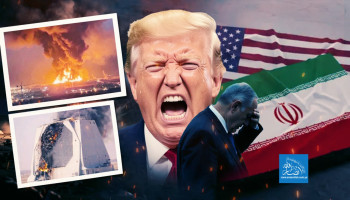
The American–Israeli war on Iran has entered its second week, marking a historic moment whose strategic outcomes include the collapse of the long-promoted narratives of “defending democracy” and “protecting allies.” In their place, the world is witnessing the core of a Zionist doctrine manifested through direct practice and reinforced by blunt imperial rhetoric. This rhetoric, aligns with Zionist Jewish tendencies that derive their ideological justification from what they regard as distorted biblical interpretations and doctrinal claims, reviving the concept that “the victor seizes the spoils.”
What is happening today in Iran is an unjustified and unacceptable aggression- according to all international norms, laws, and basic human rights principles- is organically linked to events in Venezuela and plans directed toward Cuba. The conflict serves to advance a doctrine of Zionist supremacy and the unrestricted violation of the sovereignty of states and regimes while accelerating competition for energy resources and strategic minerals in the twenty-first century.
The Doctrine of “Seizure”: From Caracas to Tehran
American President Trump left little room for interpretation when he stated days ago—according to Reuters and the New York Post—that Venezuelan oil had begun flowing into American refineries in Houston. Speaking with absolute opportunism, Trump said: “They don’t have oil now… we’re taking the oil.”
This mindset, was already applied by Washington in Venezuela through the seizure of oil tankers and control over energy facilities.Trump openly aspires to repeat this in Iran; According to reports cited from China’s Xinhua News Agency, Trump is said to have expressed interest in pursuing forced cooperation with Iran in future oil production, similar to what occurred in Venezuela, while at the same time confirming his personal insistence on choosing the next leader of Iran to ensure the flow of wealth towards the West.
The openly declared American ambitions—historically unprecedented in their bluntness—were echoed in remarks by U.S. Secretary of State Marco Rubio during the Munich Security Conference in February 2026. Rubio reportedly called for a return to an era of Western dominance, describing the decline of colonialism after World War II as a historical deviation that should be corrected.
According to Global Journal Polis, Rubio’s speech did not focus on human rights but instead emphasized the need to control “critical minerals” and re-subjugate the Global South as a necessity for protecting “Western civilization.” Critics argue that such statements, despite their lack of diplomatic restraint and disregard for established norms governing international relations, reflect an expansionist Zionist mindset often expressed by Zionist leaders and figures. Among the most recent examples cited was the U.S. ambassador to the Zionist entity, Huckabee, who revived discussions about a “New Middle East” and, at times, the notion of “Greater Israel.” Such statements, have been repeated without provoking significant reaction among Arab populations.
Within this context, comments by Republican Senator Lindsey Graham have been viewed as shedding further light on the American–Zionist strategy toward Iran. His remarks reportedly went beyond the typical language used in American statements warning about the Iranian government or emphasizing regional security and democracy. Instead, they included explicit references to economic ambitions, geopolitical calculations, and even religious dimensions underlying the conflict, including the desire to control vital energy resources and Iran’s strategic global position.
According to critics, Graham’s statements reveal the growing scope of American ambitions to access global oil resources, reflecting a new Zionist strategic vision aimed at securing the largest possible share of global oil reserves and influencing the balance of international power, including competition with China. These economic ambitions intersect with direct military actions, as Graham reportedly called on Gulf states—particularly Saudi Arabia and the United Arab Emirates—to participate directly in military operations against Iran.
Iranian Political Developments
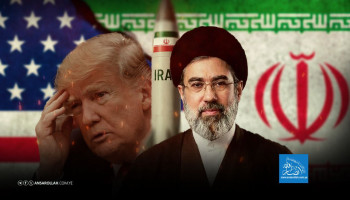
Amid the escalating conflict, Iran delivered what commentators one of the most significant responses to the American-Zionist plan since the start of hostilities. This came with the election of Mojtaba Khamenei as Iran’s new Supreme Leader. The move was accompanied by massive public demonstrations across Iranian cities, with millions reportedly taking to the streets in support.
In this context, Graham’s reaction was interpreted by analysts as reflecting a degree of shock in Washington at the unexpected Iranian step. The development is viewed by critics as evidence of the failure of the American strategy that sought to balance military pressure with economic and political control. It also highlights the risks Washington faces of jeopardizing broader strategic interests and undermining its vision of the region as a central component of long-term American strategy in the Middle East and beyond.
Objectives of the American–Israeli War on Iran
Graham sparked widespread controversy due to recent remarks about the war on Iran, in which he discussed the objectives of the American–Israeli campaign in an unusually candid and controversial manner at both political and regional levels.
According to reports by The Wall Street Journal, Graham said the war against Iran was worth the financial cost if it resulted in the collapse of the Iranian government. In an interview with Fox News, he stated:“When this regime collapses, we will have a new Middle East, and we will make enormous profits.”
Graham, known for his consistent support for American military interventions abroad, described the attack on Iran and the control of its oil reserves as a major strategic opportunity. He added:“Venezuela and Iran hold 31 percent of the world’s oil reserves. We will get a partnership with 31 percent of the known reserves. That’s a nightmare for China. It’s a good investment.”
Iran, however, has long asserted that it is fully aware of Zionist ambitions and the objectives Western countries are pursuing within its borders. Iranian officials have accused the United States of attempting to seize oil resources and divide the country.
Iranian Foreign Ministry spokesman Esmail Baghaei stated:
“Their determination is clear, their objective is clear. They seek to divide our country and illegally seize our oil wealth. Their goal is to violate our sovereignty, defeat our people, and undermine our humanity.”
The Second Target: The Strait of Hormuz
Regarding military escalation, Graham indicated that American–Israeli strikes on Tehran would expand in the coming weeks. He said the United States would confront any threat in the Strait of Hormuz, declaring:“No one will threaten the United States in the Strait of Hormuz again.” He added: “This regime is on the verge of collapse. It will be on its knees, and when it falls we will witness peace and prosperity unlike anything we have ever seen,” he claimed.
Calls for Saudi and Emirati Participation
During the same interview, Graham called on the United Arab Emirates and Saudi Arabia to join the strikes against Iran. He stated:“Yes, I want them to enter the fight. We sell them weapons, Iran strikes their countries, and they have good capability.”
He also suggested that the United States might subsequently turn its attention to Cuba, stating: “Watch the liberation of Cuba. We are advancing in the world and cleaning it of bad elements. Cuba is next.”
Prior to these remarks, Graham had made several visits to Israel, where he met with Mossad officials and the Criminal Netanyahu. According to the Journal Street newspaper, Graham said he had effectively “trained” Netanyahu on how to pressure President Trump to take action.
Graham further stated that Netanyahu had presented intelligence to Trump that convinced him to launch the joint war against Iran, amid longstanding Israeli claims that Tehran seeks to develop nuclear weapons—claims Iran rejects, maintaining that its nuclear program is solely for civilian purposes.
Prospects for Saudi–Israeli Normalization
Graham also expressed optimism about reaching an agreement to normalize relations between Israel and Saudi Arabia before the end of the year. He said he had discussed the issue with the Criminal Netanyahu.
These efforts are linked to the expansion of the Abraham Accords, which were signed during Trump’s first presidency and led to normalization agreements between Israel and the United Arab Emirates, Bahrain, and Morocco.
Graham expressed confidence that Saudi Arabia could eventually join the accords and indicated that Saudi Crown Prince Mohammed bin Salman supports the agreement. He warned that failing to achieve normalization could negatively affect the Crown Prince’s economic ambitions.
“Israel” as the Operations Room of Empire
At the heart of this farce - which is unfortunately occurring amid Arab inaction and Muslim neglect—statements continue alongside military implementation, the latest of which are the statements of Senator Lindsey Graham, which are the most revealing of the nature of the conflict, in which he renewed the emphasis that the war, in its essence and true substance, is a "biblical religious war".
Critics argue that such statements merely reflect the Zionist mindset they believe dominates American policymaking and directs U.S. actions toward achieving Zionist interests worldwide.
Reference is often made to the memoirs of John Bolton (U.S. National Security Advisor) we find that the pursuit of resource acquisition has been a primary driver of American expansionist wars, inlcuding the takeover of Venezuela, which Trump reportedly described as “wonderful” because the country possesses the world’s largest oil reserves.
This link also appears in comments by General Laura Richardson (commander of U.S. Southern Command), who openly referred to the “lithium triangle” in South America as a matter of American national security. The same approach is now being applied to Iran and Cuba: economic strangulation of populations not to achieve democratic transformation, but to ensure that strategic resources remain under American control.
Graham—who met with Netanyahu—reportedly stated explicitly that “the wars of the future are planned here in Israel,” describing military cooperation as a “Manhattan Project for the twenty-first century.”
He also pointed to the financial motivations behind the conflict, acknowledging that Iran possesses mineral resources—such as lithium, copper, and gold—valued at approximately one trillion dollars. Control of these resources, he suggested, would be the only way to offset the costs of an extended war of attrition.
About a month earlier, Graham made similar remarks in parallel with a “colonial declaration” by Secretary of State Marco Rubio at the Munich Security Conference. Rubio openly called for a return to Western domination over the Global South, describing the post–World War II era and the rise of liberation movements as a historical deviation requiring correction.
This discourse represents the "philosophical cover" for the Zionist mentality; it legitimizes genocide, siege, exploitation, and the destruction of peoples as long as this serves to restore "Western prestige." The embargo on Cuba and the massacres in Gaza are not isolated events, but rather symptoms of a "civilizational structure" that views the sovereignty of the peoples of the Global South as a "deviation from the norm." This amounts to an admission that provides an explanation for the contradiction in American propaganda. While Washington claims it came to protect the Gulf, America's new leaders reveal the Zionist objectives of America as a partner of the Zionist entity without embellishment or pretense, justifying why Washington accepts the risk of fighting and exposing its American soldiers to Iranian missiles. It is a "strategic choice" to achieve Zionist imperial ambitions and seize the spoils.
Iranian Deterrence and the Failure of American “Protection”
In contrast, Tehran has demonstrated tactical intelligence in exploiting weaknesses within this imperial doctrine.
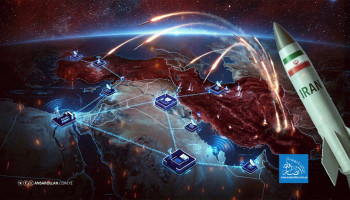
Within days of the attack against it, Iran reportedly succeeded in reducing traffic through the Strait of Hormuz by 90 percent, according to estimates by Goldman Sachs. This development transformed the war into a massive financial burden on the United States, whose daily military expenditure was estimated at approximately $891 million.
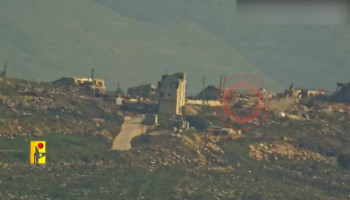
Iranian deterrence extended beyond oil markets to American interests across nine Arab countries hosting U.S. bases and facilities. Ali Larijani, Secretary of Iran’s Supreme National Security Council, delivered a firm message:
“Any use of American bases in the region against us will keep American interests within our targeting circle.”
The limitations of the American security umbrella have become increasingly evident as U.S. officials call on Arab governments to join the war. Critics argue that Washington’s inability to fully protect its own military bases from Iranian strikes suggests it may be unable to protect its allies.
While the Arab League continues to hold “televised summits” and issue statements condemning violence without identifying the party responsible for initiating the conflict, Iran continues to send deterrent messages. Tehran insists that escalation will remain directed specifically at American interests unless the aggression ceases.
An Empire Seeking Open Plunder
The comparison between Washington’s actions in Venezuela and its current strategy toward Iran—and its potential plans regarding Cuba—reveals a deeply troubled civilizational structure increasingly shaped by Zionist ideology.
Political analyst Caitlin Johnstone characterizes this structure as returning to its classical essence: domination through force and limitless exploitation, with the war on Iran representing its latest chapter.
As oil prices reached $90.90 per barrel and Barclays forecast a possible rise to $120, ambitions expressed by figures such as Graham, Trump, and Rubio may collide with economic realities capable of undermining the myth of absolute dominance.
In the end, the ultimate victor in resource wars may not be the side with the greatest firepower, but the one capable of enduring the financial earthquake created by the conflict. According to this interpretation, Iran has skillfully leveraged that economic pressure against both its attackers and those who remain silent in the face of the war.