
Ansarollah Website | Report
In a development carrying dimensions that extend far beyond a passing military or political event, dawn on Friday, July 3, 2026, marked a pivotal moment in the history of the conflict with the US-backed Saudi adversary. This occurred when a formation of Saudi warplanes attempted to intercept an Iranian civilian aircraft carrying over two hundred stranded, wounded, and sick Yemeni citizens en route to Sana'a International Airport. The move represented a violation of Yemeni airspace and embodied a fierce Saudi determination to maintain the blockade and hegemony equation it has imposed on Yemen for eleven years. However, the failure of this attempt—owing to the intervention of Yemeni air defense forces, which forced the hostile aircraft to withdraw—and the subsequent declaration of a comprehensive campaign to break the siege, signaled the dawn of an entirely new phase in the balance of power and rules of engagement.
The military statement issued by the Yemeni Armed Forces constitutes a multi-dimensional strategic declaration. Its significance goes beyond immediate military confrontation, serving as an announcement marking the end of the "no war, no peace" stalemate that Riyadh has long relied upon, and launching a decisive path toward ending the blockade, occupation, and stripping away Saudi guardianship over Yemeni decision-making.
What are the multi-faceted dimensions of this step? What are its direct sovereign implications, and its regional and international repercussions?
The Aerial Blockade as a Tool for Hegemony and Humiliation
Since the Saudi-led coalition declared its war on Yemen in March 2015, the comprehensive aerial blockade has been one of the most prominent and severe manifestations of this war. This ban evolved into a fully-fledged political tool aimed at striking at the core of Yemeni sovereignty. For eleven years, Saudi Arabia deliberately maintained absolute control over air traffic to and from Yemen, to the extent that United Nations aircraft themselves could not take off or land at any Yemeni airport without prior permission from Riyadh. This reality constituted a flagrant violation of international law, embodying a Saudi mindset of guardianship that treats Yemen as a dependent territory rather than a sovereign state.
Notably, even during periods of humanitarian de-escalation, Saudi Arabia imposed humiliating conditions on the exceptional flights permitted to transport patients to Jordan and Cairo. It designated specific destinations, imposed complex security procedures, and subjected flights to a prior-approval mechanism that undermined national sovereignty. This conduct sent a clear message: the return of life to Yemeni airports was not viewed as a sovereign right for Sana'a, but rather as a Saudi concession subject to revocation at any moment.
The Iranian Aircraft: A Deliberate Strategic Challenge
Against this backdrop, the arrival of the Iranian aircraft at Sana'a Airport represents a qualitative shift in the nature of the conflict. While this flight served a humanitarian mission to transport patients and stranded citizens, it was simultaneously a highly political act aimed at breaking the aerial blockade from a strategic standpoint. Tehran—in clear coordination with Sana'a—chose to challenge the Saudi blockade framework and operate on the premise that Yemeni airspace belongs to a fully sovereign state.
What doubles the significance of this move is its timing. It comes after a series of major strategic developments across the region, chief among them Yemen's operations in support of Gaza—which demonstrated immense military capabilities—the direct confrontation with US fleets in the Red Sea, and the US-Yemeni agreement that implicitly recognized Yemeni capabilities. These factors combined to make the Iranian flight a practical test of Saudi Arabia's ability to sustain its hegemony, and a clear message that the era of compliance with Saudi dictates has permanently ended.
Saudi Military Failure: A Dual Message
The attempt to intercept the Iranian aircraft by dispatching a formation of Saudi fighter jets revealed Riyadh's insistence on preserving the old rules of engagement. However, it simultaneously exposed the limits of its ability to enforce its will. The failure of this attempt—owing to the response of Yemeni air defenses, which forced the Saudi aircraft to withdraw—is both a military success and a dual strategic message:
- To Saudi Arabia: Signaling that Yemen’s skies are no longer an open arena for displays of Saudi power, and that any attempts at intrusion will face prompt and effective deterrence.
- To the International Community: Demonstrating that Sana'a is now capable of securing its own airspace, and that bets on the continuation of the aerial blockade have become losing propositions.
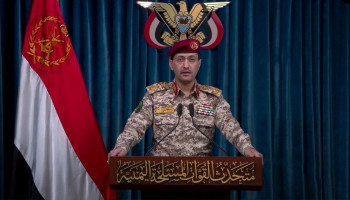
The military statement articulated this shift by warning the criminal Saudi enemy against "repeating any attempt to violate the airspace or conduct any aggression targeting our country, as it will be met with a comprehensive response targeting its airports and vital interests on land and at sea." This direct language is now backed by field-proven deterrent capabilities, which will be analyzed in detail later.
Turning the Page on "No War, No Peace": An Anatomy of the De-escalation Phase
Since the announcement of the "de-escalation" phase in April 2022, Saudi Arabia bet on a strategy predicated on buying time and managing the conflict rather than resolving it. This strategy manifested in offering limited, superficial concessions while maintaining the core status quo: continuing the blockade, freezing major sovereign issues such as occupation and control over resources, and preserving Saudi hegemony over Yemeni decision-making.
For its part, Sana'a made significant concessions during this phase, both on humanitarian and political levels. It accepted scaled-down formats for humanitarian flights, engaged in various mediations, and demonstrated remarkable flexibility in negotiation tracks. However, the outcome was consistently the same: Saudi procrastination, backtracking on commitments, and an absolute absence of any genuine political will to end the aggression and blockade.
This pattern of Saudi behavior was not the result of an inability to implement agreements, but rather a deliberate strategy based on a calculated assessment of the balance of power. Riyadh wagered that the prolonged blockade and economic warfare would ultimately weaken the Yemeni position and that time was on its side. However, what it overlooked is that in asymmetric warfare, time can work in favor of the party that remains resilient, enhances its capabilities, and redefines the terms of the conflict.
Exhausting the Cards of Patience: Why Now?
The recent military statement by the Armed Forces, alongside the speech delivered by the Leader, Sayyid Abdul-Malik Badreddin al-Houthi, at the start of the new Hijri year 1448 AH, clearly announced that Sana'a has exhausted all cards of patience and flexibility, and that the "de-escalation" phase relied upon by Saudi Arabia has come to an end. The question arises: why now in particular?
The answer lies in a combination of concurrent strategic variables:
- First: Yemen's operations supporting Gaza proved that the country is no longer the weak, isolated party it was in 2015. The missiles and drones that crossed over 2,000 kilometers to strike targets deep within the Israeli entity, and which forced US fleets to withdraw from the Red Sea, marked a qualitative shift in the strategic deterrence matrix.
- Second: The US withdrawal from the confrontation with the Yemeni military in the Red Sea, following its failure to achieve its operational objectives against Yemen, exposed a decline in the American commitment to protecting Saudi interests against real threats. This shift shook one of the foundational pillars upon which Riyadh based its reliance on the blockade.
- Third: Regional shifts, primarily the reinforcement of Iran's strategic position, demonstrated that the power dynamics in the region are no longer what they used to be. Tehran's willingness to directly confront the Saudi aerial ban is an indicator that regional calculus has fundamentally changed.
- Fourth: Domestically, the level of popular mobilization and societal readiness reached unprecedented heights, providing Sana'a with a solid foundation to transition into a more decisive phase in confronting the blockade.
From Conflict Management to Deciding the Battle
Thus, the statement of the Armed Forces represents a transition from the logic of conflict management to the logic of deciding the battle. This is a major strategic shift, meaning that Sana'a no longer accepts that the pace of progress toward ending the blockade and occupation remains subject to the Saudi tempo. Instead, the initiative shifts to Yemeni hands, which are now imposing new equations through a policy of fait accompli.
The Armed Forces' declaration that "the flight path between Sana'a and Tehran will continue regardless of the outcomes and consequences" is an announcement of Sana'a's intent, placing Saudi Arabia between two choices: either voluntarily accept the lifting of the blockade or watch as we continue to break it step-by-step within a comprehensive confrontation. In either scenario, the aerial blockade equation that Saudi Arabia sought to impose has effectively come to an end.