
Ansar ollah Website | Report by: Yahya Al-Shami
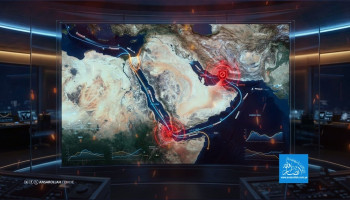
In a defining moment demonstrating Yemen’s capacity to translate military warnings into tangible strategic pressure, the "Embargo for Embargo" equation has reshaped the battlefield, subjecting the Saudi economy to a grueling test that media censorship can no longer obscure. In the early hours of Saturday—between dawn and sunrise—waves of Yemeni missiles struck global oil giant Aramco at two vital locations: Jizan in southern Saudi Arabia and Yanbu in the west. The military operation came as a direct response to Saudi escalation targeting Hodeidah, its port, and Kamaran Island, practically marking the launch of the Third Statement in the campaign to break the blockade.
It was an indelible day for the Saudi oil giant, marked by two coordinated military operations targeting Aramco’s facilities in Jizan and Yanbu.
Temporally, the missile strikes unfolded over extended intervals from Saturday dawn into the morning, according to statements by Saudi defense authorities, which highlighted the timing of the attacks in an unprecedented exposure of the region’s security posture.
As Western, American, and European air defense systems failed to intercept the successive strikes, authorities swiftly moved to restrict coverage and suppress media images to mitigate public fallout. However, limited leaks emerging from Jizan and Yanbu depicted thick plumes of smoke obscuring the sunrise, pointing to severe damages and struggling firefighting operations. The visuals underscored the precision of the Yemeni ballistic missiles, cruise missiles, and drones. While Saudi Arabia has managed to minimize the media footprint of the operations, the surge of red indicators across global financial markets reflects a reality Riyadh cannot manipulate or suppress—a trajectory expected to deepen in the coming hours and days.
Fallout of the Maritime Embargo on Saudi Shipping:
The strikes on oil infrastructure represented the land-based extension of far more consequential maritime operations conducted in the Red Sea a day earlier. Yemeni forces targeted the Saudi oil tankers Incilia and Laila for violating the embargo directive, triggering an immediate spike in crude prices and maritime insurance premiums. War risk insurance costs for certain underwriters doubled, exceeding baseline guidance of 1% of total vessel value—up from fractions of a percent in previous weeks. For vessels tied to Saudi Arabia departing Jizan, Al-Shaqeeq, or transiting Bab al-Mandab Strait, surcharges surged up to 3%, adding hundreds of thousands of dollars to single voyage costs and placing these ships in the highest risk category according to British maritime security firm Ambrey.
The escalation pushed Brent crude above the $100-per-barrel mark, capping a sharp weekly surge of nearly 14%. The ripple effects reached U.S. consumers as gasoline prices breached $4 per gallon, while Goldman Sachs warned that prolonged shipping restrictions could drive crude past $120 per barrel, threatening the most severe supply disruption since the onset of the U.S.-Zionist aggression against Iran.
The severe disruption led maritime analytics firm Kpler to register a sharp 36% decline in crude loadings via Bab al-Mandab over a two-week period, forcing several laden Saudi tankers to divert toward Suez Canal. This left Riyadh facing what Lloyd’s List Intelligence described as a "double blow": Saudi Arabia, which had redirected roughly 70% of its crude exports to the Yanbu terminal via the East-West Pipeline to bypass the Strait of Hormuz, has now lost the safety of its primary alternative route. In this context, the Financial Times revealed that major global insurers, including Ascot and Navium, notified brokers of their readiness to cancel existing policies and withdraw coverage for Saudi-linked vessels in the Red Sea, even those flying foreign flags.
Citing insurance brokers at Marsh, reports confirmed that Saudi Arabia is now subject to the same high-risk status applied to the Israeli entity, the United States, and Britain. This undermines official Saudi narrative and reinforces the Yemeni position strictly enforcing the embargo against Saudi interests until the blockade on Yemen is lifted.
Costly Alternatives:
The economic burden resulting from rerouting oil and refined product tankers from Yanbu and Red Sea ports toward northern routes—via Suez Canal, the Mediterranean, and around the Cape of Good Hope—incurs steep additional expenditures. Daily detour costs are estimated at $25 million to $36 million, bringing baseline monthly operational costs to approximately $933 million, with potential spikes exceeding $1.3 billion per month should congestion intensify along Suez Canal and the SUMED pipeline.
Additionally, Saudi commercial sectors face severe strains due to the redirection of container and cargo vessels servicing the ports of Jeddah, Yanbu, and Jizan. This adds direct monthly costs ranging between $200 million and $520 million, reaching an estimated $400 million monthly when accounting for indirect losses such as inventory delays and project disruptions.
This supply chain turmoil has directly impacted the Saudi construction and contracting sectors due to delayed deliveries of heavy machinery and building materials, compounded by surging freight and insurance rates. Under these unfolding circumstances, economic projections indicate that if the Yemeni embargo extends to a total prohibition on Saudi oil exports from Red Sea ports, Riyadh faces potential daily revenue losses ranging between $460 million and $485 million. This puts nearly $14 billion in monthly revenue at risk of complete interruption, potentially rising to $16.5 billion during peak export volumes.
These figures decisively illustrate the impact of Yemeni deterrence in leveraging the blockade into an effective strategic instrument encircling the Saudi economy. The evolving dynamics establish a new equation: Riyadh's economic stability remains contingent on lifting the blockade on Yemen, offering the Saudi regime a clear path to fulfill Yemeni demands directly without delay or procrastination.