
Ansarollah Website | Report
The global financial and economic architecture cannot be understood as a set of neutral rules governing international trade. Rather, it functions as an arena reflecting global power dynamics—a framework crafted by dominant powers to perpetuate their hegemony through mechanisms far more sophisticated than direct military occupation. What is framed today as "globalization" and "economic integration" is, in reality, a cover for a systematic drain of resources. This system transforms the wealth of nations, particularly in the Arab region, into fuel for industrial growth in Western countries, led by the United States, while leaving resource-rich nations in a position of dependency, selling raw materials at bargain prices only to import them back as manufactured goods at exorbitant markups.
This architecture was designed to deliver structural gains to wealthy nations at the expense of the developing world. The figures underscore this reality: according to the World Inequality Report 2026, published by the World Inequality Lab at the Paris School of Economics, fewer than 60,000 ultra-wealthy individuals control more than three times the combined wealth of the bottom half of the global population—roughly 2.8 billion people. Furthermore, the global financial system is structurally biased toward rich nations, which borrow at lower interest rates and invest in higher-yielding assets, while developing countries pay elevated interest on their debt, hold low-yield assets, and suffer annual net capital outflows.
US and the Zionist Entity: The Architecture of Dual Hegemony
The United States stands at the apex of this financial structure, serving as the primary architect of the post-World War II global financial system and guardian of its rules through institutions established for this purpose: the International Monetary Fund (IMF), the World Bank, and the Federal Reserve system. Researchers and analysts have documented how IMF and World Bank policy—specifically the Structural Adjustment Programs imposed on dozens of developing nations over recent decades—systematically integrated developing economies into the global capitalist system as subordinate, exploited entities, effectively reproducing colonial dynamics in a modernized format.
Recent data highlights the depth of this structural disparity: the top 10% of global earners capture 53% of global income, compared to just 8% for the bottom 50%. In terms of wealth, the top 10% own approximately 75% of global wealth, while the bottom half holds merely 2%. Most strikingly, the top 0.001%—roughly 56,000 individuals—saw their share of global wealth rise from 3.8% in 1995 to 6.1% by 2025, demonstrating that the system operates primarily to concentrate capital in fewer hands.
Within this framework, the Zionist entity functions not as a passive bystander, but as the military arm and forward logistics center for the US project in the Islamic world—a security guarantor ensuring the uninterrupted flow of regional wealth and oil to Western markets. The entity's persistence relies directly on three interconnected forms of US support: military (advanced precision weaponry), financial (over $3 billion annually in direct aid, alongside loans and guarantees), and diplomatic (the US veto in the UN Security Council protecting it from adverse resolutions).
Beyond this, the entity actively advances US imperial objectives by securing vital trade corridors, safeguarding oil and gas transit routes, and neutralizing regional powers opposing Western influence.
The military campaign launched by the US and the Zionist entity against Iran in March 2026 exposed this structural relationship. Just one day after the US-Zionist strike on Iran's South Pars gas field—which supplies roughly 80% of Iran's domestic gas needs—the war criminal Benjamin Netanyahu articulated a regional vision featuring oil and gas pipelines traversing the Arabian Peninsula toward "Israel" and its Mediterranean ports. This vision aligns with long-term US-Zionist strategy aimed at reshaping West Asia, disarming regional opposition to their expansionist project, and securing West-bound energy flows at controlled prices.
Normalization: Political Instrument of Structural Dependence
Normalization plays a critical role in consolidating this economic and security hegemony. Normalization agreements with neighboring Arab states to Palestine have established asymmetrical economic and security dependencies while fostering an Arab elite class invested in the continuation of the Zionist project in exchange for US security and economic backing. Thus, financial levers (US dominance over the global monetary system and Bretton Woods institutions), military assets (the Zionist entity as a forward base for Western power), and political mechanisms (normalization agreements) combine to form an integrated colonial system designed to maintain regional subordination and resource extraction indefinitely.
Mechanisms of Economic Coercion
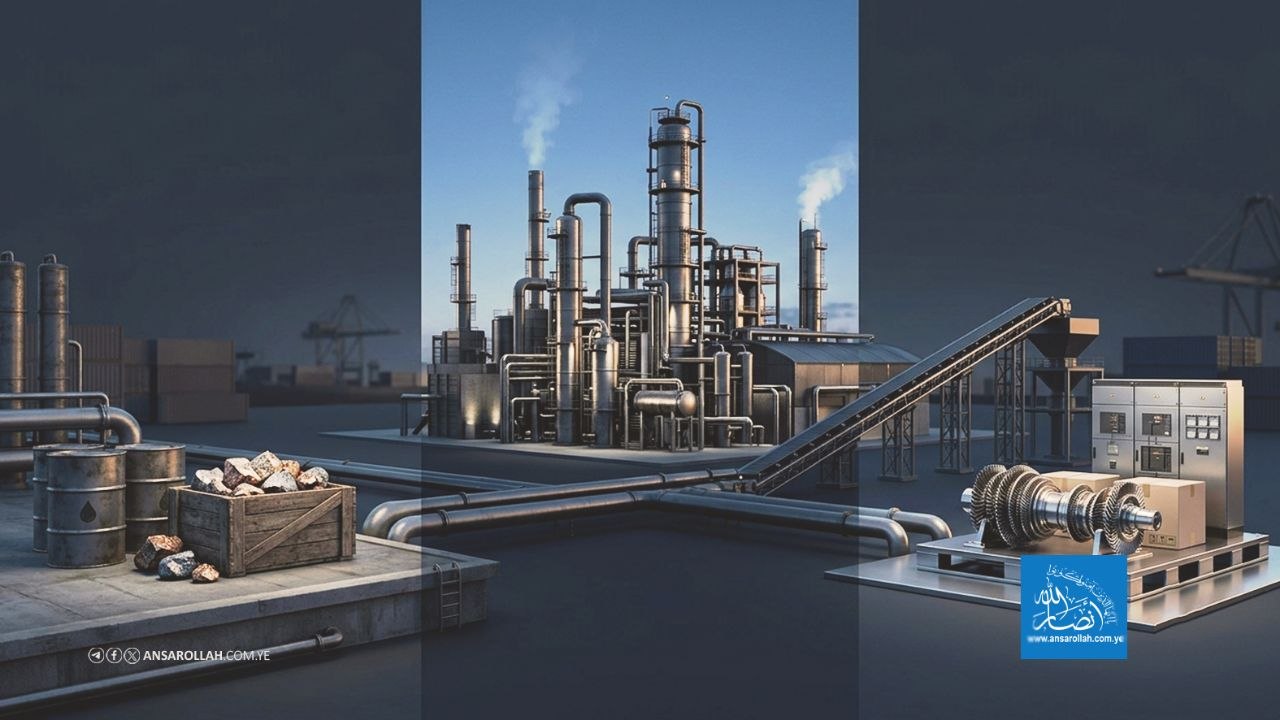
This resource-drain cycle operates along a clear trajectory: the export of low-cost raw materials from resource-rich states, offshore processing and technological development in Western nations, and the re-export of finished products back to source nations at marked-up prices. This model generates monopoly profits for global corporations while entrenching economic dependence. UNCTAD's 2025 reports indicate that two-thirds of developing nations—95 out of 143—remain commodity-dependent, a figure exceeding 80% among Least Developed Countries (LDCs).
In the Arab region, where oil, gas, and mineral exports constitute the vast majority of export revenues, states remain structurally disadvantaged against global corporate monopolies through several key mechanisms:
- Multinational Corporate Dominance: Transnational corporations control key exploration, extraction, and refining technologies, giving them immense leverage over host nations lacking technical capacity and capital.
- Technological and Knowledge Monopolies: Western firms maintain exclusive control over exploration and processing technology, preventing resource-rich nations from developing independent domestic manufacturing capabilities.
- External Commodity Pricing: Raw materials are priced on foreign exchanges (such as the London Metal Exchange and the New York Mercantile Exchange), exposing primary producers to industrial price volatility beyond their control.
- Asymmetrical Contracting: Long-term extraction rights are granted under terms offering low royalties and taxes—ranging between 2% and 15% of output value—with minimal requirements for local content or domestic processing.
- Transfer Pricing and Environmental Externalization: Corporate affiliates use transfer pricing to reduce local tax liabilities, while host nations absorb the environmental costs—including land degradation and water depletion—without compensation reflected in raw material pricing.
The Value-Added Gap
The price disparity becomes evident as raw materials move to Western processing hubs:
- Aluminum Value Chain: Bauxite extraction represents roughly 13% of the total value chain, whereas the smelting and advanced manufacturing stages capture 62% of the overall added value.
- Oil and Gas Value Chain: Processing crude oil into advanced petrochemicals, specialized polymers, and medical-grade compounds can yield an added value 8 to 15 times higher than selling crude directly as fuel.
- Phosphate Value Chain: Unprocessed rock phosphate trades internationally at $100–$150 per ton. When processed into phosphoric acid, complex fertilizers, or specialty chemicals used in electric vehicle batteries, its value reaches $1,200–$3,000 per ton.
UNCTAD and World Bank analyses indicate that raw-material-exporting nations lose between 70% and 90% of the potential economic value of their resources. For example, an Arab nation exporting 1 million barrels of crude oil per day at $70 per barrel generates $70 million daily. If that volume were refined locally into petrochemicals, its value would reach $150–$200 million daily—representing an annual loss of $29–$47 billion in potential value added, captured instead by foreign industrial conglomerates.
Stark Contradictions: Resource Wealth and Entrenched Dependence
The cycle of "raw materials → offshore manufacturing → re-exportation → mega-profits" forms the core mechanism anchoring resource-rich nations—chiefly Arab and Islamic states—in perpetual dependency on US-Zionist hegemony, leaving them at the mercy of those who control technology, capital, and global supply chains.
This status is not merely the result of temporary external shocks, but the product of structural conditions built over decades through unequal trade arrangements, structural adjustment mandates, and financial engineering overseen by Western-dominated international institutions.
This contradiction is particularly stark in the Gulf region, where sovereign wealth funds hold an estimated $5 trillion in assets, alongside an additional $2–$3 trillion in foreign investments. The majority of these funds are deployed in Western markets—US Treasuries, European equities, and real estate in London, Paris, and New York—effectively financing Western economies rather than funding local industrial and technological capacity.
Concurrently, the region imports nearly $740 billion annually in manufactured goods, technology, pharmaceuticals, and food—more than double its combined spending on education, healthcare, and research and development. This dynamic exemplifies a rentier dependency model, where natural resource revenues finance consumption and foreign investments without building domestic productive capacity, widening the regional technology gap.
The Vicious Cycle: Exporting Raw, Importing Manufactured
Arab states import between 70% and 90% of their finished goods—often derived from the very raw materials they exported at low cost. This sustains a self-reinforcing dynamic: exporting raw inputs leads to importing high-cost finished goods, accumulating trade deficits, relying on conditional foreign debt, and deepening economic dependency. International lending institutions enforce conditions that further constrain economic sovereignty.
Here, the colonial dimension of this equation becomes starkly apparent. Keeping the Arab region locked into the role of a primary supplier of raw materials—while suppressing local industrialization—is no mere oversight or negligence. Rather, it is a deliberate, systematic strategy designed to secure an uninterrupted, low-cost flow of natural resources to Western markets. Concurrently, this creates a vast consumer market for Western and Zionist manufactured goods, trapping the region in a cycle of economic deficits and debt that renders it increasingly vulnerable to foreign dictate.
In light of this analysis, no serious practitioner can plausibly argue that such dependency is accidental or simply the natural evolution of global markets. The evidence, backed by data and realities on the ground, clearly demonstrates that this entire structure is nothing less than a modern reboot of colonialism in a financial-technological guise. It was meticulously designed to guarantee the perpetual siphon of wealth from the Global South to the Global North, entrench dependency for generations to come, and consolidate US-Zionist hegemony over the levers of the global economy.
The data and structural realities demonstrate that this ongoing dynamic is a modernized financial and technological extension of historical colonial patterns, designed to maintain resource transfers from the Global South and preserve systemic economic dominance.