
Ansarollah Website. Report
In a desperate attempt, the war criminal Netanyahu tried to derail the exchange of messages between Tehran and Washington aimed at ending the status quo following a bloody war in which the Islamic Republic proved its ability to be a strong and unbreakable adversary. At the same time, Netanyahu claimed that his entity is stronger than ever.
Some believe that Netanyahu's statements reflect a deep sense of frustration resulting from the widening gap between his alleged dream of reshaping the region according to the grand Zionist plan, a gap created by the strength of the Islamic Republic.
The 14 points presented by the Islamic Republic demonstrate confidence and the setting of conditions by a powerful nation, contrary to what the enemy has tried to portray. Iran, which presented its proposal in three phases, emphasized—if the enemies truly desire peace—the necessity of a comprehensive ceasefire leading to an end to the war within a maximum of 30 days. This includes all fronts in the region, including Lebanon, with a commitment not to attack again and the establishment of an international body to guarantee that war will not resume.
Iran would also begin a gradual reopening of the Strait of Hormuz and assume responsibility for mine clearance and managing the strait, concurrently with the withdrawal of US forces from the Iranian periphery and the lifting of the blockade on its ports.
The Iranian proposal also upholds Tehran's right to a peaceful nuclear program and uranium enrichment. It rejects any attempts to dismantle nuclear infrastructure or destroy facilities, while allowing for the dilution of highly enriched uranium, and emphasizes the release of frozen assets.
No discussion about the nuclear issue
At this time, Iranian Supreme Leader Ayatollah Mojtaba Khamenei also requested that the nuclear file not be discussed during the negotiations, according to Mojtaba Zarei, a member of the Iranian Parliament's National Security Committee, quoting the head of the negotiating team, Mohammad Bagher Ghalibaf. According to Zarei, Ghalibaf explained that, by "the permission of the Supreme Leader," the head of the Atomic Energy Organization of the Islamic Republic was barred from being part of the negotiating team. As is its custom the US, in its tendency to replace facts with illusions, circulated talk on Monday about the inclusion of the nuclear issue in the negotiations, which Tehran immediately denied.
Further evidence of Iran's firm conviction in its ability to maintain the balance of power, and that its proposals are aimed at promoting peace, is that it did not wait to comment on Trump's last-minute attempt to hint at a possible return to war. Instead, it presented the deluded American president with two options, and onltwo: accept the agreement, however reluctantly, or suffer the consequences of a losing wa
Capable of Confronting the Pirates
Iran's apparent steadfastness and conviction that the enemy is not in a position to dictate terms or maneuver effectively shatters the illusion of Netanyahu, who is trying to salvage what little credibility he and his entity retain among the hordes of usurpers of Palestinian lands.
In this context, the Iranian Revolutionary Guard Corps (IRGC) asserted that "the margin of maneuver available to the United States in decision-making has shrunk," stating that Trump must "choose between an impossible operation or a bad deal with the Islamic Republic of Iran." The Supreme Leader's military advisor, former IRGC commander-in-chief Mohsen Rezaei, further emphasized that "the United States is the only pirate in the world that possesses aircraft carriers." He declared, "Our ability to confront pirates is no less than our ability to sink warships." He added, "Prepare to see your aircraft carriers and your forces end up in the graveyard."
Imposing Sovereign Decision on the Strait
According to observers, Trump's behavior on Monday carried profound implications. Having barely responded to Tehran's 14 points, Trump embarked on a futile attempt in the Strait of Hormuz that ended in a resounding failure. He claimed to be conducting what he termed a "humanitarian" operation to free the stranded ships. While this action clearly aimed to break the stalemate in the Strait, especially given the abject failure of his attempt to pressure Iran by imposing a blockade on its ports, forcing Trump to quickly back down, it also sought to curb rising energy prices on the one hand, and to convince domestic and international allies that his country still holds the final say anywhere in the world, including the Strait of Hormuz. Accordingly, Trump—as did the US Treasury Secretary—claimed that the Strait was under the control of US forces and that ships had indeed transited it. However, this American assertiveness was short-lived, as Trump quickly withdrew his Hormuz plan.under the pretext Pakistan's request for de-escalation.
Tehran has once again dealt a blow to the US and the White House, not only by refuting American claims but also by taking practical steps to protect its sovereign control over the Strait. At various leadership levels in Tehran, the emphasis has consistently been that any action taken without coordination with the Iranian side, or without adhering to the protocols and mandatory arrangements established by the Revolutionary Guard for those wishing to transit the Strait and await permission, will be met with a strong and decisive response.
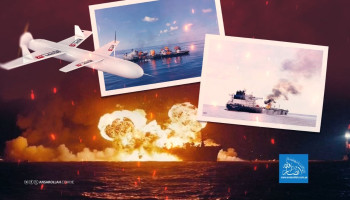
The Iranian position was effectively demonstrated on Monday when Trump moved his destroyers toward the Strait. Tehran's navy responded immediately, targeting the destroyer with two missiles, forcing it to "stop its course, turn around, retreat, and flee the area," according to Fars News Agency. Trump's gamble not only deepened the sense of American defeat but also solidified the rules established by the Islamic Republic regarding the Strait. Mojtaba Ferdowsi Pour, head of the Iranian Interests Section, affirmed: "The management of the Strait of Hormuz will not return to its pre-war state."
The spokesperson for the Islamic Revolutionary Guard Corps (IRGC) asserted that "ships adhering to the IRGC Navy's transit protocols will be safe and secure, while any violations will be met with decisive action." Analysts explained that Washington received a clear message: the Strait of Hormuz is no longer an open arena for American posturing, but rather a region entirely subject to Iran's calculations and its military will.
Full Awareness of the American Treacherous Behavior
Many believe that the situation—despite occasional deceptive signs of peace—is ripe for escalation by the US and Israel. This is evidenced by the mobilization and active arms buildup, a fact well understood by the Islamic Republic. Tehran is even more convinced that the US has never honored its commitments, having violated all international agreements and laws in its dealings with the world, and especially with the countries of the region. Trump confirmed last month that he is not bound by international law, but rather governs based on his own understanding and convictions.
Iran also understands that the American current arrogance will prevent it from accepting an enemy victory. Therefore, the targeting will continue even if some form of ceasefire agreement is reached. Consequently, statements from Iranian leaders indicate that new surprises have been prepared to deter the enemy and force it to adapt to the new reality, where its defeat is no longer unusual. This will compel Netanyahu to measure his pronouncements against their true scale, not the illusions he imagines.