Published: Jumada II 11, 1447 AH
A renewed debate is emerging in Yemen as parallels are increasingly drawn between the era of British colonial rule in the south and the current presence of Saudi Arabia and the United Arab Emirates. History has returned in different attire, the shadow of past domination has reappeared behind modern political banners, and strategic ambitions once pursued by London now echo in the policies of Riyadh and Abu Dhabi.
129 Years of British Rule: An Empire Built on Illusion
The British occupation of southern Yemen—lasting 129 years—is an imperial illusion grounded in the belief that an entire people should be uprooted, their identity reshaped, and their land placed under guardianship. Over more than a century, British power expanded across Aden and its surroundings, embedding tools of coercion and extending the reach of colonial authority.
Yet, Yemen’s history repeatedly demonstrated a central truth: colonialism, even when it spreads like a malignant root, ultimately faces a day when it must withdraw in humiliation, leaving behind an unbroken land and a people whose memory remains intact.
Fragmenting Identity: Britain’s Divide-and-Rule Strategy
Britain built its rule on the principle of divide and rule. It believed that fragmenting the Yemeni body into small sultanates and sheikhdoms would permanently shatter national identity. To that end, it established eastern and western protectorates and engineered an artificial political entity known as the Federation of South Arabia—an entity with no roots except in British intelligence files.
Sultans were given salaries, gifts, and ceremonial authority over their populations in exchange for loyalty to foreign rule. Britain believed that loyalty purchased with gold could produce legitimacy and that a fractured identity would remain powerless to rebuild itself.
After securing control over Aden, Britain expanded through a series of forced protection treaties with local rulers, creating 22 small tribal and clan entities placed under its direct or indirect supervision. The Federation of South Arabia served as Britain’s attempt to grant its rule a thin layer of fabricated legitimacy, with the British governor holding absolute authority to appoint and dismiss leaders, draw borders, and declare states of emergency.
This strategy reduced the cost of occupation while maximising its duration. It also ensured minimal investment in infrastructure, sustainable governance, or genuine alliances—producing fragile political structures that lacked roots. The ultimate geopolitical goal was to create a loyal entity with no popular legitimacy that could block the rise of a unified national project.
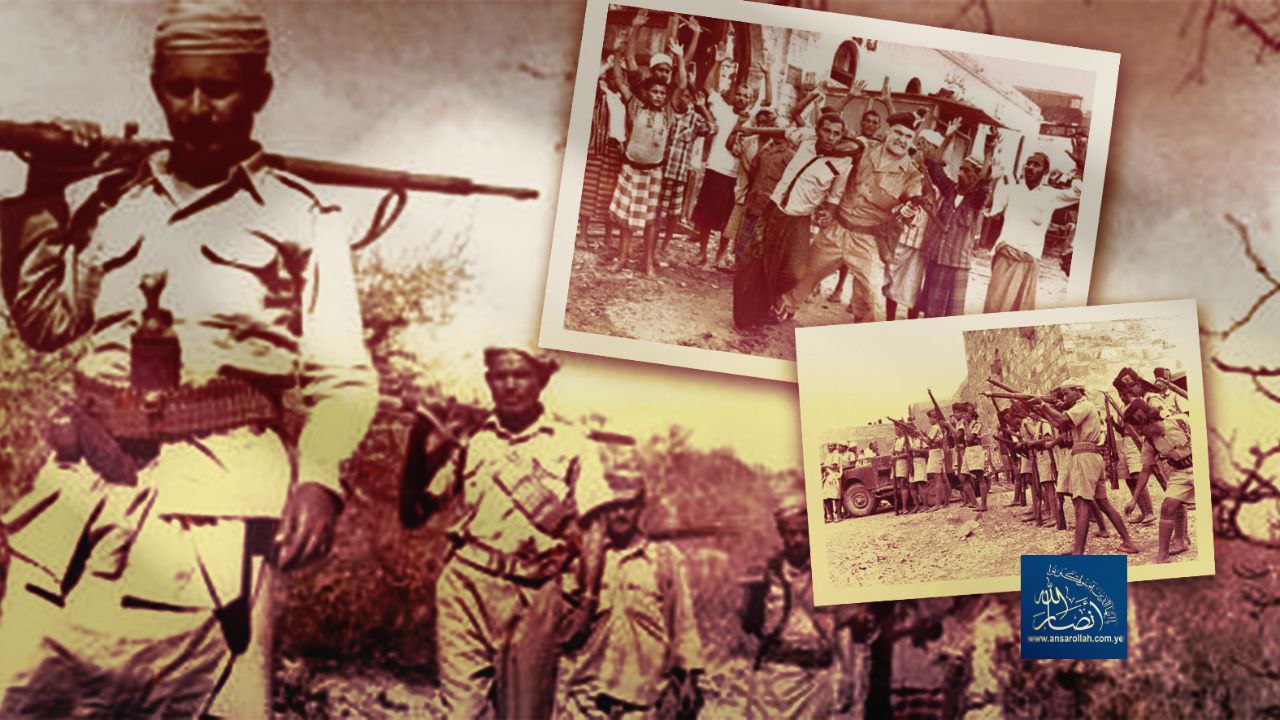
Local elites—sultans, sheikhs, and tribal leaders—became essential tools of the colonial project. Through money, positions, and privileges, they were transformed into agents of British policy. They suppressed resistance, facilitated control, justified the occupation as an engine of progress, and helped recruit local populations into the British-backed Levy Force.
Britain also relied on covert operations: secretly arming loyal tribes, mining roads, sabotaging infrastructure, and assassinating resistance leaders. Even local Jewish communities were used as intelligence sources in exchange for payment.
Collapse of the Colonial Project and the Road to November 30, 1967
In Aden—where Britain once believed its power was permanent—resistance began as a quiet pulse before erupting like a volcano. It rose from Radafan, from villages and mountains, from workers, students, and women who hid weapons beneath their clothing, and from farmers who opened their homes to fighters.
By the 1950s and 1960s, national movements intensified. Political, labour, and student organisations formed, most notably the National Front for the Liberation of South Yemen, which led the armed resistance. The October 14, 1963 revolution in Radafan, under Rajeh bin Ghalib Labouza, grew rapidly into a widespread liberation movement.
Fighters executed strategic operations: bombing British bases, attacking military patrols, setting ambushes, and undermining the occupation’s capacity to remain. Women played a vital role both in direct resistance and in providing logistical support. Public solidarity expanded, with citizens sheltering fighters and hiding revolutionary leaders.
International support also grew. The United Nations recognised the legitimacy of the southern struggle, while Egypt and Eastern Bloc countries provided strategic backing, granting the revolution regional and global momentum.
As Britain faced mounting pressure, it attempted one last tactic: to revive the divide and rule among resistance factions, negotiate with some while excluding others, and leave behind a fractured political landscape. However, the strategy failed to halt the momentum.
On November 30, 1967, the last British soldier departed Aden, and the sun of a long-declining empire finally set over a land that had never been bought or sold.
A New Occupation: Gulf Influence and the Reappearance of Old Patterns
The narrative argues that history has not vanished but returned in new forms. Today, the British legacy appears in the guise of the coalition, hiding behind the language of legitimacy. The United Arab Emirates is described as tightening its grip on ports and islands, while Saudi Arabia expands in Al-Mahra, Hadramout, and Shabwa, mirroring the geographic ambitions once pursued by British administrators.
Just as Britain engineered small political entities that competed for protection permits, Saudi and Emirati intervention has reproduced similar conditions through emergent groups and armed formations loyal to external funding rather than national identity.
The names have changed, but the method remains consistent: fragmenting identity, fueling division, creating disconnected local leaders, exchanging financial support for loyalty, and managing the south as a chessboard controlled by outside powers.
Under this analysis, the Federation of South Arabia has its modern counterpart in the Southern Transitional Council, while the British Levy Force has its equivalent in today’s Saudi- and UAE-backed armed groups.
Systematic Fragmentation Through Temporary Entities
Today, the same mechanisms continue: fueling regional and tribal conflicts, promoting separatist projects, and supporting temporary political structures with the aim of preventing the emergence of a unified national identity.
Local elites again play a central role—this time, politicians and commanders of externally funded forces directly supervised by Saudi Arabia and the UAE. Their loyalty is rooted in financial dependency, making them temporary tools destined to collapse once foreign support ends.
The Lesson of 1967: Occupation Cannot Be Reborn
Despite the parallels, the concept defeated in 1967 cannot rise again. A people who forced the departure of an empire that once ruled half the world, will not remain idle before a new project, no matter how it is decorated with slogans.
Identity, once subjected to a century of attempts at erasure, emerged stronger than before; it will not crumble before temporary forces dependent on money rather than roots in the land. Modern-day local allies are repeating the mistakes of the old sultans, for foreign powers never reward betrayal—they use it and discard it.
The presence of Saudi Arabia and the UAE, regardless of its duration, is fundamentally similar to Britain’s occupation, destined to collapse once financial and political exhaustion sets in. The lifespan of an intervention is measured not by military strength but by the resilience of the people resisting it.
Inevitable Withdrawal and the Rebirth of National Identity
All forms of domination, no matter how they disguise themselves, remain doomed projects. When the moment arrives, external powers retreat, leaving behind the tools they once relied upon.
The land always returns to its people, for nations with dignity and living revolutionary memory never lose their capacity to resist. The same strength that unified Yemenis from September to October, from Aden to Sana’a, from Radafan to Al-Mahra, will reproduce the same historical moment—the moment of departure.
Just as the British departed forever, the presence of Saudi Arabia and the UAE will also dissolve, and a genuine national identity will emerge, immune to repeated attempts at guardianship.


