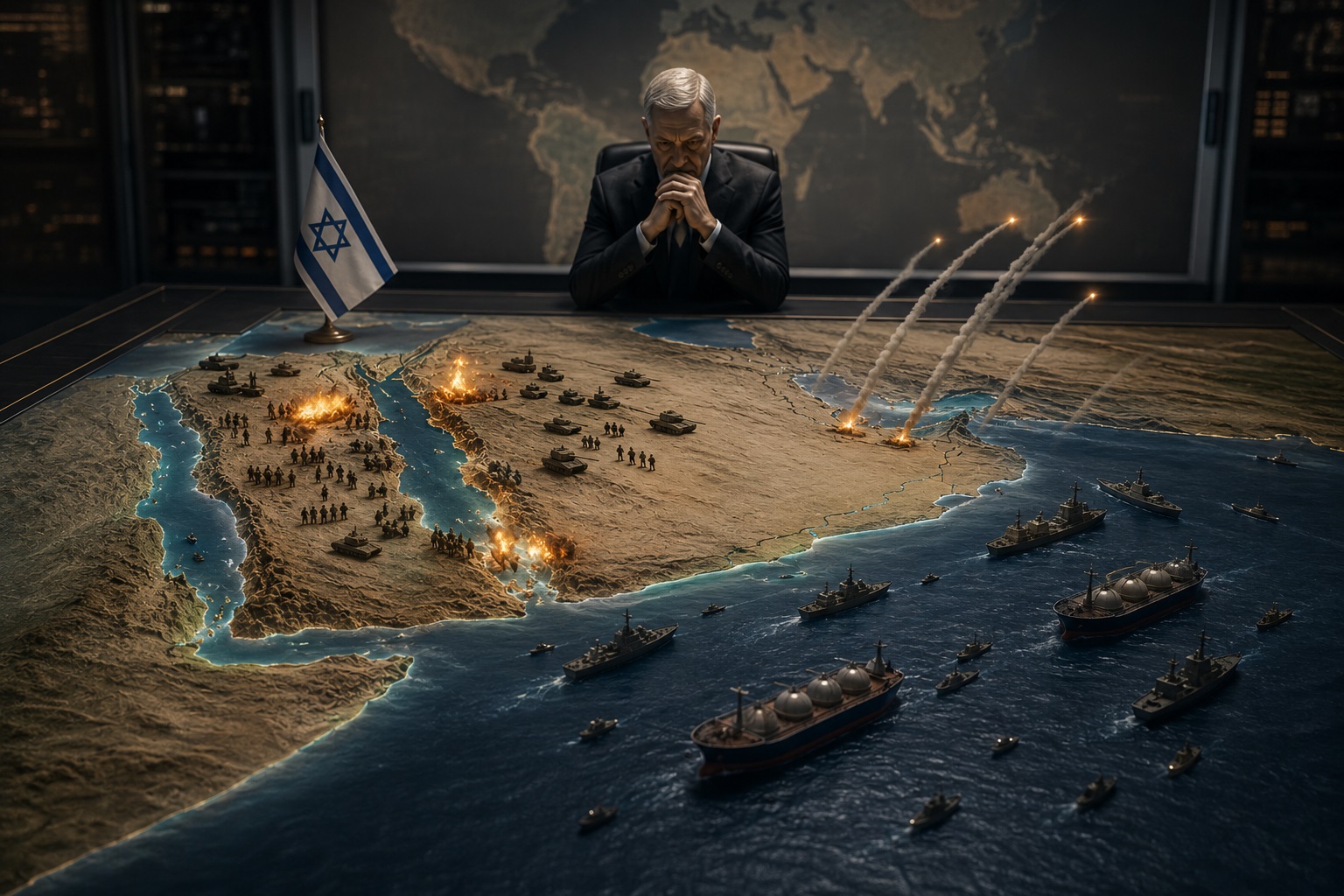
The Zionist entity views the Yemeni response to Saudi Arabia’s escalation and the military build-ups affiliated with it as a test of Riyadh’s ability to safeguard its security and interests.
The Zionists believe that the escalating Yemeni response carries implications that extend beyond the Saudi-Yemeni confrontation, potentially affecting energy security, maritime navigation, and the regional environment surrounding the entity.
Israeli attention is focused primarily on the impact of these operations on Saudi decision-making. Continued pressure on oil facilities, ports, and tankers could push Riyadh to bolster its defenses, expand maritime and intelligence cooperation, and reactivate its affiliated forces in an attempt to exert pressure on Sanaa.
The Zionists, however, see this as a course that could produce the opposite of the intended outcome: rather than achieving results against Sanaa that serve the entity’s interests, Saudi Arabia could move toward reaching an agreement with Sanaa—away from the entity, which feels increasingly threatened and sees the confrontation as an opportunity to reshape the balance of power.
Introduction:
Israeli monitoring of the latest developments in Yemen comes against the backdrop of an expansion in operations to include Saudi vessels and facilities, as well as Saudi-affiliated military build-ups in Marib, Hadramawt, and the western coast.
This has coincided with the announcement of a multinational maritime coalition project and the signing by Saudi Arabia, Türkiye, and Pakistan of the so-called “Makkah Agreement on Joint Defense.” Israeli media have brought these developments together within a single broader picture concerning the future of Saudi security, the movement of energy through the Red Sea, and Riyadh’s ability to maintain pressure on Sanaa without reverting to a full-scale war.
Zionist Interest
The entity views the latest operations as a development that goes beyond a renewed Saudi-Yemeni confrontation, particularly because they followed Sanaa’s announcement on July 20, 2026, imposing a ban on vessels linked to Saudi ports.
The operations subsequently expanded to include oil tankers near Yanbu and in the Gulf of Aden, facilities inside Saudi Arabia, and Saudi-affiliated military camps and troop concentrations in Marib, Hadramawt, the western coast, and along the border.
As a result, the pressure has been distributed across oil exports, maritime routes, the Saudi strategic depth, and Saudi-affiliated forces operating inside Yemen.
Israeli coverage has focused on the Red Sea’s connection to the Strait of Hormuz crisis. A significant portion of Saudi energy exports has been redirected through the East-West pipeline to the port of Yanbu, while a decline in shipping through the Bab al-Mandab threatens the alternative outlet on which Riyadh relies amid disruptions in the Strait of Hormuz.
From the Israeli perspective, this gives the operations against Saudi Arabia direct strategic significance: disruption of Yanbu’s exports would not only place pressure on Riyadh, but also narrow the alternatives available to global energy markets and Western powers.
It also gives Sanaa leverage over a country that the entity continues to count on joining U.S.-led security and political arrangements.
Operations Against Saudi Arabia
The Israeli enemy is monitoring the impact of these operations on Saudi decision-making more closely than the material results of each individual strike.
For the entity, the central question is whether targeting Najran Airport, oil tankers, energy transmission lines, facilities in Jizan and Yanbu, and affiliated forces will push Riyadh toward expanding the war or toward seeking an understanding that safeguards its own interests.
Escalation would serve Israeli interests if it compelled Saudi Arabia to strengthen its defenses, expand intelligence-sharing, support the maritime coalition, and reactivate its affiliated forces inside Yemen, as this would add another pressure front against Sanaa and weaken the capabilities allocated to operations related to the entity.
Yet the opposite outcome remains possible: the cost of the war could push Saudi Arabia to separate its own security from the Israeli-Yemeni conflict and return to a bilateral understanding addressing salaries, airports, ports, and borders in exchange for an end to attacks on Saudi facilities and maritime traffic.
Targeting Saudi-Affiliated Military Build-Ups
The targeting of Saudi-affiliated military build-ups in Marib, Hadramawt, Mokha, and along the border has received prominent attention in Israeli coverage.
Yedioth Ahronoth described it as one of the most significant escalations inside Yemen since the broad fronts were frozen in 2022, linking Marib’s importance to its military position and oil and gas resources, and Hadramawt’s importance to the competition between forces aligned with Saudi Arabia and the UAE.
The entity monitors Saudi-affiliated forces in Marib, Hadramawt, and the western coast according to the potential functions of each formation.
Military build-ups in Marib, al-Jawf, and the border areas could tie Sanaa down across multiple land fronts. Forces concentrated in Hadramawt serve to protect Saudi Arabia’s sphere of influence and eastern routes.
Meanwhile, the forces of mercenary Tareq Saleh hold particular value because of their proximity to the Bab al-Mandab Strait, the western coast, and the islands, as well as their ability to monitor maritime traffic, provide intelligence, and secure bases close to Hudaydah.
Nevertheless, the Israeli enemy does not base its assessment on these forces’ ability to determine the outcome of the war. The experience of previous years has demonstrated that the multiplicity of formations, commanders, and loyalties prevents them from operating under a single decision-making center.
Saudi-Emirati rivalry also divides them among competing projects. Accordingly, “Israel” benefits from these forces primarily for surveillance, diversion, and the protection of specific positions, rather than relying on them as a force capable of advancing toward Sanaa.
The Maritime Coalition
The entity initially views the maritime coalition initiative announced by Saudi Arabia with favor, as it would broaden responsibility for protecting vessels, provide the confrontation with international cover, and enable wider surveillance of the Red Sea and Gulf of Aden.
It would also reduce the need for Tel Aviv to appear as a direct party to arrangements that serve the entity’s interests and are led by an Arab and Muslim state.
However, the Israeli assessment does not equate the support of fourteen countries for the coalition’s founding statement with the creation of an effective naval force.
The coalition’s military value will be determined once its command structure, the size of its forces and naval assets, rules of engagement, intelligence-sharing mechanisms, ports of operation, and relationship with the U.S., British, and European forces already deployed in the region are made clear.
Israeli concerns are also tied to Saudi Arabia’s leadership of the coalition. Riyadh may use it to protect its tankers, ports, and oil-export routes, whereas “Israel” wants protection for vessels linked to it in any confrontation with Yemen.
Saudi Arabia could potentially secure its own special transit arrangements without addressing the Yemeni operations connected to supporting Palestine. In that case, the coalition would protect part of Saudi Arabia’s interests without resolving Israel’s underlying predicament.
The entity is also monitoring the positions of Egypt, Türkiye, and Pakistan within the coalition. Their participation would expand its potential capabilities, but would also give these countries a greater role in shaping Red Sea security arrangements independently of the entity.
Cairo remains wary of any arrangements that could diminish its role in the Suez Canal and the Red Sea, while Türkiye’s participation carries a competitive dimension linked to influence over maritime routes, ports, and the Horn of Africa.
The Makkah Joint Defense Agreement
Israeli commentary has portrayed the Makkah Agreement between Saudi Arabia, Türkiye, and Pakistan as a complex development that, from the entity’s perspective, offers a short-term security benefit while posing a long-term strategic challenge.
The immediate benefit lies in enhancing Saudi Arabia’s ability to defend against missiles and drones, shoulder greater security burdens, and strengthen deterrence against Iran and Yemen on behalf of “Israel.”
Strategically, however, Israeli media see the possibility of an independent “Islamic security framework” in which “Israel” would have no place, while granting Türkiye and Pakistan a greater role in the Gulf and the Red Sea—something that, of course, will not happen.
The sensitive point is that the agreement was concluded amid the Saudi-Yemeni confrontation, making Sanaa its first real test. If Türkiye and Pakistan limit their involvement to political and technical support and intelligence-sharing, the agreement will remain a broad deterrence umbrella.
But the deployment of air-defense systems, naval units, or military advisers, coupled with a willingness to assume the risks of direct confrontation, would transform it into a new military factor.
The Israeli entity is also closely monitoring the UAE’s absence from the agreement. Abu Dhabi is a security partner of the entity and a key party in the occupation of southern Yemen and the western coast—even if its direct military influence has diminished.
Its exclusion could intensify competition with Saudi Arabia and undermine efforts to unify the mercenary forces operating inside Yemen. “Israel” could also capitalize on Emirati concerns over the expansion of Türkiye’s role, while using Abu Dhabi to maintain an indirect presence in Red Sea security arrangements.
The Pakistani dimension gives the agreement symbolic weight because Islamabad possesses nuclear weapons. However, Israeli assessments “permitted for publication” have warned against interpreting this as a Saudi nuclear umbrella, since the provisions of the joint-defense agreement do not establish any transfer of nuclear commitments.
The entity will therefore closely monitor any cooperation in missile defense, early-warning systems, or strategic installations as the most important practical indicators.
The Relationship Between the Agreement and the Maritime Coalition
The Israeli enemy does not view the Makkah Agreement and the maritime coalition as a single framework. The coalition is currently a functional initiative aimed at protecting Saudi maritime traffic and monitoring the Red Sea, while the agreement establishes broader political and security commitments among three countries.
However, their simultaneous emergence gives Saudi Arabia an opportunity to link the defense of its territory with the protection of its maritime and energy routes.
Türkiye and Pakistan could participate in the maritime coalition without directly entering the war against Yemen, through naval deployments, surveillance, training, and defensive support—an option that would carry the lowest cost and most closely align with their interests.
Riyadh could also present such participation as an initial application of the Makkah Agreement, without testing the joint-defense provision in an open confrontation.
The Israeli enemy, however, wants the linkage between the two frameworks to generate pressure on Sanaa, while fearing that they could instead become an alternative to cooperation with it.
Saudi Arabia could succeed in building an Islamic regional defense architecture, securing protection for its ports and facilities, while maintaining political distance from “Israel.” Such a course would undermine the Israeli assumption that the Yemeni and Iranian threats will inevitably push Riyadh toward normalization.
Assessment
The Israeli enemy will view the current escalation as a test of the direction of Saudi decision-making and will prioritize preventing it from evolving into a bilateral understanding that isolates “Israel” from the Yemeni front.
However, it is unlikely to push Riyadh toward a full-scale war in the near term, given that its affiliated military build-ups remain fragmented, the maritime coalition has yet to become an operational force, and Türkiye and Pakistan have not demonstrated a willingness to bear the costs of confrontation.
“Tel Aviv” will work to keep the operations against Saudi-affiliated military build-ups linked—in international discourse—to Iran and freedom of navigation, so that the issue does not remain a Saudi-Yemeni dispute that can be resolved independently.
Through the United States and Britain, it will support expanding early-warning, surveillance, and facility-defense capabilities, while avoiding any overt presence within the maritime coalition.
“Israel” does not regard the Makkah Agreement as a guarantee that Türkiye and Pakistan will enter the war. It will assess the agreement based on the forces and systems they deploy and the risks they are prepared to assume.
At the same time, it will take its political impact seriously, as the agreement gives Saudi Arabia security alternatives that could slightly reduce its dependence on the United States and “Israel.”
It is concerned that continued Yemeni pressure on Yanbu and Jizan, as well as on Saudi oil tankers, could strengthen the option of a unilateral understanding within Riyadh.
At that point, the Israeli predicament would become clear: Saudi Arabia could end the threat to its interests through a settlement addressing the blockade, salaries, and ports, whereas “Israel” could not guarantee an end to Yemeni operations linked to supporting Palestine in any future confrontation.
Accordingly, “Israel” will measure the outcome of these developments by its ability to keep Saudi Arabia within the American camp, turn the maritime coalition and the Makkah Agreement into instruments of pressure on Sanaa, prevent the security of the Kingdom of Evil from being separated from the security of the entity, and, above all, prevent the same from happening to “Eilat,” on the Red Sea.